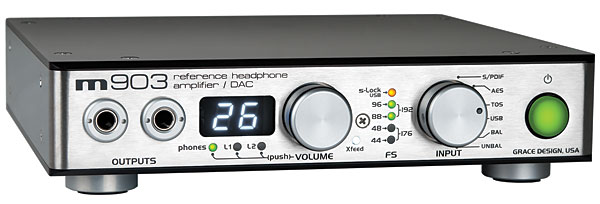
I must admit that, for a long time, I found it difficult to accept the idea that a major portion of one's audio budget should be spent on the preamplifier. Speakers, yesthey produce the sound; amps drive the speakers, so they're important. And source components? Well, everyone knows it's garbage in/garbage out. But a preamp? Even the name suggests something that's not quite the real thing, like pre-school, pre-med, or premature. Unlike amplifiers, they don't have to contend with loads that sometimes approach a short circuit, and heat dissipation is not normally a problem. What's the big deal?
If you follow jazz, you know that Ella & Louis, the 1956 Verve album of duets with Ella Fitzgerald and Louis Armstrong, is one of the most delightful vocal recordings ever.
If you're an audiophile, you've read that Chad Kassem, proprietor of Acoustic Sounds, in Salina, Kansas, has bought the finest vinyl-pressing equipment, hired some of the hottest engineers to modify and operate it, and come up with a new line of LPs called QRP, for Quality Records Pressings.
One of his first QRP products is a 45rpm, 200-gram pressing of Ella & Louis. If you're a jazz-following audiophile, go buy this right away. Flummoxed by the $50 price tag? How much would you pay for the most palpable illusion you'll ever experience that Pops and the First Lady of Song are back among the livingstanding, breathing, singing, and blowing, right in front of you?
Happy New Year! The January 2012 issue of Stereophile is now on newsstands. In this issue, you’ll find in-depth reviews of loudspeakers from TAD, Sonus Faber, Nola, and Dynaudio; amplification components from Sutherland, Fi, and Anthem; D/A processors from Weiss, Bel Canto, dCS, and Musical Fidelity; power conditioning from Audience, AudioQuest, and Shunyata; and CD players from Emotiva and Sony.
For the musically prolific, releasing too many records too close together can be problematic or worse. Just because you can make a record every week in your home studio doesn't mean you should. The impulse to commit every golden thought and performance to tape without self-editing or even pausing to reflect screams narcissism run amok. Asking listenerseven dedicated fansto then buy and spend time listening to half-baked nonsense that might have become something, given more time and care, is a sure career destroyer. There's truth in the old saw about building demand, avoiding saturation, and creating a hunger among the listening public. Most critical of all, despite downloads, piracy, and Lady Gaga's pointy hats and eggshell entrances, the old Hollywoodism still applies: while spontaneity may sound like a radical idea, you're only as good as your last album.
I've been reading a fascinating book, Leonard Shlain's The Alphabet Versus the Goddess: The Conflict Between Word and Image (New York: Viking, 1998). Shlain's thesis is that the invention of the alphabet was the cause of immense changes in primitive society, upsetting previously widespread norms of gender equality and horizontal (rather than hierarchical) social relations in general.
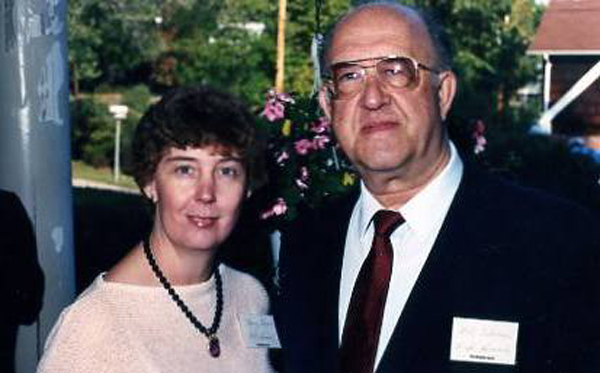
We were saddened to hear of the passing, on December 10,of Audio Research founder William "Bill" Zane Johnson. Bill, who founded Audio Research in 1970 and became its Chairman Emeritus in 2008, is survived by his wife Nancy (left in photo) and family. We are preparing a tribute to Bill, to be published in the March 2012 issue of Stereophile, but meanwhile, we are reprinting here an interview Paul Messenger and I conducted with Bill that was originally published in the June 1983 issue of Hi-Fi News. (My thanks to HFN editor Paul Miller for permission. Stereophile's 1994 interview with Bill can be found here.)John Atkinson
Sadly, I won't be able to get down to Princeton any time soon, but, if you're interested in 20th Century classical, experimental, avant-garde, drone, minimal synth, noise, and Fluxus-related stuff, now's the time to visit the Princeton Record Exchange!

 I must admit that, for a long time, I found it difficult to accept the idea that a major portion of one's audio budget should be spent on the preamplifier. Speakers, yesthey produce the sound; amps drive the speakers, so they're important. And source components? Well, everyone knows it's garbage in/garbage out. But a preamp? Even the name suggests something that's not quite the real thing, like pre-school, pre-med, or premature. Unlike amplifiers, they don't have to contend with loads that sometimes approach a short circuit, and heat dissipation is not normally a problem. What's the big deal?