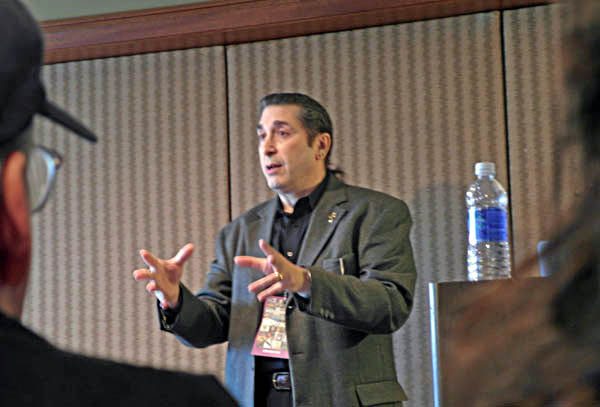
We make our beginnings in the manner of our endings; so it was on Saturday morning, when I headed back to the Rye Brook Hilton's Maple Room, where Friday evening Michael Lavorgna, Steve Guttenberg, and I had spun ripping yarns of shipping labels and galley proofs on the high seas of audio reviewing. (Yarr.) I was there to hear a presentation called Great Sound: Beyond the Gear: Life and Technology: A Compromisea title with more colons than a lower-GI specialist sees in a week!by an audio engineer/designer/producer/acoustical consultant named Stuart Allyn. I was running a minute or two late, and when I opened the door to the Maple Room I saw: a capacity crowd. Wow!
There are shows that raise our expectations and there are shows from which greatness is not expected. And after October 26, when the organizers of the New York Audio Show, taking place at the Rye Hilton in Westchester County this weekend, announced that they were capping the number of exhibitors at 30imagine Mike Huckabee or Hillary Clinton announcing a limit on corporate donationsthis event slipped into the latter. No amount of positive, industry-healthy attitude on the part of myself or anyone else can shiny that up.
Outside of the listening I do for this column, I always audition, assess, and review components without using any equalization or room correctionprimarily because I assume that most Stereophile readers listen in two-channel stereo, and that most aren't all that interested in EQ. Besides, two-channel is the tradition I come from, and my first instinct is to try to get at the essence of the individual component itself, without applying extraneous tools or accessories. John Atkinson's bench tests are based on the same philosophy.
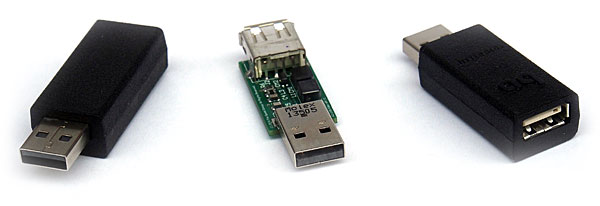
Unless something is broken, the bits from your computer will be delivered to your DAC intact; the claim behind three new products I recently listened through is that each can reduce noise within the DACnoise that could otherwise corrupt the analog signal and thus make our music less musical. This notion is not based on audiophool woo-woo, but on the basic electronics of mixed-signal systems: Although its input is digital data, a DAC's output is subject to all the noise problems of analog circuits.