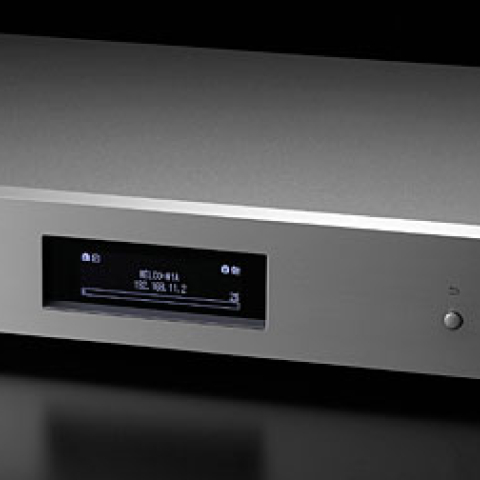
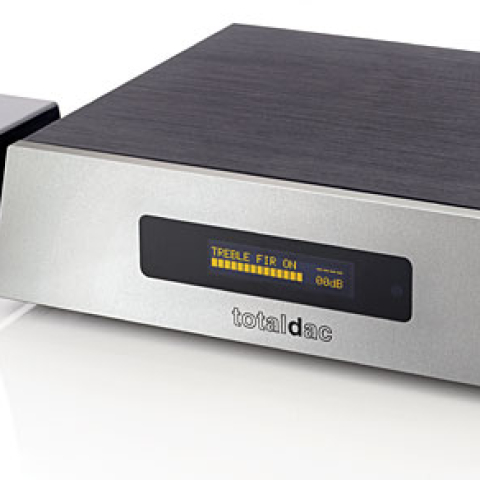
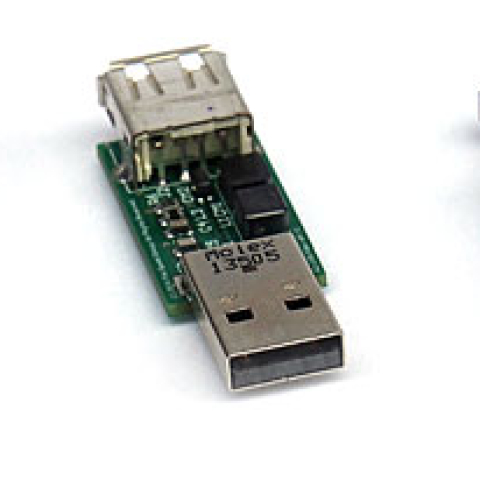
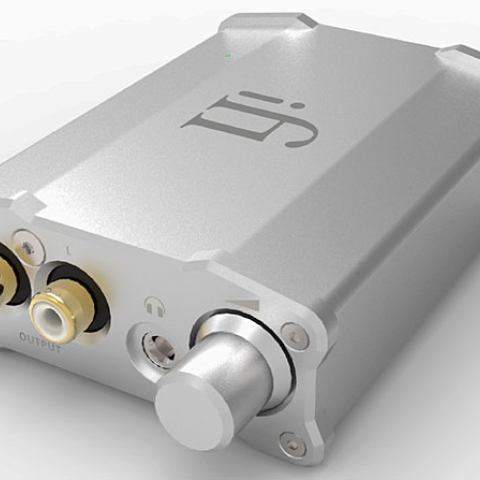
I then added just one JitterBug between my MacBook Pro and Auralic Vega DAC, and noted improvements: Bass definition was better, and the sound now had more weight overall, and was more relaxed and natural. These changes were also easy to hear. I found that I got the most benefit when I added a second 'Bug to the MacBook's unused USB port, which simply improved on the improvements already mentioned—not as dramatically as going from no 'Bugs to just one, but even these smaller-scale changes were easy to hear. Adding a third and a fourth 'Bug to my NAS and router offered very subtle sonic gains that I didn't feel were worth the extra $98. One JitterBug = good. Two JitterBugs = better.
Next in line was the Schiit Wyrd, which I inserted in the same system (no 'Bugs). Again, the improvements were easy to hear: a less brittle, less "digital" sound, and increased weight and body. Dysnomia by Dawn of Midi—a trio of prepared piano, double bass, and drums (CD, Thirsty Ear THI 57206.2)—sounded more convincing, more present, more engaging. Following each of these amazing musicians in space and time was easier with the Wyrd in than out, and made for a more natural, more engaging experience.
The difference between the Wyrd and one JitterBug was subtle, but through the Schiit my music had a greater sense of weight and solidity. Funkadelic sounded even funkier.
Next up was the UpTone Audio Regen, installed in the same system (footnote 2). I listened for a few weeks with the Regen in, then took it out. Wow: not subtle. Absent the Regen, it was as if my music had just come back from a week at weight-loss camp: Everything had less body and weight, and the overall spatial sound picture was reduced in every dimension. On a scale of sonic difference of 1 to 100, with the greatest difference possible in a hi-fi system's sound being 100, the Regen was a solid 15; the Wyrd and JitterBug were further down that scale.
The Regen also offered a less brittle, less "digital" sound. Subtle, beautiful music, such as Washington Phillips's What Are They Doing in Heaven Today? (44.1kHz file from Little Axe Records), sounded more heavenly, and it was easier to tell János Starker's cello from Yo-Yo Ma's—I'm talking improvements that made listening to music more enjoyable and more meaningful.
It's important to note that none of these devices changed the sonic character of whatever DAC was in use; rather, they enhanced its qualities.
I also ran these comparisons with a LampizatOr Lite 7 tubed DSD DAC replacing the Auralic Vega, as well as in my desktop system: an Audeze Deckard DAC–headphone amp driving ADAM A3X speakers and Audeze LCD-X headphones. All of the changes I heard with each of the three USB devices through the Vega I also heard through the LampizatOr; while the JitterBug and Wyrd offered some improvement, the Regen consistently bettered both in terms of overall improvement. But on my desktop, the improvements gained with all three devices were less noticeable, especially in terms of spatial performance: My desktop setup is very much a nearfield listening experience, in which images and reproduced spaces are smaller and more intimate. The same held true for listening through headphones, as images were not reproduced in free space. With this in mind, if I were to pick for this system one such device, it would be a single JitterBug: The additional improvements offered by the other, more expensive devices didn't strike me as worth the extra cost.
I found that my favorite USB cable, the Light Harmonic Lightspeed, remained my favorite regardless of which USB device I used. I swapped in a few others, including AudioQuest's Diamond USB, and found that the cable's character remained, even with a filtered, regenerated USB signal.
Combination of the Two
I know: crazy, right? If what we're talking about is reducing the amount of noise coming into a DAC, as well as reducing the amount of noise generated by the DAC itself by delivering a more stable and less error-prone signal—thus delivering less noise to the analog circuitry in the DAC—then perhaps adding more than one device will offer even better performance. At least in theory.
In practice I found that to be true. Using the AudioQuest JitterBug with either the UpTone Audio USB Regen or the Schiit Audio Wyrd offered additional improvements, including greater senses of clarity and ease, and a more natural sound. For my main system, the JitterBug-Regen pairing was the clear winner: I plan to use that combo from now on, for those times when I want to sit, listen, and enjoy music like any normal person, because they make that experience more enjoyable. If you already own a Wyrd and want to squeeze a bit more performance out of your DAC, try adding a JitterBug.
Bewitched, Bothered, and Bewildered
I find that the effects of cables and tweaks are most often system-dependent—but they are always user-dependent, owing to the listener's preferences and priorities. That said, I also find reviewing tweaks and cables to be a tad annoying: Obsessing over subtle changes is a sure way to kill my enjoyment of music. And I'm all about enjoyment. Then there are those bits-are-bits guys (I have yet to meet any bits-are-bits gals) who'll tell you that this is all nonsense: after all, we're dealing with digital data. While I agree that bits are bits, if you've been paying attention, you know that's not what we're talking about here.
If you want to try only one of these USB devices, I recommend UpTone's USB Regen as the performance choice, and AudioQuest's JitterBug as the budget choice. If your big rig is very resolving and subtle improvements grab your attention, I recommend the Regen-JitterBug combo for a more bewitching experience.
Footnote 2: See Kalman Rubinson's comments on the effect of the USB Regen in this issue's "Music in the Round" and my comments on the USB Regen in this issue's "Follow-Up" section.—John Atkinson
I know: crazy, right? If what we're talking about is reducing the amount of noise coming into a DAC, as well as reducing the amount of noise generated by the DAC itself by delivering a more stable and less error-prone signal—thus delivering less noise to the analog circuitry in the DAC—then perhaps adding more than one device will offer even better performance. At least in theory.
I find that the effects of cables and tweaks are most often system-dependent—but they are always user-dependent, owing to the listener's preferences and priorities. That said, I also find reviewing tweaks and cables to be a tad annoying: Obsessing over subtle changes is a sure way to kill my enjoyment of music. And I'm all about enjoyment. Then there are those bits-are-bits guys (I have yet to meet any bits-are-bits gals) who'll tell you that this is all nonsense: after all, we're dealing with digital data. While I agree that bits are bits, if you've been paying attention, you know that's not what we're talking about here.
Footnote 2: See Kalman Rubinson's comments on the effect of the USB Regen in this issue's "Music in the Round" and my comments on the USB Regen in this issue's "Follow-Up" section.—John Atkinson