The Bomb

I saw this and thought "I have to share this with my friend over at the the Sterephile forum".

Now all your non-audiophile friends and relatives will have no excuses not to sell or give you those valuable "shaded dog" lps, provided of course that you still want them after they have been played on this baby:

The Bomb

Red's Dead On, Baby!

Red's Dead On, Baby!

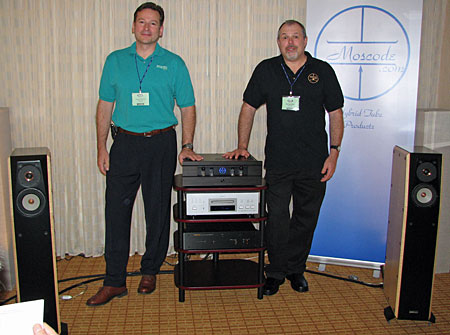
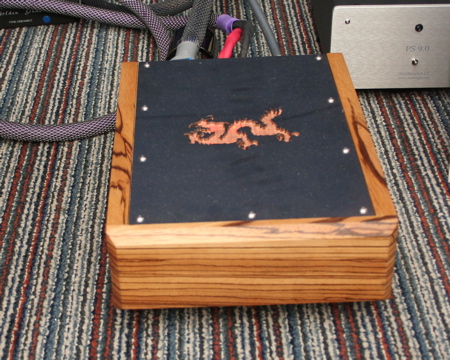
Red Dragon's Leviathan Series monoblock amplifiers deliver 500W into 8 ohms for $5995/pair. Driving Acoustic Zen Adagio loudspeakers, they sure sounded sweet—and powerful! They're packed with cool stuff, such as Neutrik silver XLR inputs and Cardas solid-copper binding posts, not to mention ERS paper, which is "employed at key locations to absorb and diffuse unwanted EMI."

Kind of Blue

Kind of Blue

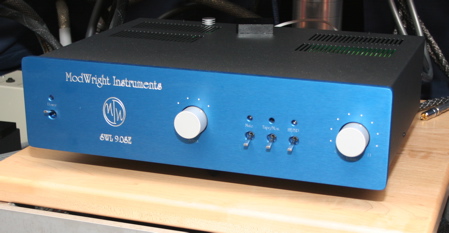
I wandered into the ModWright/Red Dragon/Acoustic Zen/Golden Sounds room expecting good sound because Dan Wright's stuff <I>always</I> delivers, but I was wowed by the system's synergy.

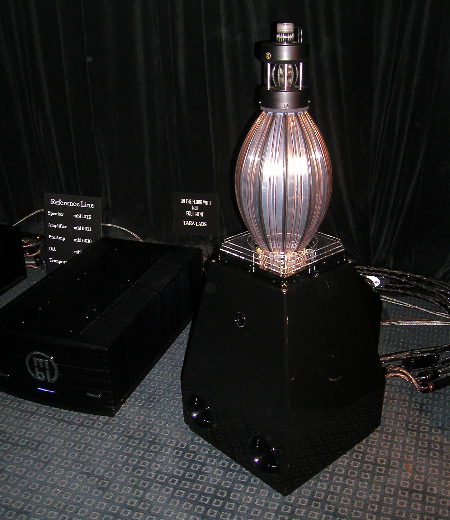
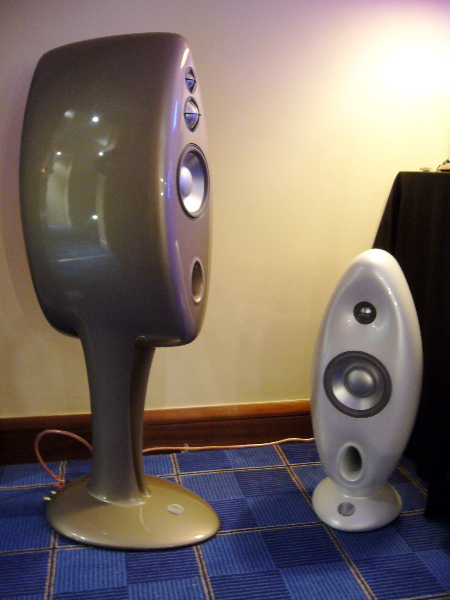
The MBL Omni Speakers...

The MBL Omni Speakers...

...use a unique drive-unit concept that provides breathtakingly realistic, silky-smooth treble reproduction. I always try to visit the German manufacturer's room at the end of the Show, to savor the sound of their 101E speakers. Driven by MBL's own amps and digital front-end, with Tara Labs "Zero" vacuum-dielectric cables, these lived up to my expectation, though the Show room was not completely sympatico with the bandpass-loaded woofers, which need a relatively well-damped acoustic to work at their best.

The Vivid & Gamut Rooms

The Vivid & Gamut Rooms

The South African Vivid Audio K1 loudspeakers ($20,000/pair) in the Musical Surroundings room&mdash;seen here behind Musical Surroundings’ Garth Leerer (right) and <I>Stereophile</I>’s Michael Fremer at the Sunday afternoon raffle&mdash;produced an impressively large, sit-up-and-listen soundstage. A similar case of a soundstage that dwarfed the speakers that produced it awaited in the Gamut room. The L-7 flagship speakers ($14,900/pair), paired with the Di150 180Wpc integrated amp ($9800) and brand new CD3 ($6000), produced an amazing sense of space and depth, as well as some mighty low bass extension. Learning that the system lacked a power conditioner and was powered by stock power cords and $300 Siltech silver cables only increased my admiration. As the audiophile press has affirmed for several years now, Gamut is on to something very, very good.

Usher Speakers Impress Scribes

Usher Speakers Impress Scribes

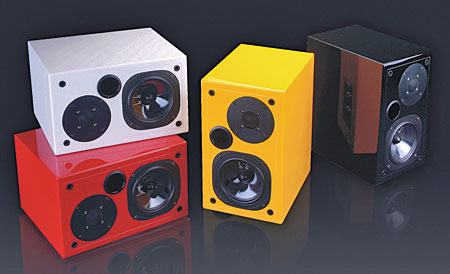
My first visit on the Show's final day was to the Usher room. After listening to their large BE10 floorstander ($14,400/pair), paired with the 2500 amp, 2200 preamp, and CD player (combined cost $5600) and cables from Shunyata and Stereovox, I was treated to Usher’s new entry-level $400 bookshelf baby. Seen here at the left of their lineup, other <I<>Stereophile</I> writers had been impressed. While Usher’s little babies understandably offered less low bass extension than the big floorstander, they delivered far higher sound quality than anyone in their right mind could either expect or hope for at this price point.

high end speakers

to most of you, this is probably not news, but the french fabricator of OCELLIA speakers uses two speakers and no crossover.

i am attracted because he relies completely on the speaker and more so on the enclosure for an 'instrumental' sound.

for those who have not seen it, the enclosure is built a little like a cello body (though it doesn't look like one), and is reinforced with an interior grid for stiffness.
More on the IsoMike Recordings

More on the IsoMike Recordings

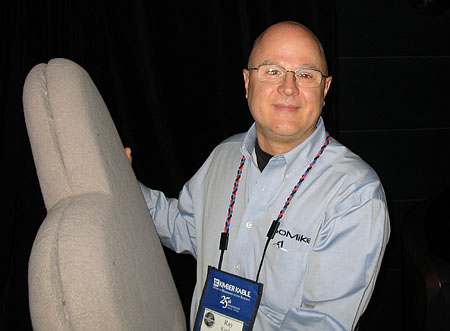
I heard some truly excellent-sounding systems at HE 2006, but if I had to pick one listening experience at the show that transcended all others, it would have to be Kimber’s IsoMike demonstration. The system itself is described by Wes Phillips in <A HREF="http://blog.stereophile.com/he2006/060406ray/">another blog entry</A>, and I’m sure it would have sounded very good playing back normal CDs, but what made the sound more closely approach reality was that the source material consisted of four-channel recordings made by Ray Kimber using his IsoMike setup. (Ray is shown here holding a scale model of his IsoMike baffle.) I’ve been often disappointed with multichannel music playback, but this was completely convincing. The voices and instruments present in the room in a way that was at times spooky. Wes was right: Ray Kimber <I>should</I> be King of the Universe.

Advertisement
Advertisement
Advertisement