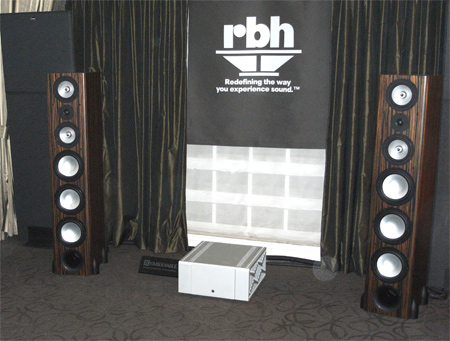
RBH Sound is best-known for its home-theater speakers, but CES saw the Utah-based company launch a "Signature" series of speakers that were demo'd in two-channel systems. I listened to a Telarc Aaron Copland recording on the three-way, sealed-box 8300-SE/R towers ($8449/pair), with a Boulder 1021 CD player and Boulder 860 power amplifier, and was impressed by the natural balance, extended low frequencies, and good dynamics.
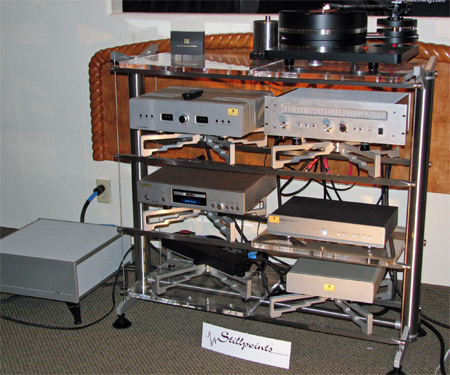
Stillpoints, a vibration-control company that has been making equipment support racks since 2003, has just introduced a 40"-wide, low mass, open-air rack that allows you to stack two components side by side on each support shelf. Each ultra long support shelf holds two 20"<I>x</I>16" equipment shelves, each of which can hold a separate component on the appropriate support technology. Each equipment shelf also contains six pockets of Stillpoints' multi-patented vibration damping technology, making for 12 pockets of vibration control per large support shelf. Stillpoints' Paul Wakeen claims that each time you add another layer of Stillpoint isolation, the sound of your system improves.
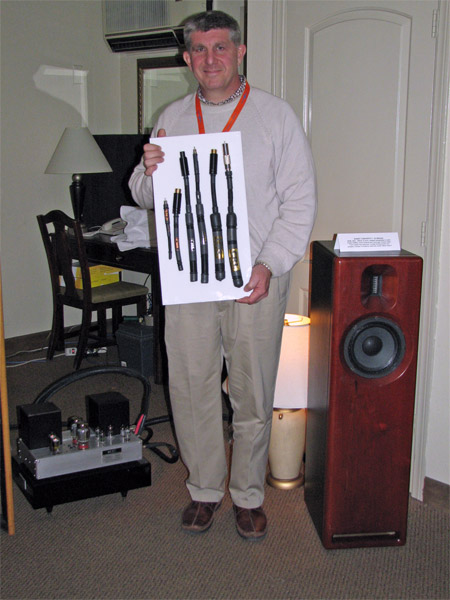
Tara Labs has so many levels of cables that factory manager Matthew Sellars, who assists designer Matthew Bond with cable design and oversees implementation, had to draw a four-tiered chart just to explain where the company's newest offerings fall in the Tara Labs hierarchy. That may be an exceedingly long opening sentence. But so is Tara Labs' product list.
Visiting Kara Chafee of de Havilland, whose amplifiers invariably grace music with a wonderful sense of air, enabled me to take a first listen to Cable Research Lab (CRL) cables. CRL's mid-level "Silver" line is a very recent recipient of a "Product of the Year Award" from a certain publication known for its absolutism. Another very positive publication fed CRL an award in 2007.
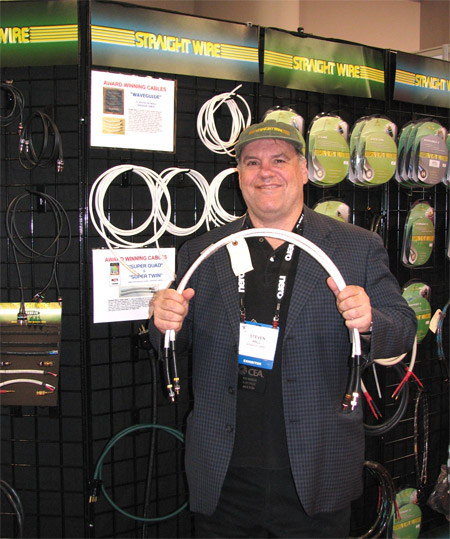
CES presented me with my first opportunity to make the acquaintance of Stephen Hill and Straight Wire. The Florida company has just released a "push prong" re-usable, solderless RCA plug that makes Straight Wire cable termination a snap. Especially appealing to custom installers, the termination actually leads to a higher level of performance by enabling quick silver-plated termination without piercing cable insulation.
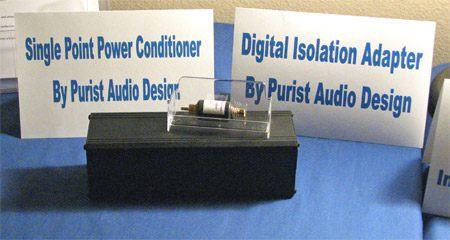
Jim Aud of Purist Audio Design has released several new products. The diminutive Digital Isolation Adapter ($300) plugs into the S/PDIF output of a CD transport or music server with then the RCA digital cable that connects the transport and DAC plugged into it. The Adapter is claimed to electrically isolate the transport to the DAC, reduce jitter via control of the 75 ohm impedances, and reduce EMI/RF noise.
I know some of us are sick of reading more posts deriding extravagantly priced gear and the people who price them, but I hope this thread rises above the simplistic flame-throwing... today, while reading the Phile's coverage of amplification by a new company called Tenor ($90K monoblocks; $40K preamp) in the CES section, I stumbled upon this passage -
Much has been made of the influence that Linn, Naim, and Rega have had on our ideas about music-system hierarchies: Before they and a handful of other British audio manufacturers kicked off the debate in the 1970s, the conventional wisdom worldwide was that the loudspeaker was more important than the record player, amplifier, or any other link in the domestic audio chain, and thus deserved to be the object of significantly greater care and attention, not to mention investment of cash. But the Brit-fi approach was different, and ostensibly better reasoned: Because musical information that's distorted or dropped entirely by a record player, a CD player, or any other source can't be made right by any other component in the system, it is the source that must be considered the most important component of all, and to which the majority of funds should be allocated.
Just when I thought that my headphone system had settled down, Jason Victor Serinus goes gah-gah over the new Sennheiser HD 800 cans that he heard at CES.
Jason, what were your reference cans before hearing the new Senns?




I know some of us are sick of reading more posts deriding extravagantly priced gear and the people who price them, but I hope this thread rises above the simplistic flame-throwing... today, while reading the Phile's coverage of amplification by a new company called Tenor ($90K monoblocks; $40K preamp) in the CES section, I stumbled upon this passage -