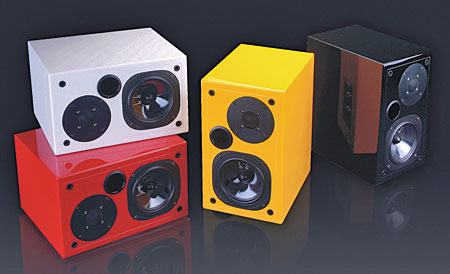
My first visit on the Show's final day was to the Usher room. After listening to their large BE10 floorstander ($14,400/pair), paired with the 2500 amp, 2200 preamp, and CD player (combined cost $5600) and cables from Shunyata and Stereovox, I was treated to Usher’s new entry-level $400 bookshelf baby. Seen here at the left of their lineup, other <I<>Stereophile</I> writers had been impressed. While Usher’s little babies understandably offered less low bass extension than the big floorstander, they delivered far higher sound quality than anyone in their right mind could either expect or hope for at this price point.
to most of you, this is probably not news, but the french fabricator of OCELLIA speakers uses two speakers and no crossover.
i am attracted because he relies completely on the speaker and more so on the enclosure for an 'instrumental' sound.
for those who have not seen it, the enclosure is built a little like a cello body (though it doesn't look like one), and is reinforced with an interior grid for stiffness.
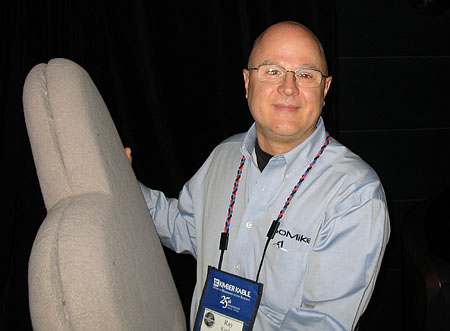
I heard some truly excellent-sounding systems at HE 2006, but if I had to pick one listening experience at the show that transcended all others, it would have to be Kimber’s IsoMike demonstration. The system itself is described by Wes Phillips in <A HREF="http://blog.stereophile.com/he2006/060406ray/">another blog entry</A>, and I’m sure it would have sounded very good playing back normal CDs, but what made the sound more closely approach reality was that the source material consisted of four-channel recordings made by Ray Kimber using his IsoMike setup. (Ray is shown here holding a scale model of his IsoMike baffle.) I’ve been often disappointed with multichannel music playback, but this was completely convincing. The voices and instruments present in the room in a way that was at times spooky. Wes was right: Ray Kimber <I>should</I> be King of the Universe.
Loudspeakers based on the Lowther full-range driver have a considerable following—our own Art Dudley included—but most will admit that the driver has its limitations, including some midrange resonant peaks and less-than-impressive bass response. These have been addressed in The Second Rethm by a set of modifications to the driver and the availability of an extension to the cabinet that produces better bass response. I heard a couple of the Rethm speakers (I don’t remember which models) a few years ago at CES, and was not too impressed, but I quite liked the sound of The Second Rethm with the cabinet extension. The extension adds $2000 to the $7500/pair price, but I suspect it’s worth it.
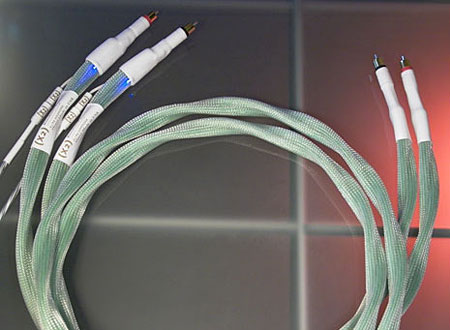
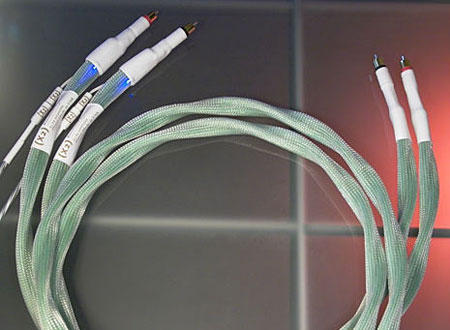
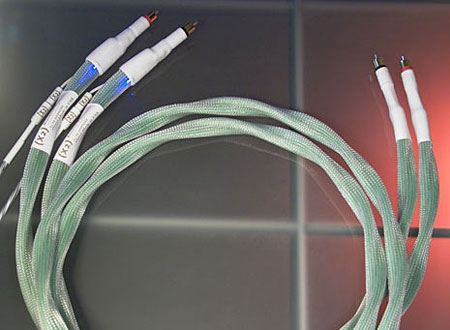
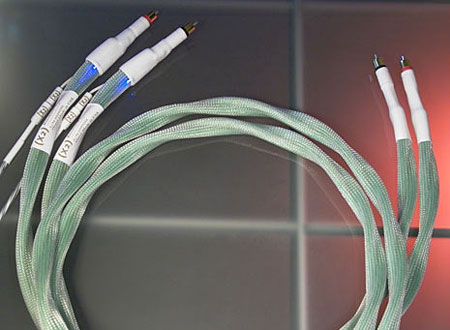
Ted Denney at Synergistic Research has come a very long way in a very short time. In the past I've enjoyed and commented on his Resolution Reference interconnect and speaker cable. Great stuff, but I'm picky. Then, not too long ago, boxes of his new, top-of-the-line Designers' Reference interconnect began raining down upon us (liveried, I might add, in an extremely vivid shade of green!).
Ted Denney at Synergistic Research has come a very long way in a very short time. In the past I've enjoyed and commented on his Resolution Reference interconnect and speaker cable. Great stuff, but I'm picky. Then, not too long ago, boxes of his new, top-of-the-line Designers' Reference interconnect began raining down upon us (liveried, I might add, in an extremely vivid shade of green!).
Ted Denney at Synergistic Research has come a very long way in a very short time. In the past I've enjoyed and commented on his Resolution Reference interconnect and speaker cable. Great stuff, but I'm picky. Then, not too long ago, boxes of his new, top-of-the-line Designers' Reference interconnect began raining down upon us (liveried, I might add, in an extremely vivid shade of green!).
Synergistic Research cables Synergistic chez Damkroger
Ted Denney at Synergistic Research has come a very long way in a very short time. In the past I've enjoyed and commented on his Resolution Reference interconnect and speaker cable. Great stuff, but I'm picky. Then, not too long ago, boxes of his new, top-of-the-line Designers' Reference interconnect began raining down upon us (liveried, I might add, in an extremely vivid shade of green!).
Ted Denney at Synergistic Research has come a very long way in a very short time. In the past I've enjoyed and commented on his Resolution Reference interconnect and speaker cable. Great stuff, but I'm picky. Then, not too long ago, boxes of his new, top-of-the-line Designers' Reference interconnect began raining down upon us (liveried, I might add, in an extremely vivid shade of green!).
I find it astonishing that two products built on completely opposing engineering principles can both have musical merit. Design goals exalted by one company are considered anathema by another, yet both components produce superb sonic results.


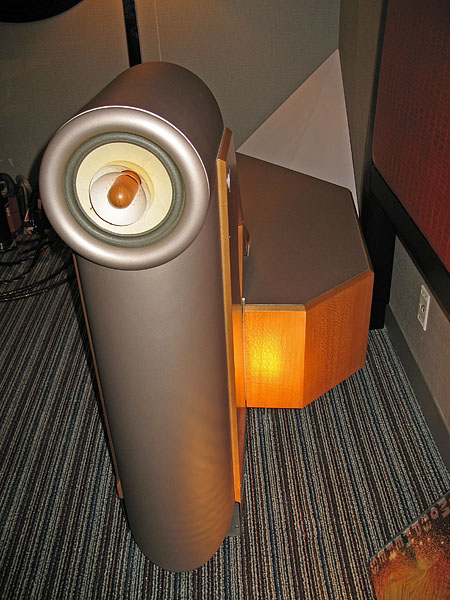
to most of you, this is probably not news, but the french fabricator of OCELLIA speakers uses two speakers and no crossover.
i am attracted because he relies completely on the speaker and more so on the enclosure for an 'instrumental' sound.
for those who have not seen it, the enclosure is built a little like a cello body (though it doesn't look like one), and is reinforced with an interior grid for stiffness.