Sidebar 3: Measurements
Although the LōKē was reviewed by JVS in a system with the Wilson Alexia V loudspeakers, I measured it in a different context, paired up with the Wilson SabrinaX. As noted in the review in Hi-Fi News (December 2022), the scope of the LōKē's low-pass (LPF) and subsonic (HPF) frequency and slope options plus phase, output level, parametric EQ, and placement scenarios allows many response combinations. For the sake of expediency, I left the subsonic (HPF) and PEQ features disabled for the flattest LF response and focused on the tunable (30Hz–125Hz, ±1Hz) LPF options.
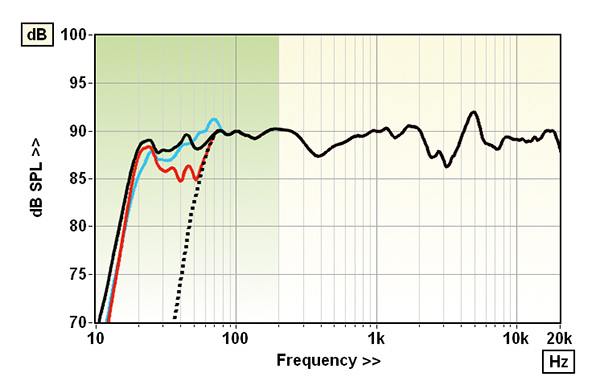
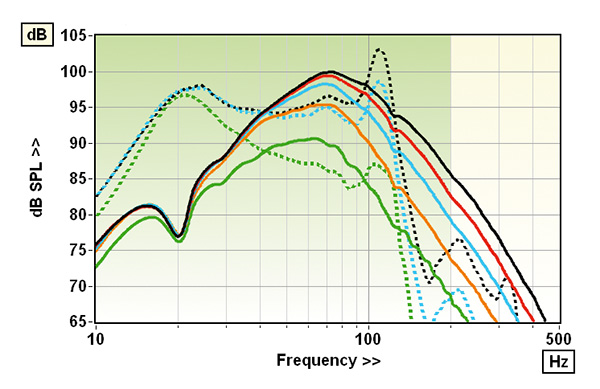
Fig.1 Wilson SabrinaX/LōKē response incl. nearfield summed bass (80Hz LPF, blue; 60Hz, black; 40Hz, red) freefield corrected to 1m at 2.83V. Dashed line is w/o the LōKē sub.
The Sabrina's port has a 27Hz–85Hz range, supporting the 60Hz–280Hz passband of the Sabrina's woofer (all limits –6dB), realizing a 52Hz bass extension (–6dB ref. 200Hz) despite a steep LF roll-off (dashed trace, fig.1). When optimally integrated with the LōKē using a 60Hz LPF and 12dB/octave slope (black trace, fig.1), the diffraction-corrected system response extends to a rib-tickling 17Hz. The impact of higher and lower LPF frequencies (80Hz, blue; 40Hz, red, fig.1) is shown. The residual notch at approximately 50Hz may be fine-tuned by boundary placement and the LōKē's output via its Phase Degree facility.
Fig.2 Nearfield driver (solid) & port (dashed) response for the LōKē with LPF set to 120Hz black, 100Hz red, 80Hz blue, 60Hz orange, and 40Hz green. All slopes 12dB/oct.
In common with most modern DSP-governed subs, the LōKē is very versatile. Increasing the LPF frequency from 40Hz in steps up to 125Hz results in a shift in the LōKē's passband from 19Hz–98Hz to 42Hz– 120Hz (all ref. –6dB). These ranges are not significantly influenced by the choice of roll-off slope (solid traces, fig.2). The long slot port is tuned to 22Hz with an effective 13Hz–134Hz (–6dB) output when the LPF is set to its maximum (125Hz, dashed traces, fig.2). The peak at 111Hz just before a steep roll-off is tamed when the LPF is set to 80Hz or lower (dashed blue trace). Ultimate bass extension is influenced by boundary reinforcement and the LPF (and subsonic HPF if applied), but useful output below 15Hz (–6dB ref. 100Hz) is perfectly achievable. There is some small penalty in second harmonic distortion below 60Hz, however, where levels increase from approximately 0.1% to approximately 0.9% at 50Hz and approximately 9% at 40Hz (measured at 90dB spl).—Paul Miller