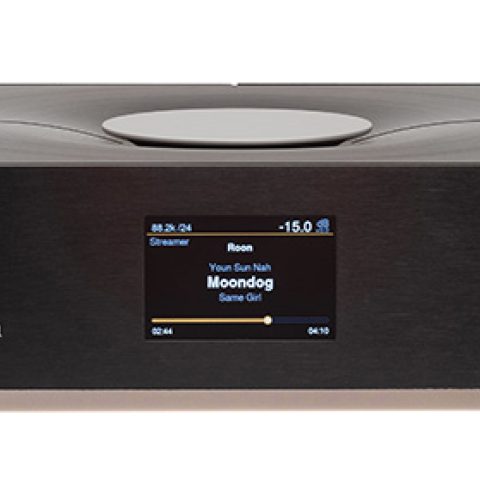
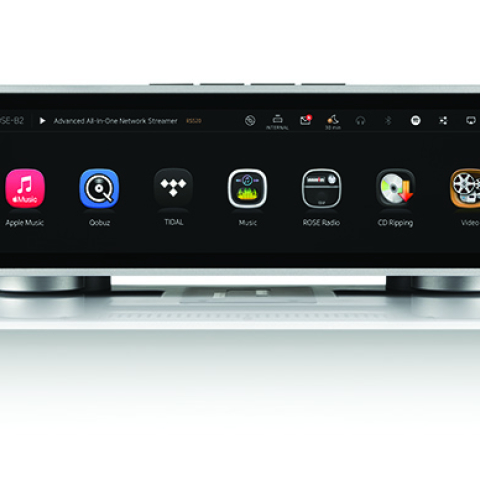
The settings menu includes Sources (music libraries, local or networked), Playback Options (choose your output device and configure formats, the volume control, and so on), Appearance (screen color, backgrounds, etc.), Network (addresses, DNS, and so on), System (startup settings, system updates, etc.), Plugins (both those installed and the ones available), Alarm (to use Primo as an alarm clock), Sleep (to set the sleep timer), Shutdown (to power off or restart), and Help (which takes you to Volumio's online documentation). Almost all the options have buttons to open pop-up help. A few options require you to restart Volumio before they can take effect.
The Primo as a streamer
The most obvious application for the Primo is as a network music streamer that allows you to choose and play music from your own files or from an internet music source, including streaming apps like Qobuz and Tidal. Storage options include directly connected storage such as USB thumb drives and hard discs and network sources via wired or wireless LAN. I tried all three options: streaming services Qobuz and Tidal, local storage, and network storage. All worked fine.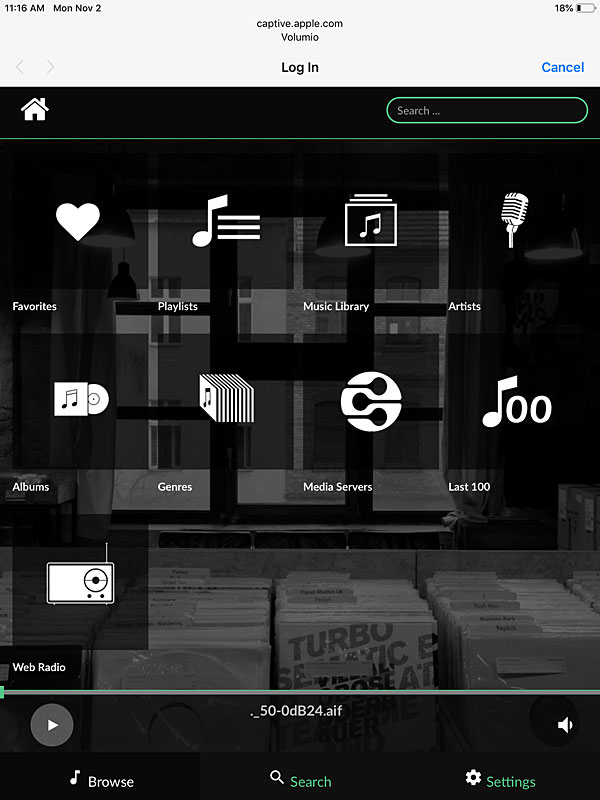 Via the setup menu, the Primo saw all the music sources available on my LAN. But when I selected my main library, which includes all my hi-rez, DSD, and multichannel files, it was slow to load, and when it did, performance was slow and unreliable and many albums were missing. Volumio told me that the Primo performs best with libraries up to about 40,000 tracks, and my library is much larger. When I selected a subset of my library—about 40k tracks of primarily stereo PCM music—the Primo's performance was smooth. I'm guessing this is a hardware limitation of the Primo's CPU and RAM.
Volumio seems to rely on the library's file structure for organization, but it provides no library-management tools, and the documentation says nothing about how it expects a library to be configured. I have set up most of the directories and files in my library by date added and not by artist, work, etc. Other programs, like JRiver and Roon, are okay with this: They use flexible, sophisticated metadata tagging. Volumio's system, however it works, didn't play as well with my library. Search often returned incongruous results, and the standard views, such as Albums, Genres, Artists, Playlists, and Favorites, failed to display cover art for a substantial part of my collection. (Why didn't it discover all the cover art in my library?) Maybe this wouldn't happen if I were a more scrupulous curator, but it has not been a problem with other servers I've used. Also, Volumio seems unable to search by file format, and it cannot tell me a file's sampling/ bit rate until after I start playing it.
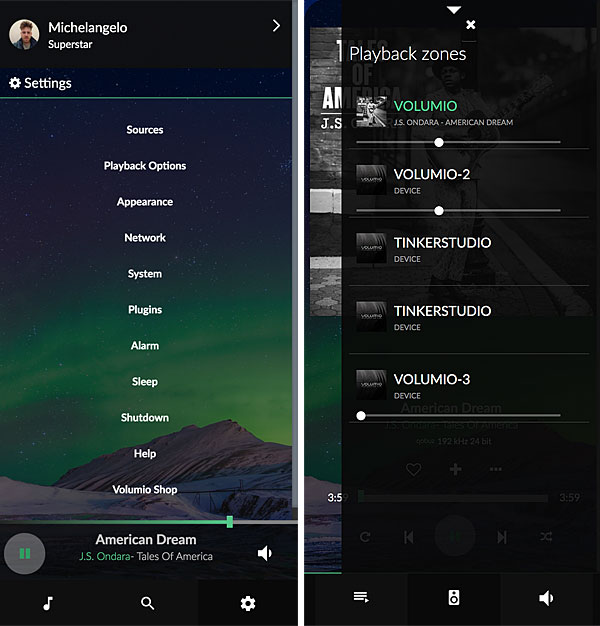
In addition to directing audio to its own analog outputs (via the built-in DAC), the Primo can send it on to another endpoint via its S/PDIF, USB, Wi-Fi, and Ethernet outputs. While the Primo seamlessly integrates multiple libraries and music sources, it supports only one output at a time, and any change in output requires the user to access the settings menu, make the change, click "Save," and wait for the installed application to be updated. (You can switch between network endpoints without as much delay, but it's still a slightly tedious process.)
Via the setup menu, the Primo saw all the music sources available on my LAN. But when I selected my main library, which includes all my hi-rez, DSD, and multichannel files, it was slow to load, and when it did, performance was slow and unreliable and many albums were missing. Volumio told me that the Primo performs best with libraries up to about 40,000 tracks, and my library is much larger. When I selected a subset of my library—about 40k tracks of primarily stereo PCM music—the Primo's performance was smooth. I'm guessing this is a hardware limitation of the Primo's CPU and RAM.
Volumio seems to rely on the library's file structure for organization, but it provides no library-management tools, and the documentation says nothing about how it expects a library to be configured. I have set up most of the directories and files in my library by date added and not by artist, work, etc. Other programs, like JRiver and Roon, are okay with this: They use flexible, sophisticated metadata tagging. Volumio's system, however it works, didn't play as well with my library. Search often returned incongruous results, and the standard views, such as Albums, Genres, Artists, Playlists, and Favorites, failed to display cover art for a substantial part of my collection. (Why didn't it discover all the cover art in my library?) Maybe this wouldn't happen if I were a more scrupulous curator, but it has not been a problem with other servers I've used. Also, Volumio seems unable to search by file format, and it cannot tell me a file's sampling/ bit rate until after I start playing it.
In addition to directing audio to its own analog outputs (via the built-in DAC), the Primo can send it on to another endpoint via its S/PDIF, USB, Wi-Fi, and Ethernet outputs. While the Primo seamlessly integrates multiple libraries and music sources, it supports only one output at a time, and any change in output requires the user to access the settings menu, make the change, click "Save," and wait for the installed application to be updated. (You can switch between network endpoints without as much delay, but it's still a slightly tedious process.)
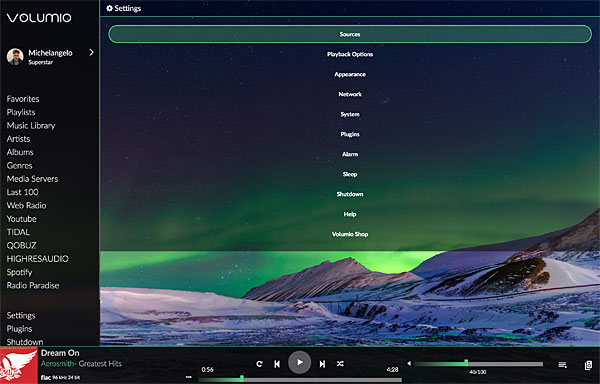 One final gripe: The Primo has an HDMI output for displaying its user interface on a video monitor, but its use weighs heavily on system response, as a Volumio rep acknowledged to me. The system also slows and stutters when asked to downsample high-resolution tracks for output to external devices that require lower rates. This is not surprising when you consider that all of Volumio is running in 2GB of RAM; how could it efficiently resample files larger than that in real time?
The Primo had none of these issues when I used it as it surely is most often used: with its own DAC and its analog outputs, controlled from my iPhone or iPad with no external display connected to the HDMI port.
All that aside, the Volumio Primo is a neat little music player. Its sound was clean and balanced through any of my three DACs, but they sounded better from the Baetis or Pink Faun players than from the USB or S/PDIF of the Primo. Overall, I preferred the Volumio Primo's sound from its own DAC!
The Primo as endpoint
One final gripe: The Primo has an HDMI output for displaying its user interface on a video monitor, but its use weighs heavily on system response, as a Volumio rep acknowledged to me. The system also slows and stutters when asked to downsample high-resolution tracks for output to external devices that require lower rates. This is not surprising when you consider that all of Volumio is running in 2GB of RAM; how could it efficiently resample files larger than that in real time?
The Primo had none of these issues when I used it as it surely is most often used: with its own DAC and its analog outputs, controlled from my iPhone or iPad with no external display connected to the HDMI port.
All that aside, the Volumio Primo is a neat little music player. Its sound was clean and balanced through any of my three DACs, but they sounded better from the Baetis or Pink Faun players than from the USB or S/PDIF of the Primo. Overall, I preferred the Volumio Primo's sound from its own DAC!
The Primo as endpoint
In addition to being a standalone player, the Primo can operate as a target for music data streamed from another device on your network, most often a server. It can then convert the data with its own internal DAC and output analog music, or it can send the digital data on to a different DAC via one of its digital outputs.
I was able to stream music to the Primo, used both of these ways, from my Baetis streamer using JRiver or Roon. JRiver saw the Primo as a "Generic DLNA Server"; Roon saw it, via AirPlay, as "Volumio (ShairportSync)" or, with the installable "Roon Bridge" plug-in, as "ES90x8Q2M." In this configuration, I had access to my whole music library. All the artwork and ancillary documents were available, and the Primo was relieved of any downsampling or conversion tasks. All of my high-resolution files (and multichannel files) played through the Primo without stuttering or interruptions, whether using the internal DAC or an external one. Now I could get a proper 5.1-to-stereo mixdown because Roon handled the channel management. The "Shairport-Sync" operation worked fine except that it imposed a 16/44.1 resolution limit on music files.
After a few days of success, the "Roon Bridge" plug-in became unresponsive. Roon no longer recognized its existence, but I was unable to uninstall it from the Primo.
 The Primo's own DAC
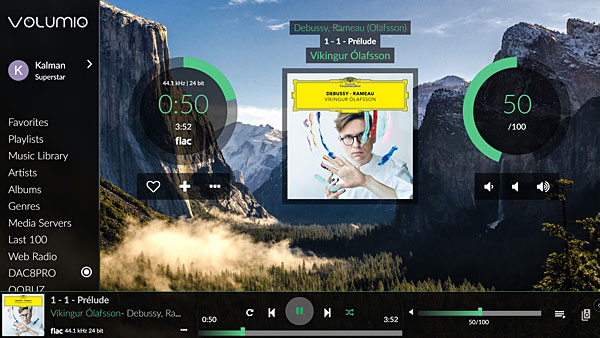
To my own surprise, I actually loved the analog output from Primo's own DAC. Its sound was clean and balanced, with impact and scale. I play Víkingur Ólafsson's fascinating interpretations of Debussy and Rameau (Deutsche Grammophon DG 4837701, CD) quite often, and the subtlety of the piano playing is clearly revealed via the Primo's analog outputs. All the inner details were there to savor.
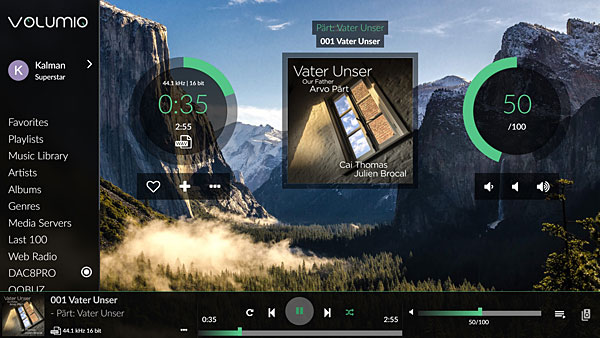 On more dynamic stuff, like Fiona Boyes's album Blues in My Heart (FR-740), the Primo's ability to convey the impact of a live performance was clear from the first note. I was disarmed by Cai Thomas's lovely, pure treble, in a spacious acoustic, in his recording of Arvo Pärt's "Vater Unser" (Rubicon 3060DS, also available on YouTube).
The Primo also handled DSD with aplomb via its analog outputs. I downloaded the "Gypsy Jazz Trio" from NativeDSD.com in its original recording format: DSD256. What a delightfully clear, open, peppy sound with engaging in-room presence!
With the larger challenge of Riccardo Muti's new Chicago recording of Shostakovich's Babi Yar (Symphony No.13, CSO Resound, available from symphonystore.com), the Primo rises to the task. The size, presence, and detail of soloist Alexey Tikhomirov and the CSO Chorus and orchestra were all in appropriate balance. Sure, other, more expensive DACs can eke out incremental improvements, but, faced with a choice of using the Primo's analog output or hanging a fancy DAC on the USB or S/PDIF output, I'd be happy to save some money.
On more dynamic stuff, like Fiona Boyes's album Blues in My Heart (FR-740), the Primo's ability to convey the impact of a live performance was clear from the first note. I was disarmed by Cai Thomas's lovely, pure treble, in a spacious acoustic, in his recording of Arvo Pärt's "Vater Unser" (Rubicon 3060DS, also available on YouTube).
The Primo also handled DSD with aplomb via its analog outputs. I downloaded the "Gypsy Jazz Trio" from NativeDSD.com in its original recording format: DSD256. What a delightfully clear, open, peppy sound with engaging in-room presence!
With the larger challenge of Riccardo Muti's new Chicago recording of Shostakovich's Babi Yar (Symphony No.13, CSO Resound, available from symphonystore.com), the Primo rises to the task. The size, presence, and detail of soloist Alexey Tikhomirov and the CSO Chorus and orchestra were all in appropriate balance. Sure, other, more expensive DACs can eke out incremental improvements, but, faced with a choice of using the Primo's analog output or hanging a fancy DAC on the USB or S/PDIF output, I'd be happy to save some money.
 Conclusions
Making sense of the Volumio Primo requires separating the hardware and the software, even though they are packaged together, and also considering its affordable price. The Volumio player system is nimble and lightweight. The graphics are crisp, and its network features are excellent. Its open structure encourages the development of enhancements. Over the few weeks I used it, I witnessed improvements, and thanks to the efforts of skilled enthusiasts, it will continue to improve. And there is room for improvement. The Volumio Primo does not (yet?) offer the richness of information, features, and flexibility of Roon or JRiver, but it is more resource-efficient than either. The responsive web interface allowed me to control it from any device that fell to hand—all that was needed was a browser and a network connection. The Primo's hardware is underpowered for my downsampling/multichannel/DSP needs, but if your music library and streaming sources are stereo only, and you intend to use the Primo's very good ESS DAC, I can recommend it highly.
The Primo is very good on its own terms, as an affordable music-server option for those who like to tinker. It's a good choice for tech-savvy, hands-on hobbyists. I would not hesitate to buy it for travel (if that ever happens again) or as a gift for a music lover. Hey, I have a granddaughter whose birthday is coming up!
The most obvious application for the Primo is as a network music streamer that allows you to choose and play music from your own files or from an internet music source, including streaming apps like Qobuz and Tidal. Storage options include directly connected storage such as USB thumb drives and hard discs and network sources via wired or wireless LAN. I tried all three options: streaming services Qobuz and Tidal, local storage, and network storage. All worked fine.
Via the setup menu, the Primo saw all the music sources available on my LAN. But when I selected my main library, which includes all my hi-rez, DSD, and multichannel files, it was slow to load, and when it did, performance was slow and unreliable and many albums were missing. Volumio told me that the Primo performs best with libraries up to about 40,000 tracks, and my library is much larger. When I selected a subset of my library—about 40k tracks of primarily stereo PCM music—the Primo's performance was smooth. I'm guessing this is a hardware limitation of the Primo's CPU and RAM.
One final gripe: The Primo has an HDMI output for displaying its user interface on a video monitor, but its use weighs heavily on system response, as a Volumio rep acknowledged to me. The system also slows and stutters when asked to downsample high-resolution tracks for output to external devices that require lower rates. This is not surprising when you consider that all of Volumio is running in 2GB of RAM; how could it efficiently resample files larger than that in real time?
In addition to being a standalone player, the Primo can operate as a target for music data streamed from another device on your network, most often a server. It can then convert the data with its own internal DAC and output analog music, or it can send the digital data on to a different DAC via one of its digital outputs.
The Primo's own DACTo my own surprise, I actually loved the analog output from Primo's own DAC. Its sound was clean and balanced, with impact and scale. I play Víkingur Ólafsson's fascinating interpretations of Debussy and Rameau (Deutsche Grammophon DG 4837701, CD) quite often, and the subtlety of the piano playing is clearly revealed via the Primo's analog outputs. All the inner details were there to savor.
On more dynamic stuff, like Fiona Boyes's album Blues in My Heart (FR-740), the Primo's ability to convey the impact of a live performance was clear from the first note. I was disarmed by Cai Thomas's lovely, pure treble, in a spacious acoustic, in his recording of Arvo Pärt's "Vater Unser" (Rubicon 3060DS, also available on YouTube).
The Primo also handled DSD with aplomb via its analog outputs. I downloaded the "Gypsy Jazz Trio" from NativeDSD.com in its original recording format: DSD256. What a delightfully clear, open, peppy sound with engaging in-room presence!
With the larger challenge of Riccardo Muti's new Chicago recording of Shostakovich's Babi Yar (Symphony No.13, CSO Resound, available from symphonystore.com), the Primo rises to the task. The size, presence, and detail of soloist Alexey Tikhomirov and the CSO Chorus and orchestra were all in appropriate balance. Sure, other, more expensive DACs can eke out incremental improvements, but, faced with a choice of using the Primo's analog output or hanging a fancy DAC on the USB or S/PDIF output, I'd be happy to save some money.
ConclusionsMaking sense of the Volumio Primo requires separating the hardware and the software, even though they are packaged together, and also considering its affordable price. The Volumio player system is nimble and lightweight. The graphics are crisp, and its network features are excellent. Its open structure encourages the development of enhancements. Over the few weeks I used it, I witnessed improvements, and thanks to the efforts of skilled enthusiasts, it will continue to improve. And there is room for improvement. The Volumio Primo does not (yet?) offer the richness of information, features, and flexibility of Roon or JRiver, but it is more resource-efficient than either. The responsive web interface allowed me to control it from any device that fell to hand—all that was needed was a browser and a network connection. The Primo's hardware is underpowered for my downsampling/multichannel/DSP needs, but if your music library and streaming sources are stereo only, and you intend to use the Primo's very good ESS DAC, I can recommend it highly.