Sidebar 3: Measurements
Because of the VAC Statement 452 iQ's bulk and weight, I drove my Audio Precision SYS2722 system and its host PC (see the January 2008 "As We See It"), test loads, digital and analog oscilloscopes, cables, and other gear to Michael Fremer's place for the measurements. The only space available for me to set everything up was in the garage, along the corridor from Michael's basement listening room. I ran two extension cables from a 20A outlet in the corridor, one for the test system and the other for one of the amplifiers (serial number 1929703). I later repeated some of the testing on the other amplifier, SN 1929702. The graphs in this report show the results with SN 1929702, which has slightly lower distortion in the treble. The two samples otherwise behaved identically.
The Statement 452 iQ can be used as a two-channel amplifier, but as Michael had exclusively performed his listening with a pair of the amplifiers connected as monoblocks, that is how I tested it. I made sure I connected the test loads to the third, right-most pair of binding posts, which were labeled Mono, and that both switches on the rear panel were set to Mono. As the VAC amplifier's output in this mode floats with respect to ground, I left the analyzer's input floating. I connected the Audio Precision's signal generator outputs, balanced or single-ended, to the right channel's input jacks, which is how Michael had been using the amplifiers. I let the amplifier warm up before performing any testing, and the LEDs on the front panel indicated that all was well with the eight KT88 output tubes.
The VAC's voltage gain into 8 ohms measured 27dB from both inputs, and the amplifier preserved absolute polarity (ie, was noninverting). The balanced input impedance was a usefully high 96k ohms at low and middle frequencies, dropping slightly and inconsequentially to 92k ohms at the top of the audioband. The unbalanced input impedance was a high 83k ohms at 1kHz but, unusually, dropped to 3.2k ohms at 20Hz and 8.85k ohms at 20kHz.
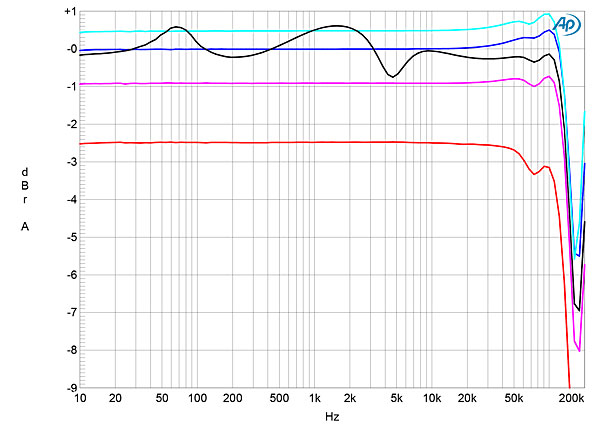
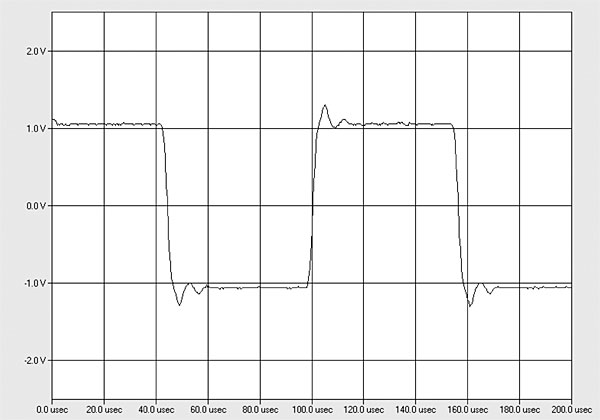
The Statement 452 iQ's output impedance was 0.94 ohm at all audio frequencies, which is low for a tube amplifier. As a result, the modulation of the amplifier's frequency response, due to the Ohm's law interaction between this source impedance and the impedance of our standard simulated loudspeaker, was relatively small, at ±0.7dB (fig.1, gray trace). The response into resistive loads (fig.1, cyan, blue, magenta, and red traces) was flat in the audioband, with then a steep rolloff above 100kHz. A very small peak just before the ultrasonic rolloff is associated with the VAC's reproduction of a 10kHz squarewave (fig.2), which features a small amount of overshoot and three damped cycles of ultrasonic ringing. A 1kHz squarewave was reproduced with superbly flat tops and bottoms (not shown), confirming the extended low-frequency response, a tribute to the amplifier's output transformers.
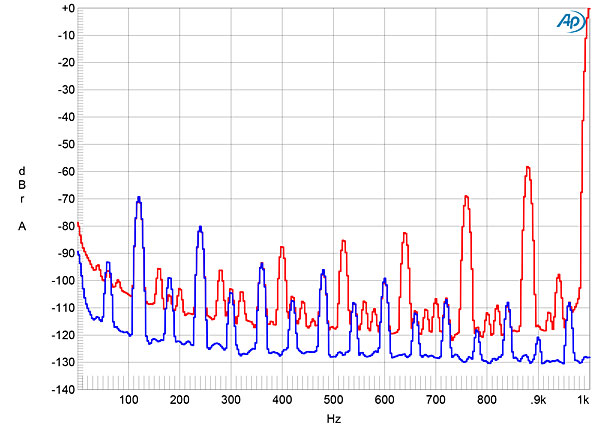
 Measured with the balanced input shorted to ground, the amplifier's unweighted, wideband signal/noise ratio was 68.7dB ref. 1W into 8 ohms, increasing slightly to 69.2dB when I restricted the measurement bandwidth to the audioband. When the reading was A-weighted, the S/N ratio improved further to a good 83.75dB. With no signal (fig.3, blue trace), spuriae were present at the 60Hz power-supply frequency and its harmonics. The odd-order harmonics, which will be due to magnetic interference from the power transformer, were lower in level than the even-order harmonics, which are due to a nonzero impedance to ground somewhere in the circuit. Peculiarly, when I drove the amplifier with a balanced 1kHz tone, with the output equal to 1W into 8 ohms, not only did the low-frequency noise floor rise by about 10dB (fig.3, red trace), but sidebands spaced at 120Hz now accompanied the 1kHz tone. I have no idea where these sidebands come from, but they remained unchanged when I experimented with different cables and grounding arrangements between both samples of the amplifier and the Audio Precision analyzer.
 In some ways, the Valve Amplification Company Statement 452 iQ did well on the test bench. The wide small-signal bandwidth, the excellent squarewave reproduction, the low intermodulation distortion, and the very low distortion in the treble at low-to-moderate powers into high impedances are commendable. But the shortfall in maximum power into 4 ohms and the supply-related spuriae present in the noise floor did concern me.—John Atkinson
Footnote 1: With the amplifier idling, the AC line voltage was 119V. This dropped to 117.5V with the amplifier clipping into 8 ohms. The shortfall in power wasn't due, therefore, to an unusually low line voltage.
Fig.1 V.A.C. Statement 452 IQ, frequency response at 2.83V into: simulated loudspeaker load (gray), 16 ohms (cyan), 8 ohms (blue), 4 ohms (magenta), 2 ohms (red) (1dB/vertical div.).
Fig.2 V.A.C. Statement 452 IQ, small-signal 10kHz squarewave into 8 ohms.
When I repeated the frequency response measurement with the single-ended input (not shown), the ultrasonic rolloff started a little earlier, at 60kHz rather than 100kHz, and the low-frequency output gently sloped down below 400Hz, reaching –1dB at 30Hz. This behavior might have been associated with the reduced input impedance at low frequencies. It wouldn't have affected Michael's auditioning, as he exclusively used the balanced input. However, it does suggest that the VAC amplifier's balanced input is to be preferred to the single-ended input.
Fig.3 V.A.C. Statement 452 IQ, spectrum of 1kHz sinewave, DC–1kHz, at 1W into 8 ohms (red) and with no signal (blue, linear frequency scale).
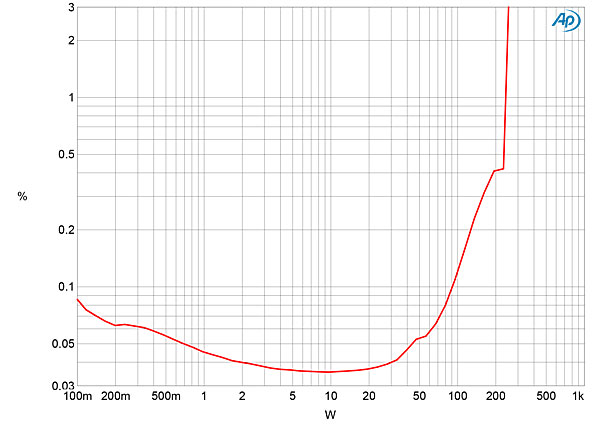
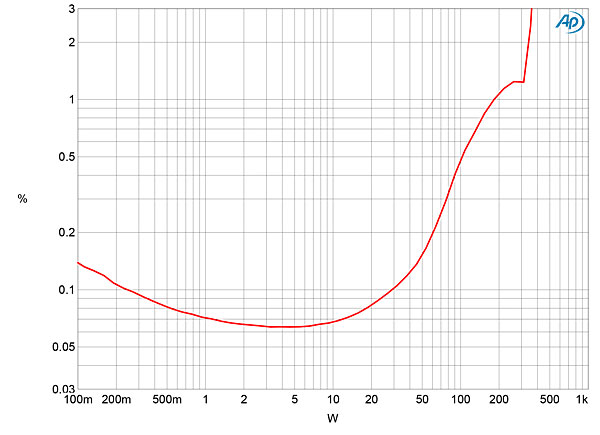
VAC specifies the Statement 452 iQ's maximum power when used as a monoblock as 450W into 4 ohms (23.5dBW). With our usual definition of clipping, which is when the output's percentage of THD+noise reaches 1%, the VAC clipped at 235W into 8 ohms (23.7dBW, fig.4, footnote 1). However, less power was available into 4 ohms at 1% THD+N: 183W (19.6dBW, fig.5), though 370W was available at 3% THD+N (22.7dBW) and 410W at 10% THD+N (23.1dBW). I doubt that this shortfall in maximum power into 4 ohms would have affected the auditioning. Given the high sensitivity of the Wilson speakers, Michael was never asking the amplifiers to deliver more than 40W or so.
Fig.4 V.A.C. Statement 452 IQ, distortion (%) vs 1kHz continuous output power into 8 ohms.
Fig.5 V.A.C. Statement 452 IQ, distortion (%) vs 1kHz continuous output power into 4 ohms.
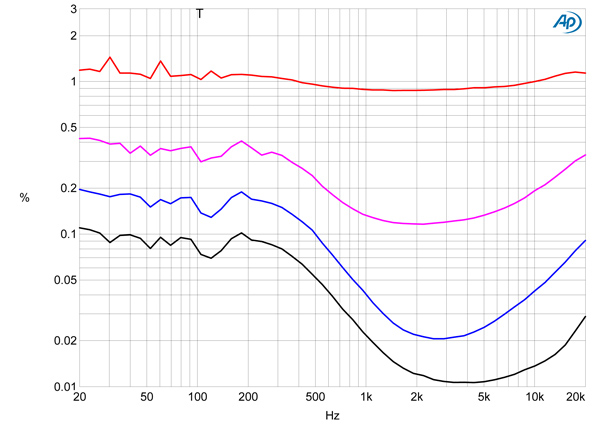
I examined how the percentage of THD+noise changed with frequency at 12.65V, which is when the distortion in figs.4 and 5 begins to rise above the noise floor. This voltage is equivalent to 10W into 16 ohms, 20W into 8 ohms, 40W into 4 ohms, and 80W into 2 ohms. The THD+N was commendably low in the treble into 16 and 8 ohms (fig.6, gray and blue traces), but rose at lower frequencies and into lower impedances. The distortion at 40W into 4 ohms (magenta trace) was still acceptably low, but at 80W into 2 ohms, it rose above 1% at the frequency extremes. This suggests that the single secondary winding of the Statement 452 iQ's output transformer is optimized for loads of 8 ohms rather than the 4 ohms specified by the manufacturer.
Fig.6 V.A.C. Statement 452 IQ, THD+N (%) vs frequency at 12.65V into: 16 ohms (gray), 8 ohms (blue), 4 ohms (magenta), and 2 ohms (red).
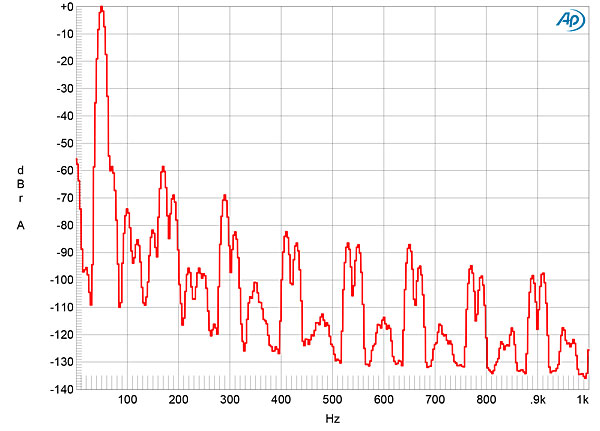
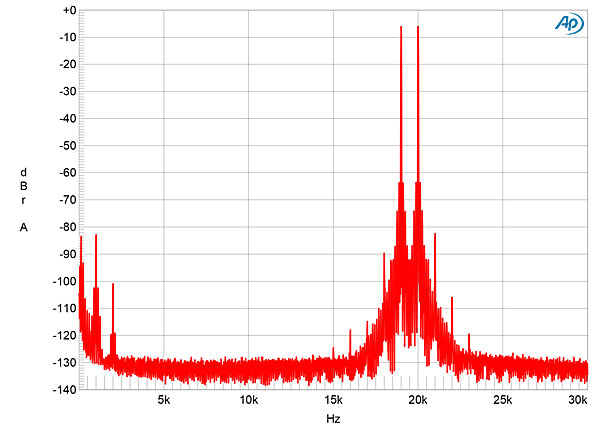
Fortunately, the VAC amplifier's distortion in the midrange and above was predominantly the subjectively innocuous second harmonic (fig.7). The level of the third harmonic was below that of the second at low frequencies into 8 ohms (fig.8) but, peculiarly, spurious tones were present at frequencies mathematically related to the 50Hz signal and 60Hz and its even-order harmonics. This odd behavior was also present at the same voltage in 4 ohms, though the third harmonic of the 50Hz tone was now equal in level to the second (not shown). Intermodulation distortion when the amplifier drove an equal mix of 19 and 20kHz tones at 20W into 8 ohms (fig.9) was commendably low, the second-order difference product at 1kHz lying at –82dB (0.009%). Higher-order products were also low in level.
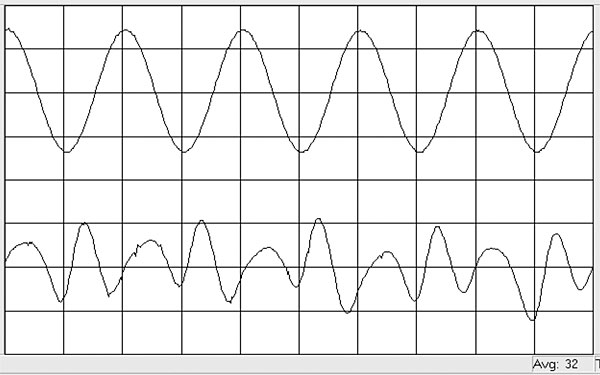
Fig.7 V.A.C. Statement 452 IQ, 1kHz waveform at 1W into 8 ohms, 0.047% THD+N (top); distortion and noise waveform with fundamental notched out (bottom, not to scale).
Fig.8 V.A.C. Statement 452 IQ, spectrum of 50Hz sinewave, DC–1kHz, at 20W into 8 ohms (linear frequency scale).
Fig.9 Valve Amplification Company Statement 452 IQ, HF intermodulation spectrum, DC–30kHz, 19+20kHz at 20W peak into 8 ohms (linear frequency scale).
Footnote 1: With the amplifier idling, the AC line voltage was 119V. This dropped to 117.5V with the amplifier clipping into 8 ohms. The shortfall in power wasn't due, therefore, to an unusually low line voltage.