While the tale of Jimmy Scott's return from obscurity sounds apocryphal, it is surely one of popular music's happier endings. After years of being out of music and working in his hometown of Cleveland as a hospital orderly, shipping clerk, and at other non-musical jobs, Scott's reemergence began in flamboyant fashion when he sang at the 1991 funeral of revered songwriter Doc Pomus (footnote 1). Several record label heads in attendance had assumed Scott was dead. Their interest was piqued. He was tabbed to sing on the finale of David Lynch's ABC TV series Twin Peaks. A guest shot on Lou Reed's Magic and Loss album followed. In 1992, he signed with Seymour Stein, founder of Sire Records.
After years of being ignored (or worse), Scott's second chance began with the album he'd always dreamed of making: 1992's All the Way. With its resonant title, the set—produced by Tommy LiPuma, recorded by Al Schmitt, and mastered by Doug Sax—featured A-list instrumental accompaniment by pianist Kenny Barron, bassist Ron Carter, and saxophonist David "Fathead" Newman. The program of songs was also top shelf, drawn from the greatest hits of the Great American Songbook. Scott sang his heart out on slow, haunted, stretching-every-word versions of Gershwin's "Embraceable You", Cole Porter's "Every Time We Say Goodbye," and the Jimmy Van Heusen/Sammy Cahn–penned title track.
Scott's voice was and is an acquired taste. The result of Kallmann syndrome, which kept him from going through puberty, his contralto spooked some and was considered a superpower by others. Scott learned to use its crying quality to his advantage. The adage "no one can sing like Jimmy Scott," coined separately by Dexter Gordon and Madonna, never rings truer than on the Grammy–nominated All the Way.
I became acquainted with Scott and his saga when old friend Bill Bentley, then a PR exec at Warner Music, which included Sire Records, hipped me to All the Way. Bentley played a leading role in making Scott's return happen, and he then became Scott's guru and minder. "I've never been so in awe of something coming back in the record business; it was like a dream," Bentley told me recently when I asked him about Scott, who passed away in 2014 at the age of 88. "It was like being on the planet of bliss. I put that at the top of my life."
A weekend in San Francisco made me a Scott believer for life. I saw him at the Fairmont Hotel and struggled to hold back tears. I was able to interview him several times, including on a magical day in NYC when I tagged along as he did radio-station appearances and print-journalism interviews. After three albums for Sire/ Warner Bros., he made an appearance on film in Ethan Hawke's 2001 feature-length directorial debut Chelsea Walls and recorded for Artists Only! and Milestone Records.
Scott's fragile voice made him seem angelic. "Burned by life," in Bentley's words, Scott absorbed torrents of abuse from ignoramuses who claimed he was a woman, transsexual, or homosexual. (Scott had five wives.) These injustices were the pain he poured into his singing. There were sweet, gracious sides to his character, but he could be curt and dictatorial, once sending me to buy him a pack of cigarettes before consenting to an interview. Another time, after a show at Birdland in New York City, I introduced him to my mother, and he promptly stood up, kissed her, and tried to slip his tongue in her mouth.
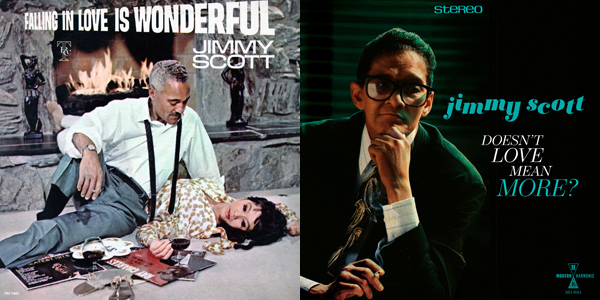
Scott's recording history began with Savoy Records, founded by Herman Lubinsky, one of the legendary villains of the music business, who had unerring ears, signing Charlie Parker, Miles Davis, and Lester Young, among others. In 1963 Ray Charles, looking for talent for his new Tangerine imprint, signed the singer. Falling in Love Is Wonderful, the resulting all-ballad album, was withdrawn from circulation when Lubinsky, who claimed Scott was under contract to him for life, threatened to sue. A subsequent album for Atlantic Records, The Source, recorded in 1969, met the same fate. Material from a 1972 session, for Atlantic, went unreleased until 1993. Forced to wait out Lubinsky, who died in 1974, Scott retired from music after The Source failed.
Falling in Love Is Wonderful has just been (re)issued on vinyl and CD in mono and stereo versions by the resurrected Tangerine label. It remains an early high point in Scott's career. While Charles, who played piano and supervised the professionally recorded sessions, favored a "with strings" approach to most tracks, the focus is rightly on Scott's voice. The singer's gift for wringing every bit of emotion from Gershwin songs began here, with a classic version of "Someone to Watch Over Me."
When Scott ended his 20-year exile from music in the early 1990s, he assembled a band he called the Jazz Expressions, led by standup bassist Hilliard Greene and pianist Ken-Ichi Shimazu. In retrospect, they were underrated. Scott and the Expressions recorded and released Doesn't Love Mean More? in 1990 on CD; Scott sold it at gigs. Recently remastered and reissued on CD and LP by Modern Harmonic Records, it, too, is ballad-centric. Scott's voice here is noticeably thinner but captured in respectable fidelity. The album features the fast instrumental "Itchy" and the swinging "Another Side of Me," on which Scott proves that he knew how to sing upbeat material.
There will never be enough Jimmy Scott recordings. These notable reissues are a welcome reminder of what an inimitable artist he could be
Footnote 1: For the definitive account of the life of Doc Pomus, including his relationship with Little Jimmy Scott, read Lonely Avenue: The Unlikely Life and Times of Doc Pomus, by our very own Alex Halberstadt.—Jim Austin
Footnote 1: For the definitive account of the life of Doc Pomus, including his relationship with Little Jimmy Scott, read Lonely Avenue: The Unlikely Life and Times of Doc Pomus, by our very own Alex Halberstadt.—Jim Austin