Sidebar 3: Measurements
 Jim Austin reviewed the original version of the T+A MP 3100 HV in June 2020. On the outside, the upgraded G3 version reviewed by HR appears unchanged, but the processor is now Roon Ready. I measured the T+A with my Audio Precision SYS2722 system using CD and SACD test discs, the S/PDIF inputs, and with test tone files played with Roon or stored on a USB stick inserted into the front-panel port. (I wasn't able to send data to the MP 3100 HV G3 via USB from my 2017 MacBook Pro, and the review sample had to be picked up and shipped to AXPONA 2026 before I was able to diagnose the problem.)
Looking first at the MP 3100 HV G3 as a disc player, its error correction was one of the best I have encountered—there were no glitches in the T+A's output until the gaps in the data spiral on the Pierre Verany Digital Test CD were >2.4mm in length. (The Compact Disc standard, the so-called Red Book, requires only that a player cope with gaps of up to 0.2mm.) The maximum output level varied according to which kind of disc was playing. Playing a full-scale 1kHz tone on a Sony test SACD resulted in an output level of 4.96V at the balanced outputs compared with 4.75V when I played 1kHz at 0dBFS on a test CD, a difference of 0.38dB. With S/PDIF and network data, the maximum balanced output levels at 1kHz were also 4.75V; the maximum level from the single-ended output was 2.375V with PCM data.
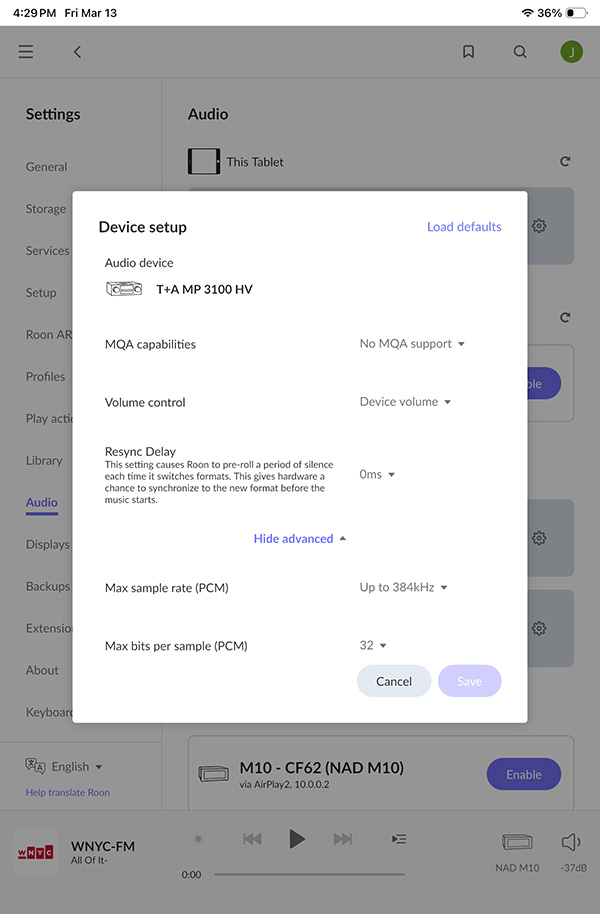
The optical and coaxial S/PDIF inputs locked to datastreams with sample rates up to 192kHz. The Roon app indicated that the processor would accept 32-bit network data with sample rates up to 384kHz; the T+A would also play 384kHz data from a USB stick. Apple's USB Prober utility identified the processor as "MP3100HV" from "T+A elektroakustik," and indicated that the T+A's USB port operated in the optimal isochronous asynchronous mode, though I wasn't able to use this port for the testing (see earlier).
With Polarity set to "Normal" with the remote control, the balanced and single-ended outputs preserved absolute polarity with all inputs. The unbalanced output impedance is specified as 50 ohms. I measured 46.3 ohms at 20kHz and 1kHz, increasing very slightly to 52 ohms at 20Hz. The balanced output impedances were exactly twice the unbalanced values.
Jim Austin reviewed the original version of the T+A MP 3100 HV in June 2020. On the outside, the upgraded G3 version reviewed by HR appears unchanged, but the processor is now Roon Ready. I measured the T+A with my Audio Precision SYS2722 system using CD and SACD test discs, the S/PDIF inputs, and with test tone files played with Roon or stored on a USB stick inserted into the front-panel port. (I wasn't able to send data to the MP 3100 HV G3 via USB from my 2017 MacBook Pro, and the review sample had to be picked up and shipped to AXPONA 2026 before I was able to diagnose the problem.)
Looking first at the MP 3100 HV G3 as a disc player, its error correction was one of the best I have encountered—there were no glitches in the T+A's output until the gaps in the data spiral on the Pierre Verany Digital Test CD were >2.4mm in length. (The Compact Disc standard, the so-called Red Book, requires only that a player cope with gaps of up to 0.2mm.) The maximum output level varied according to which kind of disc was playing. Playing a full-scale 1kHz tone on a Sony test SACD resulted in an output level of 4.96V at the balanced outputs compared with 4.75V when I played 1kHz at 0dBFS on a test CD, a difference of 0.38dB. With S/PDIF and network data, the maximum balanced output levels at 1kHz were also 4.75V; the maximum level from the single-ended output was 2.375V with PCM data.
The optical and coaxial S/PDIF inputs locked to datastreams with sample rates up to 192kHz. The Roon app indicated that the processor would accept 32-bit network data with sample rates up to 384kHz; the T+A would also play 384kHz data from a USB stick. Apple's USB Prober utility identified the processor as "MP3100HV" from "T+A elektroakustik," and indicated that the T+A's USB port operated in the optimal isochronous asynchronous mode, though I wasn't able to use this port for the testing (see earlier).
With Polarity set to "Normal" with the remote control, the balanced and single-ended outputs preserved absolute polarity with all inputs. The unbalanced output impedance is specified as 50 ohms. I measured 46.3 ohms at 20kHz and 1kHz, increasing very slightly to 52 ohms at 20Hz. The balanced output impedances were exactly twice the unbalanced values.
Figs.4, 5, and 6 were taken with the analog low-pass filter set to Wide. Repeating these spectral analyses with the filter set to Normal lowered the level of the noisefloor above 70kHz by approximately 8dB.
Jim Austin reviewed the original version of the T+A MP 3100 HV in June 2020. On the outside, the upgraded G3 version reviewed by HR appears unchanged, but the processor is now Roon Ready. I measured the T+A with my Audio Precision SYS2722 system using CD and SACD test discs, the S/PDIF inputs, and with test tone files played with Roon or stored on a USB stick inserted into the front-panel port. (I wasn't able to send data to the MP 3100 HV G3 via USB from my 2017 MacBook Pro, and the review sample had to be picked up and shipped to AXPONA 2026 before I was able to diagnose the problem.)
Looking first at the MP 3100 HV G3 as a disc player, its error correction was one of the best I have encountered—there were no glitches in the T+A's output until the gaps in the data spiral on the Pierre Verany Digital Test CD were >2.4mm in length. (The Compact Disc standard, the so-called Red Book, requires only that a player cope with gaps of up to 0.2mm.) The maximum output level varied according to which kind of disc was playing. Playing a full-scale 1kHz tone on a Sony test SACD resulted in an output level of 4.96V at the balanced outputs compared with 4.75V when I played 1kHz at 0dBFS on a test CD, a difference of 0.38dB. With S/PDIF and network data, the maximum balanced output levels at 1kHz were also 4.75V; the maximum level from the single-ended output was 2.375V with PCM data.
The optical and coaxial S/PDIF inputs locked to datastreams with sample rates up to 192kHz. The Roon app indicated that the processor would accept 32-bit network data with sample rates up to 384kHz; the T+A would also play 384kHz data from a USB stick. Apple's USB Prober utility identified the processor as "MP3100HV" from "T+A elektroakustik," and indicated that the T+A's USB port operated in the optimal isochronous asynchronous mode, though I wasn't able to use this port for the testing (see earlier).
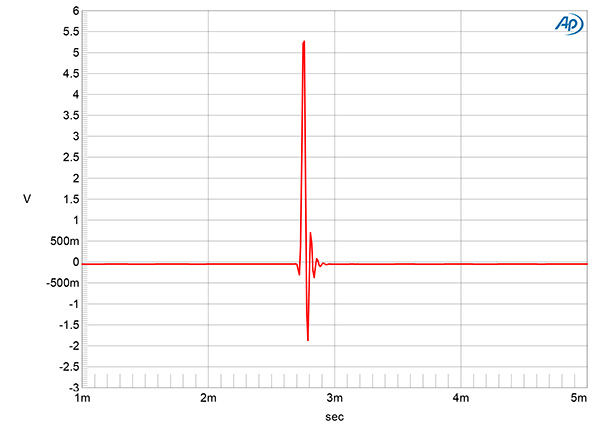
Fig.1 T+A MP 3100 HV G3, Bezier IIR filter, impulse response (one sample at 0dBFS, 44.1kHz sampling, 4ms time window).
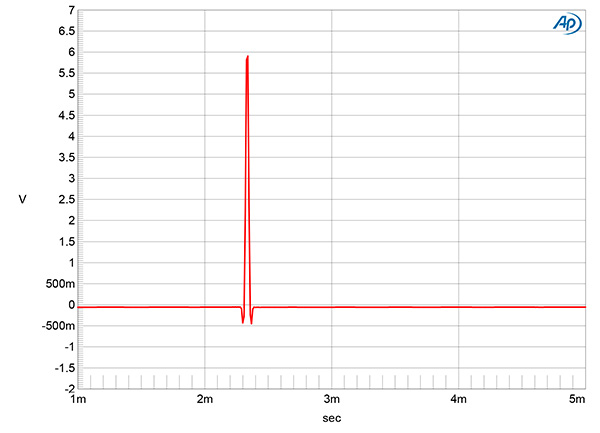
Fig.2 T+A MP 3100 HV G3, Bezier filter, impulse response (one sample at 0dBFS, 44.1kHz sampling, 4ms time window).
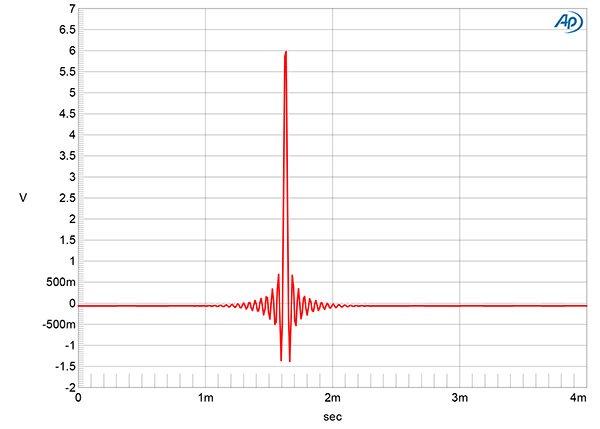
Fig.3 T+A MP 3100 HV G3, FIR Long filter, impulse response (one sample at 0dBFS, 44.1kHz sampling, 4ms time window).
The four oversampling digital reconstruction filters are labeled FIR Long, FIR Short, Bezier IIR, and Bezier. HR told me that he had used the Bezier IIR filter for his auditioning. The T+A's impulse response with this filter and 44.1kHz data had a single cycle of pre-ringing and two of post-ringing (fig.1). The Bezier filter offered an almost time-perfect symmetrical pulse (fig.2), while the FIR Long filter had a conventional time-symmetrical linear-phase impulse response (fig.3); the FIR Short filter's impulse response revealed that it was a shorter, linear-phase type.
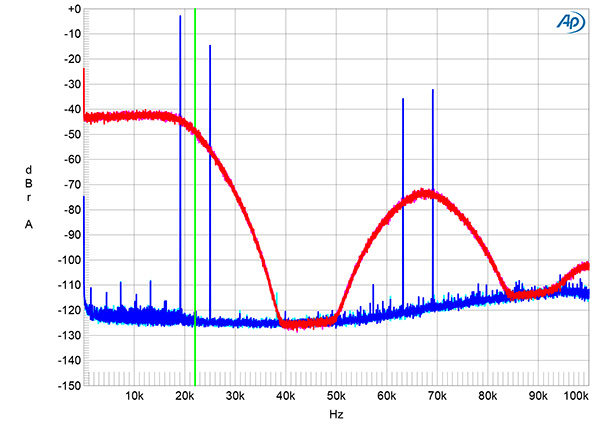
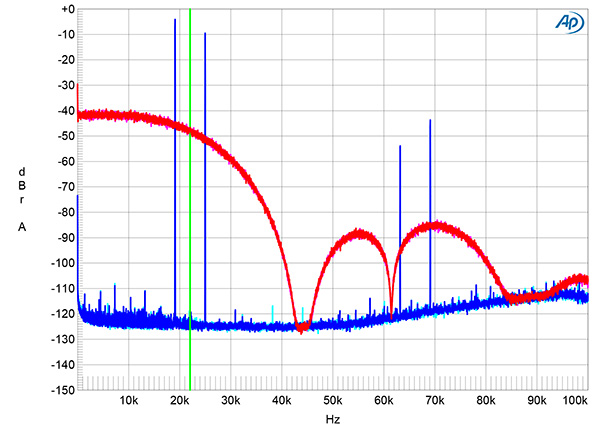
Fig.4 T+A MP 3100 HV G3, Bezier IIR filter, Wide bandwidth, wideband spectrum of white noise at –4dBFS (left channel red, right magenta) and 19.1kHz tone at 0dBFS (left blue, right cyan) into 100k ohms with data sampled at 44.1kHz (20dB/vertical div.).
Fig.5 T+A MP 3100 HV G3, Bezier filter, Wide bandwidth, wideband spectrum of white noise at –4dBFS (left channel red, right magenta) and 19.1kHz tone at 0dBFS (left blue, right cyan) into 100k ohms with data sampled at 44.1kHz (20dB/vertical div.).
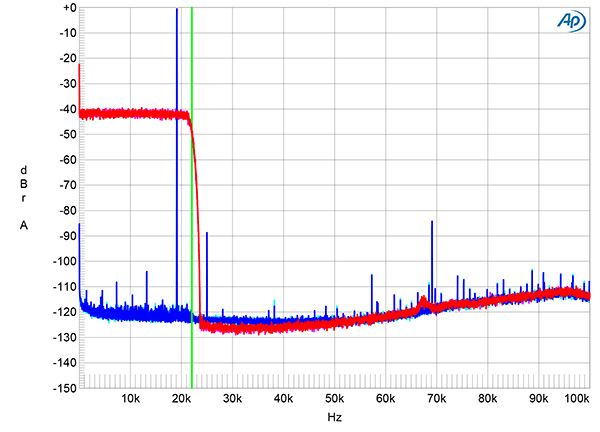
Fig.6 T+A MP 3100 HV G3, FIR Long filter, Wide bandwidth, wideband spectrum of white noise at –4dBFS (left channel red, right magenta) and 19.1kHz tone at 0dBFS (left blue, right cyan) into 100k ohms with data sampled at 44.1kHz (20dB/vertical div.).
With 44.1kHz-sampled white noise, the T+A's response with the Bezier IIR filter rolled off slowly above the audioband and didn't reach full stop-band attenuation until 39kHz (fig.4, red and magenta traces). The aliased image at 25kHz of the 19.1kHz tone (blue and cyan traces) was down by just 12dB. The Bezier filter offered an even slower ultrasonic rolloff (fig.5), while the FIR Long filter featured a fast rolloff above the audioband (fig.6, red and magenta traces), with the aliased image of the full-scale 19.1kHz tone (blue and cyan traces) suppressed by 90dB.
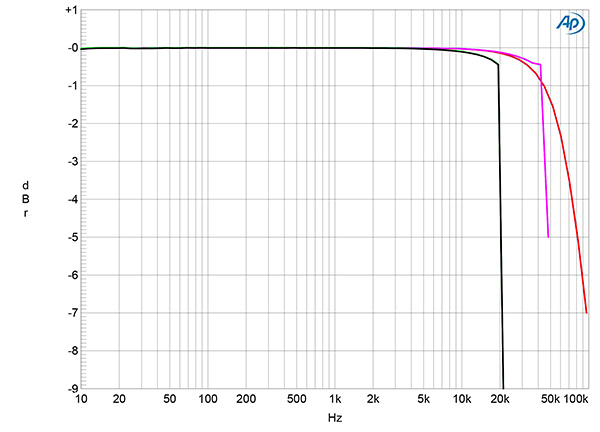
Fig.7 T+A MP 3100 HV G3, FIR Long filter, Wide bandwidth, frequency response at –12dBFS into 100k ohms with data sampled at: 44.1kHz (left channel green, right gray), 96kHz (left channel cyan, right magenta), 192kHz (left blue, right red) (1dB/vertical div.).
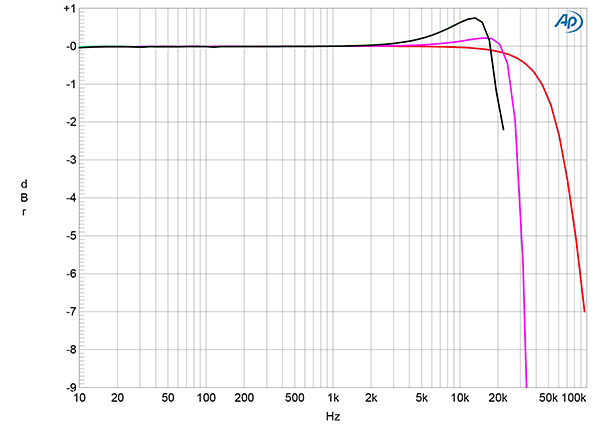
Fig.8 T+A MP 3100 HV G3, Bezier IIR filter, Wide bandwidth, frequency response at –12dBFS into 100k ohms with data sampled at: 44.1kHz (left channel green, right gray), 96kHz (left channel cyan, right magenta), 192kHz (left blue, right red) (1dB/vertical div.).
Fig.9 T+A MP 3100 HV G3, Bezier filter, Wide bandwidth, frequency response at –12dBFS into 100k ohms with data sampled at: 44.1kHz (left channel green, right gray), 96kHz (left channel cyan, right magenta), 192kHz (left blue, right red) (1dB/vertical div.).
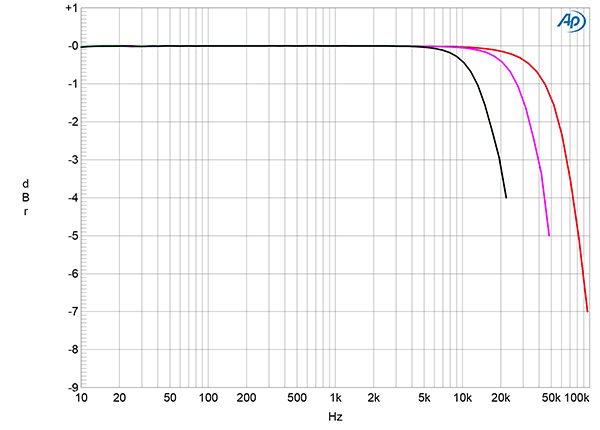
With the two FIR filters and data sampled at 44.1kHz, the MP 3100 HV G3's frequency response was flat almost up to 20kHz, with then a sharp rolloff just below half the two lower sample rates (fig.7). (I had the analog low-pass filter set to Wide for these response tests.) The Bezier IIR filter was peculiar in that a small, 0.75dB-high peak was present with 44.1kHz data (fig.8, green and gray traces). The peak was lower in amplitude and higher in frequency with 96kHz data (cyan and magenta traces), and was absent with 192kHz data (blue and red traces). The Bezier filter started rolling off earlier than the other filters and was down by 3dB at 20kHz with 44.1kHz data (fig.9).
Fig.10 T+A MP 3100 HV G3, balanced output, spectrum with noise and spuriae of dithered 1kHz tone at 0dBFS with 24-bit data (left channel blue, right red) (20dB/vertical div.).
The T+A's channel separation was superb, at >125dB in both directions below 1kHz and still 113dB at the top of the audioband. With a full-scale, 24-bit 1kHz tone, the noisefloor lay below –140dB and there were no supply-related spuriae present (fig.10).
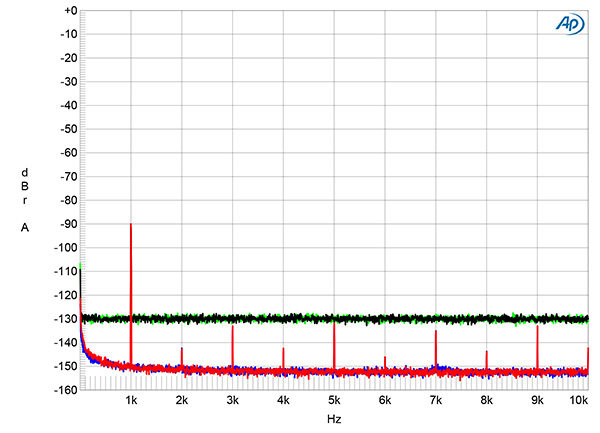
Fig.11 T+A MP 3100 HV G3, balanced output, spectrum with noise and spuriae of dithered 1kHz tone at –90dBFS with: 16-bit data (left channel cyan, right magenta), 24-bit data (left blue, right red) (20dB/vertical div.).
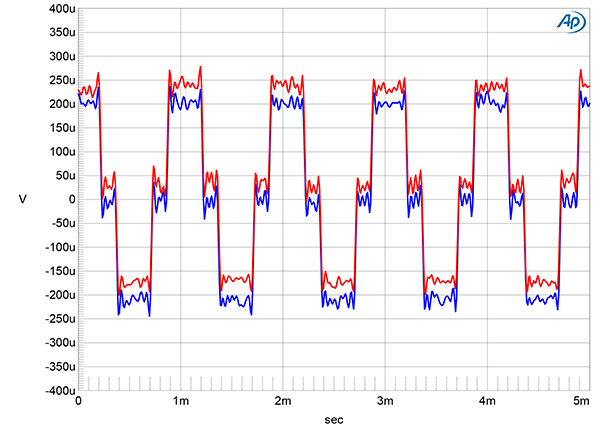
Fig.12 T+A MP 3100 HV G3, FIR Long filter, balanced output, waveform of undithered 16-bit, 1kHz sinewave at –90.31dBFS (left channel blue, right red).
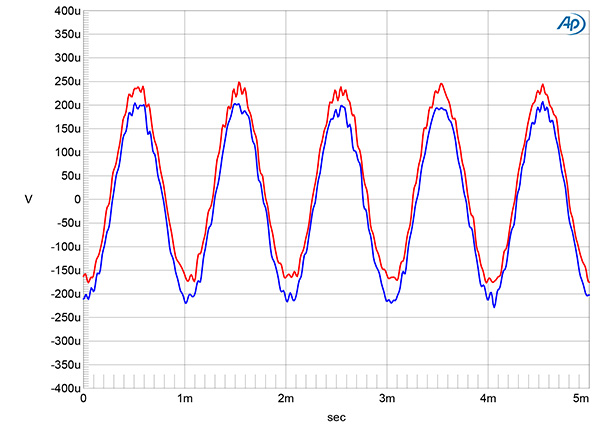
Fig.13 T+A MP 3100 HV G3, FIR Long filter, balanced output, waveform of undithered 24-bit, 1kHz sinewave at –90.31dBFS (left channel blue, right red).
When I increased the bit depth from 16 to 24 with a dithered 1kHz tone at –90dBFS (fig.11), the random noisefloor dropped by around 22dB, meaning that the MP 3100 HV G3 offers almost 20 bits' worth of measured resolution. However, the appearance of odd-order harmonics with the 24-bit signal suggests that the least-significant, 24th bit was being truncated. With undithered 16-bit data representing a tone at exactly –90.31dBFS, the three DC voltage levels described by the data were perfectly resolved (fig.12). With undithered 24-bit data at –90dBFS, the T+A output a clean sinewave despite the very low signal level (fig.13).
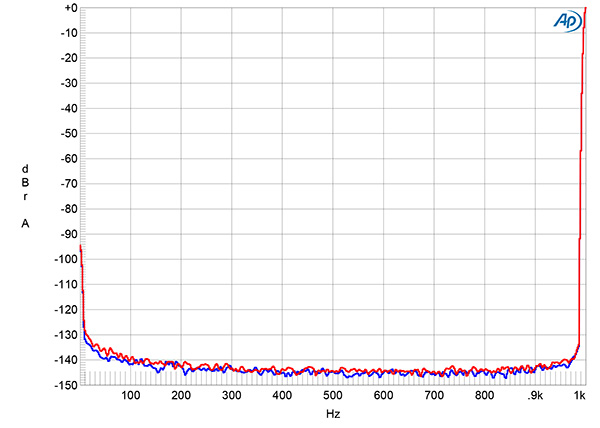
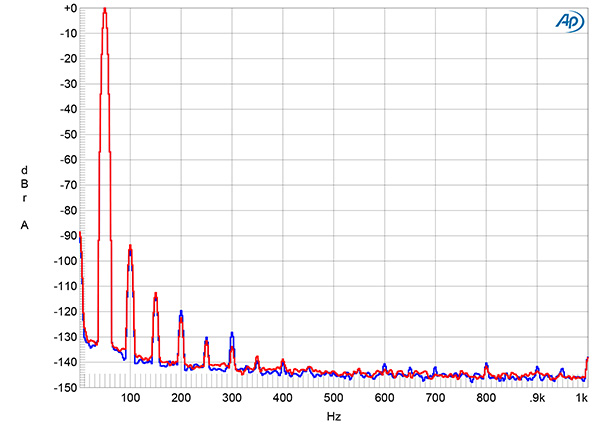
Fig.14 T+A MP 3100 HV G3, balanced output, spectrum of 50Hz sinewave, DC–1kHz, at 0dBFS into 100k ohms (left channel blue, right red; linear frequency scale).
The T+A MP 3100 HV G3 offered very low levels of harmonic distortion. With a full-scale 50Hz tone, the second harmonic in both the balanced and unbalanced outputs was the highest in level, but at –94dB in the left channel (fig.14, blue trace) and –96dB in the right channel (red trace), was inconsequential. Higher-order harmonics all lay below –114dB (0.0002%). However, as with the original sample the balanced outputs clipped when driving a 0dBFS tone into 600 ohms. I had to reduce the signal level to –6dBFS to reduce the levels of the distortion harmonics to below –90dB (0.003%) into this very demanding load. The single-ended outputs had no problem driving a full-scale signal into 600 ohms.
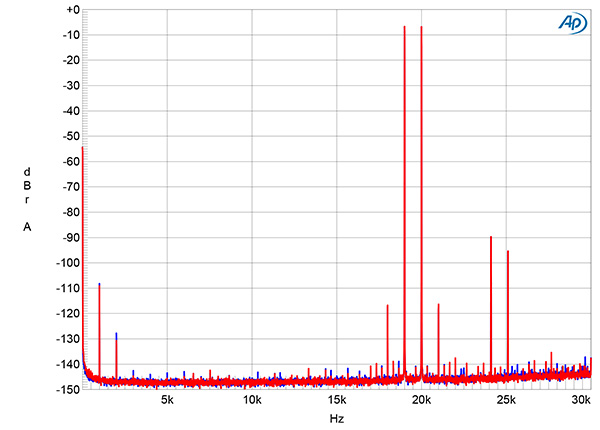
Fig.15 T+A MP 3100 HV G3, FIR Long filter, balanced output, HF intermodulation spectrum, DC–30kHz, 19+20kHz at 0dBFS into 100k ohms, 44.1kHz data (left channel blue, right red; linear frequency scale).
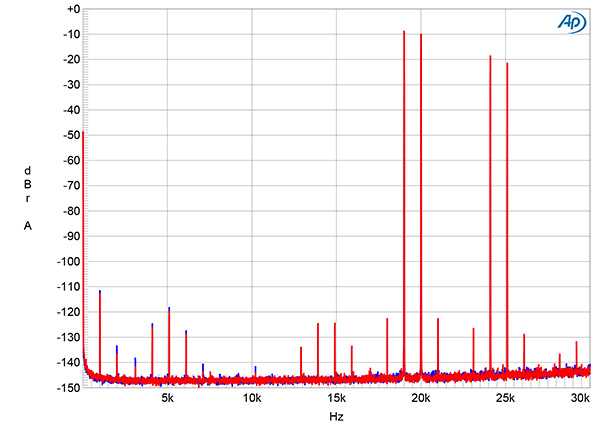
Fig.16 T+A MP 3100 HV G3, Bezier IIR filter, balanced output, HF intermodulation spectrum, DC–30kHz, 19+20kHz at 0dBFS into 100k ohms, 44.1kHz data (left channel blue, right red; linear frequency scale).
While the T+A's intermodulation distortion was very low in level, the second-order difference product produced by equal-level tones at 19 and 20kHz with the combined waveform peaking at 0dBFS lying around –104dB (0.0006%), the suppression of the ultrasonic aliased images of these tones depended on the digital reconstruction filter in use. While the aliased tones were attenuated by 90dB or more with the FIR Long filter (fig.15), the Bezier IIR filter suppressed them by around 20dB (fig.16) and aliased images appeared in the audioband, though these are still at a very low level.
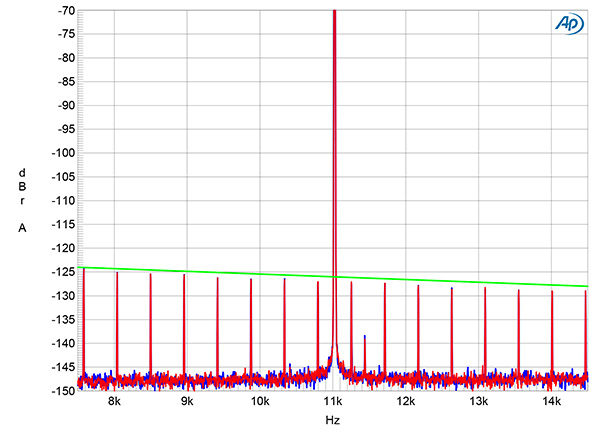
Fig.17 T+A MP 3100 HV G3, balanced output, high-resolution jitter spectrum of analog output signal, 11.025kHz at –6dBFS, sampled at 44.1kHz with LSB toggled at 229Hz: 16-bit optical data (left channel blue, right red). Center frequency of trace, 11.025kHz; frequency range, ±3.5kHz.
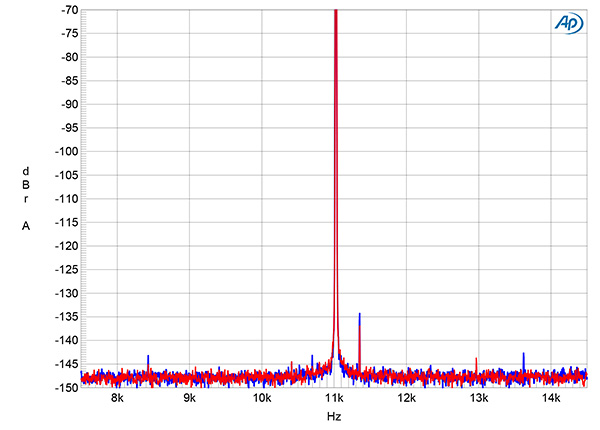
Fig.18 T+A MP 3100 HV G3, balanced output, high-resolution jitter spectrum of analog output signal, 11.025kHz at –6dBFS, sampled at 44.1kHz with LSB toggled at 229Hz: 24-bit optical data (left channel blue, right red). Center frequency of trace, 11.025kHz; frequency range, ±3.5kHz.
When I tested the T+A processor for its rejection of word-clock jitter with 16-bit TosLink J-Test data, all the odd-order harmonics of the LSB-level, low-frequency squarewave were at the correct levels (fig.17, sloping green line). No sidebands were visible when I repeated the jitter test with 24-bit optical J-Test data or Roon data (fig.18), though there was a spurious tone present at 11.36kHz; with a level of just –136dB, this is inconsequential.
The T+A MP 3100 HV G3 offered superb test bench performance, very similar to that of the 2020 version, though like the earlier processor, the balanced outputs shouldn't be used with preamplifiers that have a very low input impedance. (Subsequent to the testing, HR told me that he exclusively used the single-ended outputs.) The Bezier IIR reconstruction filter offers the best balance between time-domain performance and frequency-domain performance.—John Atkinson