Sidebar 3: Measurements
Ron Sutherland refers to his Little Loco phono preamplifier as a "transimpedance" amplifier, which means that it amplifies a current rather than a voltage—ie, the input signal is a current and the output signal is a voltage. Phono preamplifiers almost all use voltage-amplification circuitry. However, as a moving-coil cartridge inherently generates an output current, sourced from a very low impedance, it makes sense for a moving-coil phono preamplifier input stage to operate in current mode rather than voltage mode. I measured the Sutherland Little Loco using my Audio Precision SYS2722 system (see the January 2008 "As We See It"). However, as the Loco's input is not referenced to ground and its input impedance is effectively a short circuit, I had to improvise some changes to my usual procedure. If I connected the AP's balanced output to the Little Loco's input, the resultant current would be very high and might damage the preamp's input circuitry.
As I had when I measured the B.M.C. MCCI phono preamplifier for our June 2013 issue, I soldered a 10k ohm resistor in series with pins 2 and 3 of a male XLR plug. (The two 10k resistors were matched to within 2 ohms.) I then soldered a 10 ohm resistor between pins 2 and 3. The Audio Precision's balanced output stage would thus see a high 20k ohm load, but the signal presented to the Sutherland preamp would be typical of an MC cartridge. I then used a second cable terminated with a female XLR plug at the source end and an RCA plug at the other, with the XLR's pin 2 signal connected to the RCA's center pin and its pin 3 signal connected to the shell of the RCA. This RCA plug was connected in turn to each of the Little Loco's input jacks. Pin 1 of the XLR was connected to the preamplifier's chassis ground terminal. This setup attenuated the Audio Precision's signal level by 67dB, a 1kHz signal with a level of 1V resulting in 437µV at the preamplifier's input.
The module for each channel of the Sutherland preamplifier has plug-in resistors to set the overall gain. It ships with 3k ohm resistors installed for medium gain; replacing the 3k ohm resistors with 1k ohm equivalents reduces the output voltage by 6dB, or removing those resistors increases the output voltage by 6dB. These resistors are tightly matched: I measured 2997 and 2992 ohms for the left channel and 3001 and 3004 ohms for the right channel. So what was the Loco's gain with these 3k ohm resistors?
Ron Sutherland has a strong opinion regarding the specified gain of a transimpedance amplifier. In an email he told me "I think that measuring and spec'ing the Loco 'as if' it is a voltage-gain amplifier (albeit of very low input impedance) is useless. Worse, it invites a confidence in a number for comparison to voltage-gain amplifiers that is misleading. Fundamentally, voltage-gain and transimpedance amplifiers are different and have different units of gain. There is a matter of adhering to technical correctness. I understand that the reader wants (demands) a voltage gain in dB. That is like a car reviewer being forced into spec'ing a Tesla's miles-per-gallon.
"The real question; is there the right gain for the cartridge of interest? The answer is No for moving-magnet and moving-iron cartridges or the use of a step-up transformer. The answer is Very Likely Yes, for most moving-coil cartridges."
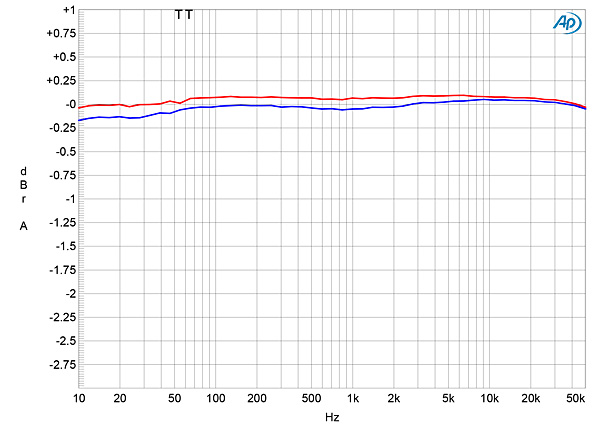
So with Ron's opinion in mind, I found that a balanced input of 500µV at 1kHz resulted in an output voltage of 415.4mV—ie, a gain of 58.4 mpg . . . er, 58.4dB, which is indeed appropriate for a moving-coil cartridge. The Sutherland preamp preserved absolute polarity and its input impedance was indistinguishable from a short circuit. The output impedance was a low 200 ohms from 20Hz to 20kHz. The Little Loco offers both very accurate RIAA equalization and very close channel matching (fig.1).
 These spuriae can also be seen in fig.3, which shows the spectrum of the Little Loco's output with the input fed 1kHz at 5mV. I suspect that these supply-related artefacts are due to the high-impedance balanced adaptor cable I constructed picking up interference from the Sutherland's power supply, even though the preamp has a steel top plate and chassis. (The levels varied when I moved the adaptor cable around; this graph was taken with the cable positioned to give the lowest levels.) The input signal level for this graph was 20dB higher than the standard MC level of 500µV because at lower input levels, the distortion harmonics were obscured by noise. Even so, while the second harmonic can now be seen, it lies at just –94dB (0.002%). Reducing the load impedance to the punishing 600 ohms increased the level of the second harmonic to –80dB (0.01%), and the third harmonic was now the highest in level, at –74dB (0.02%). But these are still too low in level to be a problem.
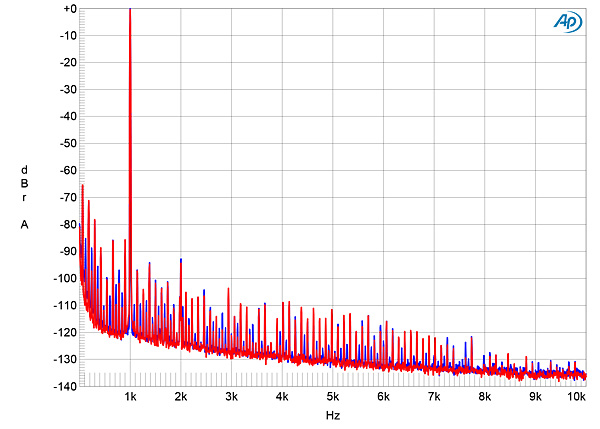
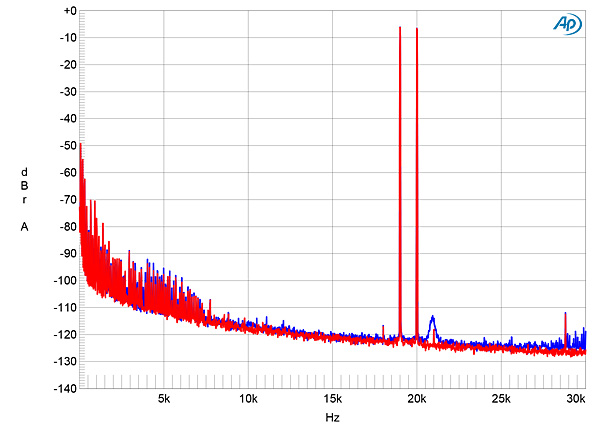
Fig.1 Sutherland Little LOCO, response with RIAA correction into 100k ohms (left channel blue, right red) (0.5dB/vertical div.).
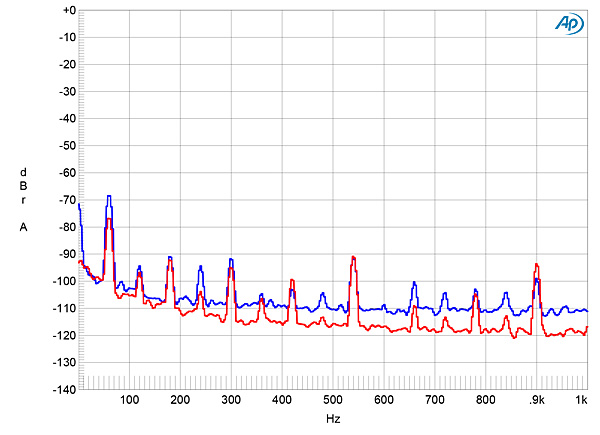
The Little Loco's unweighted, wideband S/N ratio, measured with the input shunted with a 10 ohm resistor as recommended by Ron Sutherland in his email, was 47.8dB, ref. 1kHz at 500µV. Restricting the measurement bandwidth to 22Hz–22kHz increased the ratio to a respectable 64.8dB, while switching an A-weighting filter into circuit increased it further, to 72.85dB. Spectral analysis of the Sutherland's low-frequency noise floor with the input shunted by a 10 ohm resistor (fig.2) indicated that random noise components were low in level, though some supply-related spuriae are visible in this graph.
Fig.2 Sutherland Little LOCO, spectrum, DC–1kHz, of output ref. 500µV input with input shunted with a 10 ohm resistor (linear frequency scale).
Fig.3 Sutherland Little LOCO, spectrum of 1kHz sinewave, DC–10kHz, into 100k ohms for 5mV input (linear frequency scale).
Fig.4 shows how the Sutherland Little Loco handled an equal mix of 19 and 20kHz tones, at an input level of 600mV. This is 21.5dB higher than the standard MC level at these frequencies, but the difference product at 1kHz lies at just –80dB (0.01%), and there are no higher-order intermodulation products visible. This is a very linear circuit.
Fig.4 Sutherland Little LOCO, HF intermodulation spectrum, DC–30kHz, 19+20kHz into 100k ohms for 600mV peak input (linear frequency scale).
I must admit that measuring a preamplifier with a current-mode input stage when my test system is optimal for conventional voltage-mode input stages makes me break out in a sweat. But Sutherland's Little Loco appears to be a well-engineered device, its measured performance confirming that it is perfectly appropriate for use with low-output moving-coil phono cartridges.—John Atkinson