Sidebar 2: Measurements
The Theorem had the lowest output voltage of the processors I review this month, measuring 1.97V when reproducing a full-scale, 1kHz sinewave. Output impedance was a fairly low 152 ohms across the band, which suggests the Theorem will have no trouble driving a passive level control.
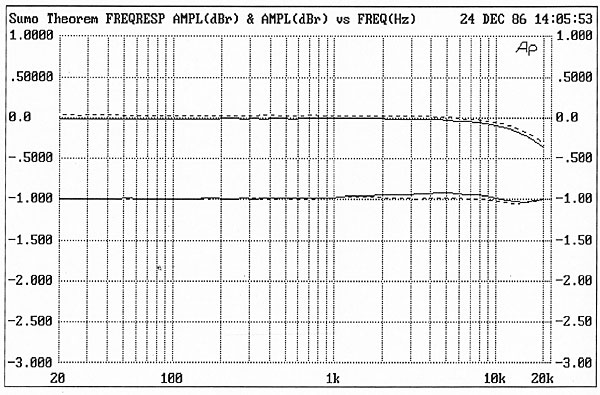
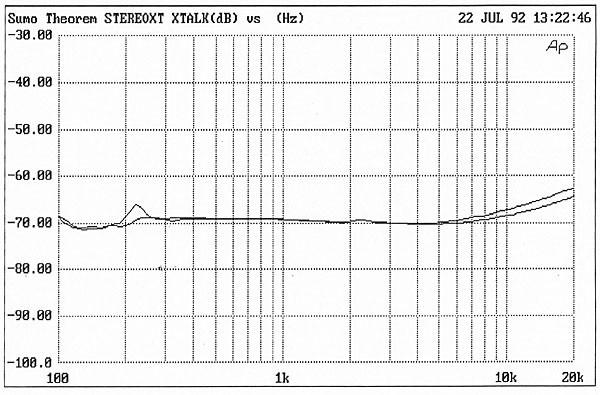
The unit's frequency response (fig.1) showed a moderate (0.3dB) rolloff at 20kHz. De-emphasis tracking (also shown in fig.1) was virtually perfect. Interchannel crosstalk, shown in fig.2, was difficult to measure; the true crosstalk didn't emerge from the noise floor until 5kHz and above, indicated by the flat, then gently rising curve.
 Low-level linearity (fig.5) was only fair, with a 2.5dB positive error (right channel) and a 1.7dB positive error (left) at –90dB. The channels are not that well matched, especially considering that both converters are within the same monolithic chip.
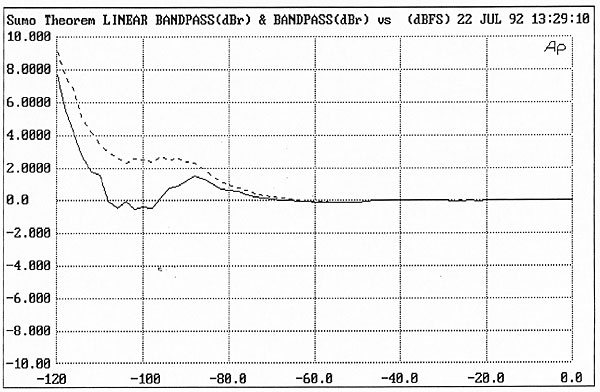
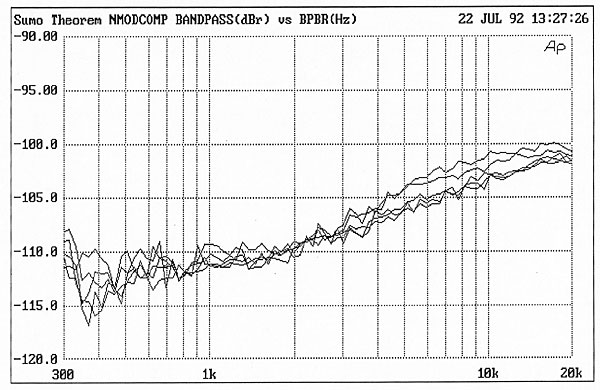
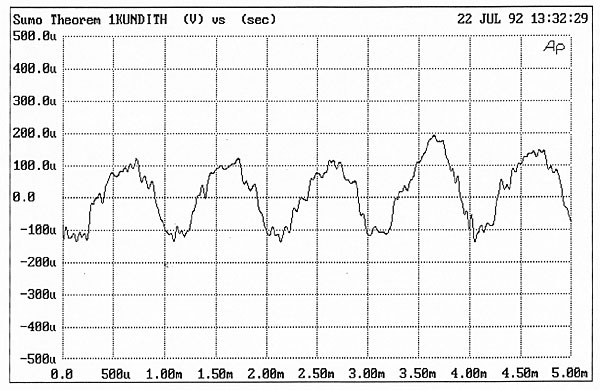
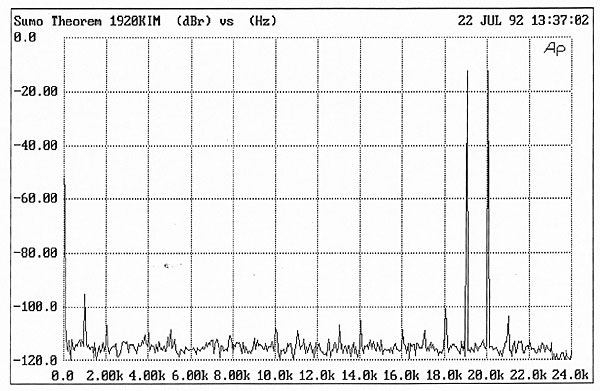
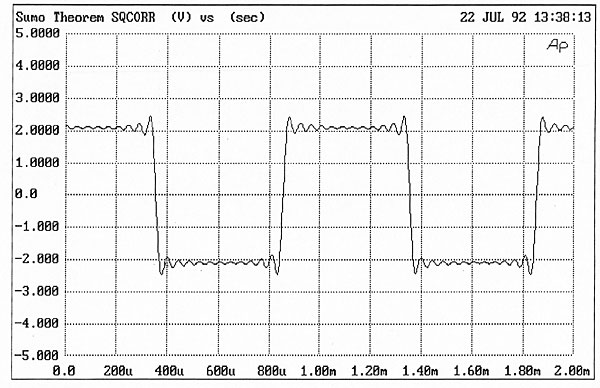
Fig.1 Sumo Theorem, CD frequency response at –12dBFS into 100k ohms, with de-emphasis (bottom) and without (top). (Right channel dashed, 0.5dB/vertical div.)
Fig.2 Sumo Theorem, channel separation (10dB/vertical div.).
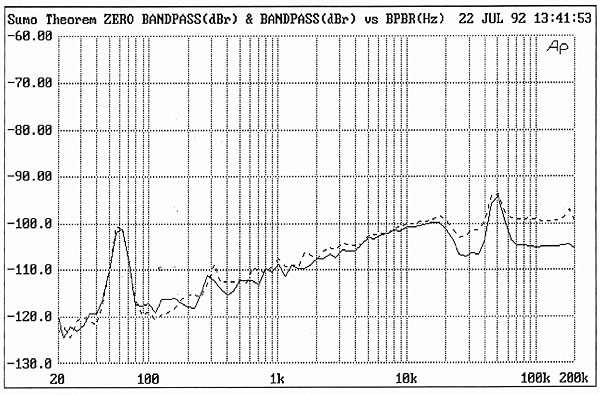
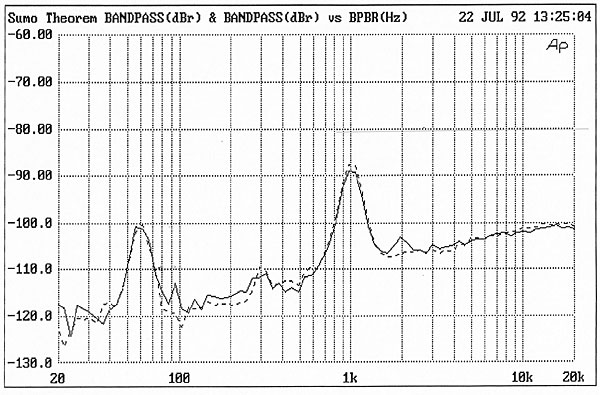
A spectral analysis of the Theorem's output when decoding digital silence is shown in fig.3. There is a a fairly high level of 60Hz power-supply noise and an unusual peak at 50kHz, either the result of the noise-shaping scheme in the Burr-Brown PCM67 hybrid DAC or due to an idle tone. Fig.4 is the same type of spectral analysis, but this time with the Theorem decoding a dithered 1kHz, –90dB sinewave. There is a small peak at 2kHz in the left channel not present when the Theorem decoded digital silence, suggesting it is a signal-related second-harmonic distortion. It is, however, very low in level.
Fig.3 Sumo Theorem, 1/3-octave spectrum of silent track, with noise and spuriae, 16-bit data (right channel dashed.)
Fig.4 Sumo Theorem, 1/3-octave spectrum of dithered 1kHz tone at –90dBFS, with noise and spuriae, 16-bit data (right channel dashed.)
Fig.5 Sumo Theorem, departure from linearity (right channel dashed, 2dB/vertical div.)
The noise-modulation plot (fig.6) reflects the Theorem's less than ideal low-level linearity. There is a fairly wide divergence in the traces, particularly above 3kHz. Moreover, the bandwidth of the change in the noise floor's spectral balance as a function of input level is wide, spanning two and a half octaves. Capturing the Theorem's reproduction of a 1kHz, –90dB undithered sinewave produced the waveform of fig.7. There seems to be a low level of audioband noise, and inexplicably, the fourth and fifth positive peaks in the plot are of higher amplitude. The low noise level is paradoxical: the Theorem had a subjectively higher noise level than the other converters, and the crosstalk measurement also seemed to indicate a high noise floor. The unusual shape of this waveform is perhaps idiosyncratic to the hybrid DAC used in the Theorem; this is the first processor I've measured to use this hybrid converter.
Fig.6 Sumo Theorem, waveform of undithered 1kHz sinewave at -90.31dBFS, 16-bit data.
Fig.7 Sumo Theorem, noise modulation, –60 to –100dBFS (5dB/vertical div.)
An FFT-derived spectral analysis of the Theorem's output when decoding a full-scale mix of 19kHz and 20kHz is shown in fig.8. The 1kHz difference component and sidebands around the test signals are well down in level, but there are a few low-amplitude spikes in the audioband. These spikes, however, are far fewer and lower in level than those seen in the Fort;ae DAC 50's intermodulation spectrum. Fig.9 is the Theorem's reproduction of a 1kHz, full-scale squarewave. It has slightly less overshoot and more ringing than the Fort;ae DAC 50, but is otherwise typical in shape.
Fig.8 Sumo Theorem, HF intermodulation spectrum, DC–30kHz, 19+20kHz at 0dBFS into 100k ohms (linear frequency scale).
Fig.9 Sumo Theorem, 1kHz squarewave at 0dBFS.
Finally, the Theorem doesn't invert absolute polarity, and I measured 200µV of DC offset (left channel) but a moderate 1.2mV offset at the right-channel output.
Compared with the other processors, the Theorem's bench performance was only mediocre. There was, however, nothing in the plots that would indicate the Theorem's musicality.—Robert Harley