Your little car gets in and out of traffic better than minivans or monster trucks. Your little dog runs rings around the other dogs at the park. Maybe it's time to get a couple of little loudspeakers, too?
The reasons for doing so are pretty much the same: little speakers deserve consideration not because they sell for little prices—although some of them do—but because they're nimble, they're fast, and they get out of the way of the music they play. That last characteristic can be crucial to listeners for whom stereo imaging is important: A small speaker has less cabinetry to diffract and delay high-frequency spatial information, and a small box is better than a large one at approximating an acoustically ideal point source. But a small enclosure also stores less energy than a large one, which itself translates into cleaner, clearer sound. Regarding the latter characteristic, and to paraphrase the 19th-century economist John Stuart Mill, while it is not true that all large speakers are dumb, it is unassailably true that most small speakers are smart.
Throughout their 70-year history, Sony Corporation has designed scores of little speakers, most of which have been at the budget ends of their product lines. Yet with their new SS-NA5ES ($6000/pair), Sony sets a loftier goal: to create a compact loudspeaker that's as well balanced and as reliably musical as their SS-NA2ES floorstander ($10,000/pair)—currently the top of Sony's ES line, and a product that has impressed me at two recent audio shows.
Description
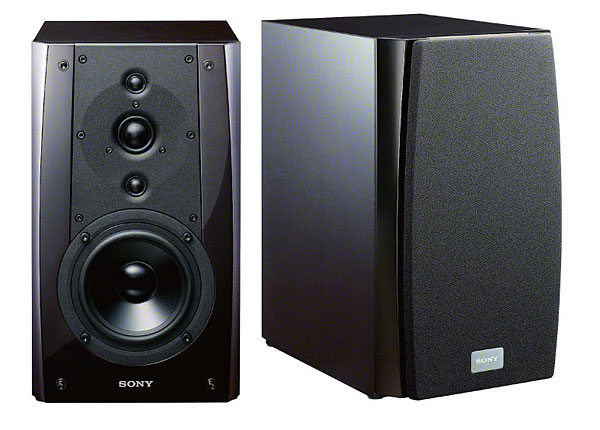
Small or large, the loudspeakers I consider most impressive are usually the work of a designer with a strong point of view—and such creatures aren't often found at large, multinational consumer-electronics companies. A notable exception is Sony's Yoshiyuki Kaku, designer of the SS-NA5ES and the SS-NA2ES. In a white paper that accompanied my review samples of the former, Kaku confirmed that, in designing the smaller speaker, he wasn't interested in impressing listeners with "lots of bass coming out of a tiny cabinet." Instead, he strives to "make the listener oblivious to highs and lows when listening to music, and instead, have the listener feel the music, as if it were being played right." I am, as the young people say, down with that. At first glance, the SS-NA5ES appears to be little more than the top third of an SS-NA2ES: as if someone approached the latter with a chain saw, measured 13.75" down from the top, and started cutting. There is slight justification for this point of view: As Kaku also writes, both the SS-NA2ES and Sony's flagship SS-AR1—a $27,000/pair floorstander he designed in 2010—are "effectively high-end bookshelf speakers seated on a high-quality subwoofer system." That said, deriving a well-balanced and musical—as opposed to merely analytical—bookshelf speaker from a floorstander requires as much cunning as cutting. Ultimately, Kaku adapted his earlier design in three distinct ways. The first and perhaps least immediately apparent change was to make the lowest portion of the SS-NA5ES's baffle narrower than the same point on the larger speaker's baffle. The second was to create for the smaller speaker a very different loading scheme: Whereas the SS-NA2ES has a single reflex port for its twin woofers, in addition to a separate, upper-cabinet vent intended to lower the effective resonant frequency of its midrange driver, the SS-NA5ES has twin reflex ports, the final positions of which were said by Kaku to be determined "through hundreds of design iterations and tests."
The third adaptation is also the most apparent: In place of the larger speaker's 5" spiral-cut paper midrange cone is an identically sized woofer cone of aluminum, anodized for greater rigidity. According to Kaku, this woofer is unique to the SS-NA5ES, with a distinctly different surround and spider—the latter is made from a special blend of wool and polyester, to lower the driver's resonant frequency—from those of other Sony drivers. Like all of the SS-NA5ES's drivers, this one is made to order in Denmark, by ScanSpeak.
Mated to that midbass driver is Sony's I-Array multiple-tweeter system, which first appeared in the SS-NA2ES: By supplementing a single 1" soft-dome tweeter with two 0.75" soft-dome tweeters, one above and one below, and giving all three the same operating bandwidth, Yoshiyuki Kaku was able to combine the wider dispersion of the smaller tweeters with the superior power handling of the larger, to maximize both soundstage size and smoothness of high-frequency response. (Remember that, as the radius of a circular driver approaches or exceeds a quarter of the wavelength of the tone being played, its dispersion of soundwaves becomes increasing beamy.)
The metal plate that forms the basis of the I-Array is finished in black textured paint and measures 4.5" wide by 7.5" at its tallest point (its bottom edge has a curved cutaway whose radius matches the outer edge of the midbass driver's frame). Each of the 0.75" tweeters is spaced 2" on-center from the single 1" tweeter, in a vertical array. As John Atkinson observed in his review of the SS-NA2ES in the September 2013 issue, in order to prevent the polar-response irregularities that might otherwise result from such an array, it was necessary for Kaku to place the motor of the larger tweeter slightly behind those of the smaller ones, relative to the listener; the solution was to manufacture the I-Array plate with a slight depression at its center. I checked this with a machinist's straightedge and noted a maximum deflection of less than 2mm.
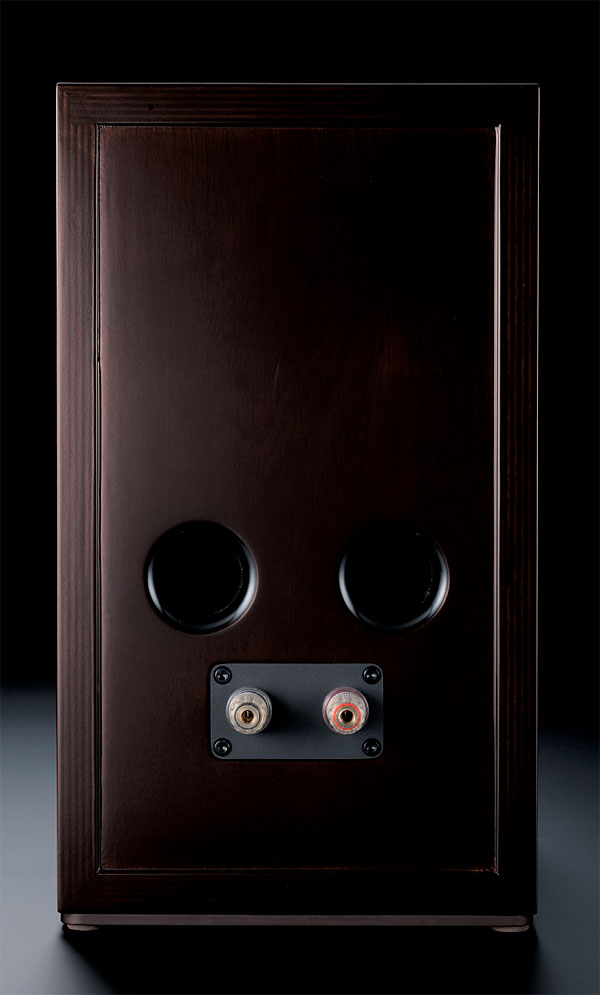 Also like the floorstanding SS-NA2ES, the enclosure of the SS-NA5ES—which measures 13.75" high by 7.9" wide by 11" deep—is made from Scandinavian birch ply, as are its internal braces. The side edges of the 1.2"-thick baffle are beveled, at an angle that's greater at the top and bottom of the baffle than in the middle, lending a sculpted appearance to the front of the enclosure; the side edges of the removable grilles, which I didn't use during my listening tests—leaving them off resulted in a more open sound—follow the shifting angle of that bevel. All surfaces are veneered, and given a semi-opaque finish that is dark brown in direct light but otherwise looks black: let's call it off-black. (Judging from what I could see of the grain, I would guess that the veneer is mahogany.) Overall, I admired the SS-NA5ES's appearance, even if its tweeter array, with those multiple dark domes of different size, reminded me of spider eyes.
Installation and Setup
Also like the floorstanding SS-NA2ES, the enclosure of the SS-NA5ES—which measures 13.75" high by 7.9" wide by 11" deep—is made from Scandinavian birch ply, as are its internal braces. The side edges of the 1.2"-thick baffle are beveled, at an angle that's greater at the top and bottom of the baffle than in the middle, lending a sculpted appearance to the front of the enclosure; the side edges of the removable grilles, which I didn't use during my listening tests—leaving them off resulted in a more open sound—follow the shifting angle of that bevel. All surfaces are veneered, and given a semi-opaque finish that is dark brown in direct light but otherwise looks black: let's call it off-black. (Judging from what I could see of the grain, I would guess that the veneer is mahogany.) Overall, I admired the SS-NA5ES's appearance, even if its tweeter array, with those multiple dark domes of different size, reminded me of spider eyes.
Installation and Setup
Like most bookshelf speakers, the Sony SS-NA5ES isn't really meant to be placed on a bookshelf, just as most sports jackets aren't made for sports and most cowboy boots aren't made for cowboys. These speakers like to be on stands, such as the model that was supplied to me by Sony for this review from TAOC. This is a single-column steel stand that holds the speaker 23" to 23.5" off the floor, depending on the adjustment of the base plate's four spiked feet. For shipping or storage, it can be easily disassembled by loosening a few well-fitted bolts. These stands are well made and pleasant to use; unfortunately, TAOC products don't appear to be distributed in the US at this time.
Small or large, the loudspeakers I consider most impressive are usually the work of a designer with a strong point of view—and such creatures aren't often found at large, multinational consumer-electronics companies. A notable exception is Sony's Yoshiyuki Kaku, designer of the SS-NA5ES and the SS-NA2ES. In a white paper that accompanied my review samples of the former, Kaku confirmed that, in designing the smaller speaker, he wasn't interested in impressing listeners with "lots of bass coming out of a tiny cabinet." Instead, he strives to "make the listener oblivious to highs and lows when listening to music, and instead, have the listener feel the music, as if it were being played right." I am, as the young people say, down with that. At first glance, the SS-NA5ES appears to be little more than the top third of an SS-NA2ES: as if someone approached the latter with a chain saw, measured 13.75" down from the top, and started cutting. There is slight justification for this point of view: As Kaku also writes, both the SS-NA2ES and Sony's flagship SS-AR1—a $27,000/pair floorstander he designed in 2010—are "effectively high-end bookshelf speakers seated on a high-quality subwoofer system." That said, deriving a well-balanced and musical—as opposed to merely analytical—bookshelf speaker from a floorstander requires as much cunning as cutting. Ultimately, Kaku adapted his earlier design in three distinct ways. The first and perhaps least immediately apparent change was to make the lowest portion of the SS-NA5ES's baffle narrower than the same point on the larger speaker's baffle. The second was to create for the smaller speaker a very different loading scheme: Whereas the SS-NA2ES has a single reflex port for its twin woofers, in addition to a separate, upper-cabinet vent intended to lower the effective resonant frequency of its midrange driver, the SS-NA5ES has twin reflex ports, the final positions of which were said by Kaku to be determined "through hundreds of design iterations and tests."
Also like the floorstanding SS-NA2ES, the enclosure of the SS-NA5ES—which measures 13.75" high by 7.9" wide by 11" deep—is made from Scandinavian birch ply, as are its internal braces. The side edges of the 1.2"-thick baffle are beveled, at an angle that's greater at the top and bottom of the baffle than in the middle, lending a sculpted appearance to the front of the enclosure; the side edges of the removable grilles, which I didn't use during my listening tests—leaving them off resulted in a more open sound—follow the shifting angle of that bevel. All surfaces are veneered, and given a semi-opaque finish that is dark brown in direct light but otherwise looks black: let's call it off-black. (Judging from what I could see of the grain, I would guess that the veneer is mahogany.) Overall, I admired the SS-NA5ES's appearance, even if its tweeter array, with those multiple dark domes of different size, reminded me of spider eyes.
Installation and SetupLike most bookshelf speakers, the Sony SS-NA5ES isn't really meant to be placed on a bookshelf, just as most sports jackets aren't made for sports and most cowboy boots aren't made for cowboys. These speakers like to be on stands, such as the model that was supplied to me by Sony for this review from TAOC. This is a single-column steel stand that holds the speaker 23" to 23.5" off the floor, depending on the adjustment of the base plate's four spiked feet. For shipping or storage, it can be easily disassembled by loosening a few well-fitted bolts. These stands are well made and pleasant to use; unfortunately, TAOC products don't appear to be distributed in the US at this time.