Sidebar 2: Measurements
I measured the Sentec EQ11 using my top-of-the-line Audio Precision SYS2722 system (see www.ap.com, and the January 2008 "As We See It."). With all settings of its front-panel knob, the EQ11 preserved absolute polarity (ie, was non-inverting). Its input impedance was 45k ohms at low and middle frequencies, dropping to 33k ohms at the top of the audioband. The treble and midrange output impedances were high, at 2k ohms, rising to 5k ohms in the low bass.
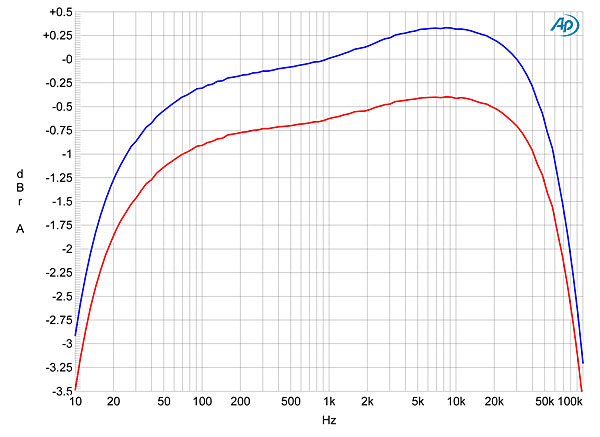
As well as RIAA phono equalization, labeled "RIAA, New Ortho" on the Sentec's front panel, the EQ11 offers five other EQ curves: "NARTB, NAB old," "78, Decca ffrr 78," "CCIR, Decca LP ffrr," "Columbia LP," and "AES, Philips, Capitol." The voltage gain at 1kHz varied slightly with the EQ chosen, from 29.5dB at the "NARTB" and "Columbia LP" settings to 30.6dB at the "78, Decca ffrr 78" and "CCIR, Decca LP ffrr" settings. The right-channel gain was between 0.5 and 1dB lower than the left, as can be seen in fig.1, which plots the Sentec's response with RIAA correction. The shapes of the two channels' responses closely match, and feature a small, +0.7dB plateau in the treble and the IEC low-frequency rolloff, which reaches –3dB at 10Hz.
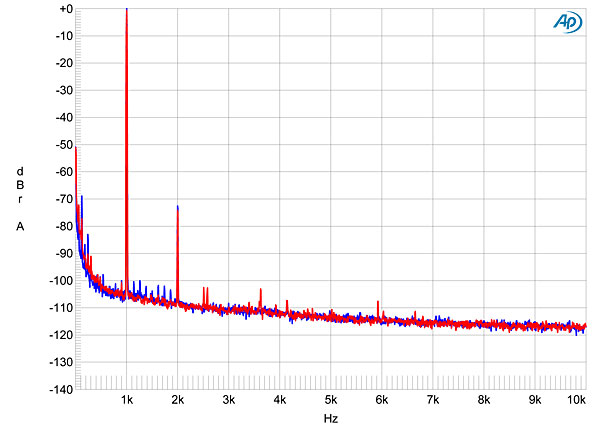
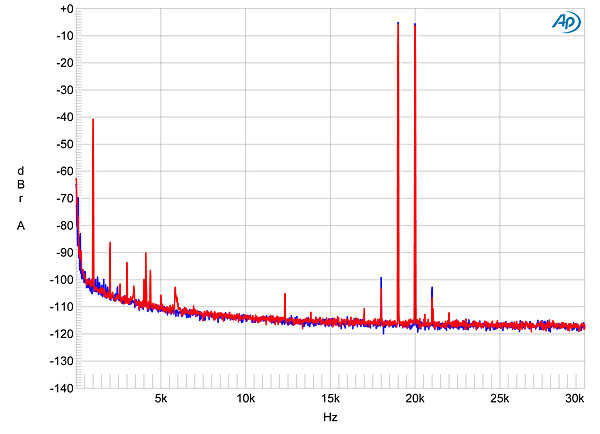
 Again related to the low gain, overload margins were excellent. With RIAA equalization, the THD+noise percentage in the EQ11's output didn't reach 1% until a 1kHz input signal reached 411mV, which is equivalent to a margin ref. 5mV of 38.3dB! The margin at 20Hz was the same, and even at 20kHz, it was still a high 24dB. Harmonic distortion was fairly low, and almost entirely second harmonic in nature (fig.4). Tested with an equal mix of 19 and 20kHz tones at a level equivalent to 1kHz at 5mV and with the EQ11 set to RIAA EQ (fig.5), the intermodulation distortion was higher than I was expecting from the EQ11's harmonic-distortion behavior, with the 1kHz difference product lying at –40dB (1%).
 Despite its modest appearance and wall-wart power supply, Sentec's EQ11 offers respectable measured performance to accompany its flexibility of equalization.—John Atkinson
Fig.1 Sentec EQ11, response with RIAA correction (left channel blue, right red) (0.25dB/vertical div.).
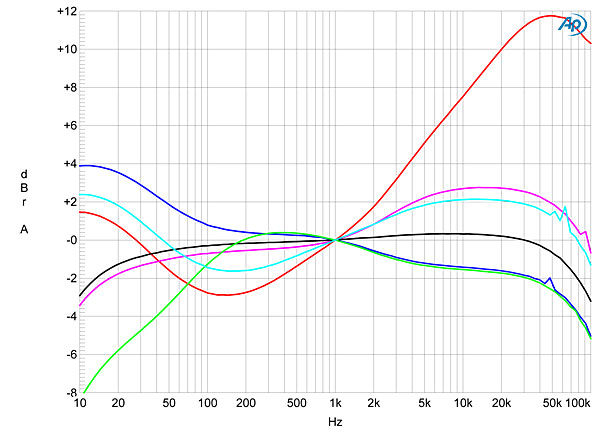
Fig.2 shows the response of the six EQ settings with an RIAA-equalized test signal. The green trace shows the effect of the "Columbia LP" setting compared with RIAA. Though the low frequencies roll off more quickly with Columbia than with RIAA, there is a slight boost in the midrange and a shelved-down treble that reaches –2dB at 20kHz. This change in tonal balance nicely correlates with what HR heard with his Dinu Lipatti LP.
Fig.2 Sentec EQ11, left-channel response with these corrections: NARTB, NAB old (blue); 78, Decca ffrr 78 (red); CCIR, Decca LP ffrr (magenta); RIAA, New Ortho (gray); Columbia LP (green); AES, Philips, Capitol (cyan) (2dB/vertical div.).
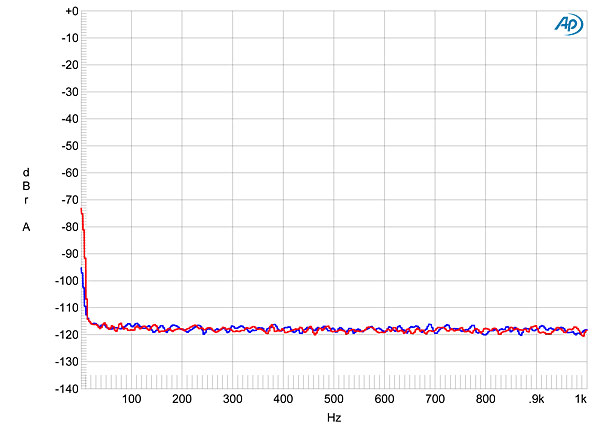
With its relatively low voltage gain, the Sentec EQ11 is a quiet preamp. Fig.3 shows the low-frequency spectrum of its background noise with the EQ11 set to RIAA: No AC-supply–related spuriae are visible, though a rise in the noise floor can be seen below 20Hz, due to what's called "flicker noise." The unweighted, wideband signal/noise ratio was affected by this noise, measuring 59.9dB ref. 1kHz at 5mV in both channels with the inputs shorted. When A-weighted, this ratio improved to 72.6dB.
Fig.3 Sentec EQ11, background noise spectrum, DC–10kHz, ref. 1kHz, 5mV input into 100k ohms (linear frequency scale).
Fig.4 Sentec EQ11, spectrum of 1kHz sinewave, DC–10kHz, at 318mV (10mV input) into 100k ohms (linear frequency scale).
Fig.5 Sentec EQ11, HF intermodulation spectrum, DC–30kHz, 19+20kHz at 318mV peak into 100k ohms (linear frequency scale; left channel blue, right red).