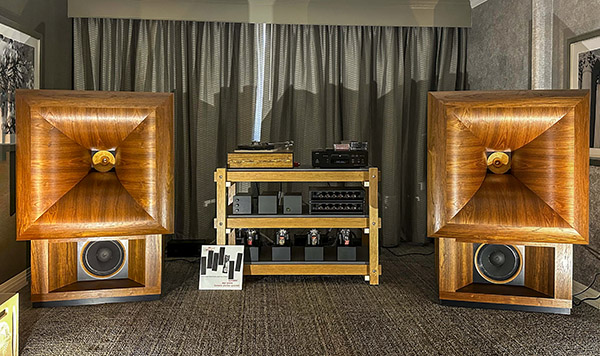
Show attendees entered John Semrad and Dave Slagle’s room and let out an involuntary gasp. The components on display epitomized bespoke, handmade craftsmanship, of the highest quality, with purity and provenance their bywords.
The setup included a Garrard 301 turntable in a Semrad bocate wood plinth with a Sorane TA1L tonearm ($1875) mounted with a Mutech Hayabusa MC cartridge (4500€).
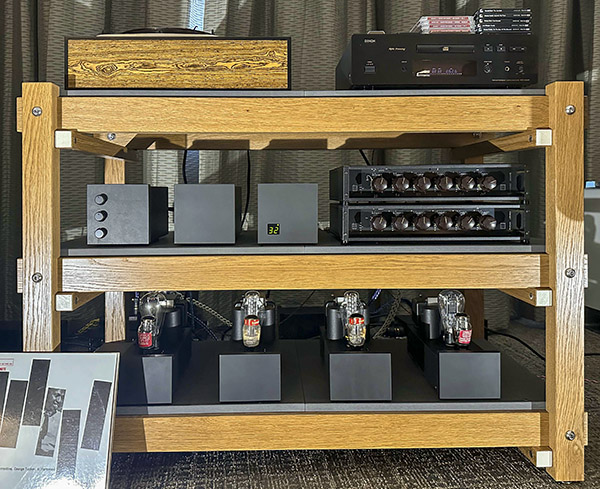 Slagle’s electronics included an EM/IA MC Trio SUT ($6000), and an EM/IA LR Phono Corrector phono stage ($33,750).
“The Trio SUT allows for up to three tonearms to be routed to any one of three different SUTs, each optimized for a desired cartridge,” Slagle explained over email. “For the Hayabusa, we used a silver-wound 80% nickel 1:40 optimized for low-impedance cartridges.”
“The LR Phono is direct-coupled and uses only inductors and resistors for the RIAA EQ,” he continued. “It also has an 80% nickel output transformer. It is not the typical LCR design since it omits the capacitor.”
An EM/IA Remote Autotransformer volume control ($7525), and EM/IA prototype tone controller (six-band EQ), fed a nickel autoformer DHT EM/IA line stage ($33,750) into an EM/IA Permalloy 50 300B SET amplifier ($40,625).
“The EQ is transformer-coupled with only inductors and transformer volume controls for the individual band level adjust. I hand-wind all the transformers with silver on 80% nickel cores; that has a major impact on the sound and isn’t, to my knowledge, done by anyone else.”
Slagle’s electronics included an EM/IA MC Trio SUT ($6000), and an EM/IA LR Phono Corrector phono stage ($33,750).
“The Trio SUT allows for up to three tonearms to be routed to any one of three different SUTs, each optimized for a desired cartridge,” Slagle explained over email. “For the Hayabusa, we used a silver-wound 80% nickel 1:40 optimized for low-impedance cartridges.”
“The LR Phono is direct-coupled and uses only inductors and resistors for the RIAA EQ,” he continued. “It also has an 80% nickel output transformer. It is not the typical LCR design since it omits the capacitor.”
An EM/IA Remote Autotransformer volume control ($7525), and EM/IA prototype tone controller (six-band EQ), fed a nickel autoformer DHT EM/IA line stage ($33,750) into an EM/IA Permalloy 50 300B SET amplifier ($40,625).
“The EQ is transformer-coupled with only inductors and transformer volume controls for the individual band level adjust. I hand-wind all the transformers with silver on 80% nickel cores; that has a major impact on the sound and isn’t, to my knowledge, done by anyone else.”
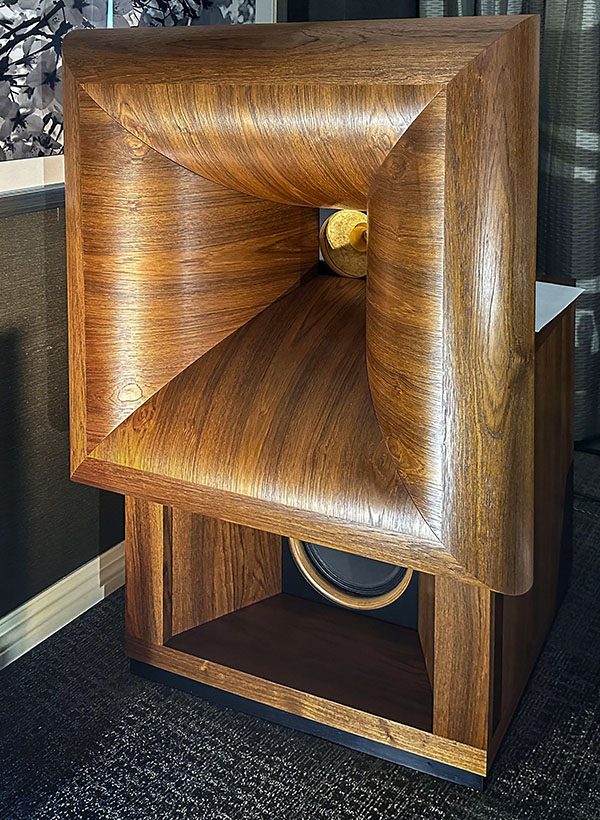 John Semrad’s curvaceous Large Format Horns [are available] in either light walnut or teak veneer with lacquer finish, field coil drivers. Each speaker contains a Super Aero 9 8” driver, solid basswood core, poplar cross ply, with a Great Plains Audio 414B Alnico bass driver, nominally a 12” driver.
As in CAF 2021 but now with the addition of Slagle’s electronics, the sound of Semrad’s rig was sublime. Playing Milt Jackson and John Coltrane’s early 60s Atlantic release, the system presented all the sinew, richness, and emotion of Trane’s tenor as grandly as I’ve ever heard. Horace Parlan’s “Oh So Blue” sounded wistful, pure, with utterly natural pacing, with exquisite tone and flow.
This is why we do what we do: to be awed, to be humbled, to be transported. It’s the promise of the extraordinary.
John Semrad’s curvaceous Large Format Horns [are available] in either light walnut or teak veneer with lacquer finish, field coil drivers. Each speaker contains a Super Aero 9 8” driver, solid basswood core, poplar cross ply, with a Great Plains Audio 414B Alnico bass driver, nominally a 12” driver.
As in CAF 2021 but now with the addition of Slagle’s electronics, the sound of Semrad’s rig was sublime. Playing Milt Jackson and John Coltrane’s early 60s Atlantic release, the system presented all the sinew, richness, and emotion of Trane’s tenor as grandly as I’ve ever heard. Horace Parlan’s “Oh So Blue” sounded wistful, pure, with utterly natural pacing, with exquisite tone and flow.
This is why we do what we do: to be awed, to be humbled, to be transported. It’s the promise of the extraordinary.
Slagle’s electronics included an EM/IA MC Trio SUT ($6000), and an EM/IA LR Phono Corrector phono stage ($33,750).
John Semrad’s curvaceous Large Format Horns [are available] in either light walnut or teak veneer with lacquer finish, field coil drivers. Each speaker contains a Super Aero 9 8” driver, solid basswood core, poplar cross ply, with a Great Plains Audio 414B Alnico bass driver, nominally a 12” driver.
As in CAF 2021 but now with the addition of Slagle’s electronics, the sound of Semrad’s rig was sublime. Playing Milt Jackson and John Coltrane’s early 60s Atlantic release, the system presented all the sinew, richness, and emotion of Trane’s tenor as grandly as I’ve ever heard. Horace Parlan’s “Oh So Blue” sounded wistful, pure, with utterly natural pacing, with exquisite tone and flow.