Like many aging American music lovers, my earliest memories include watching the televised supernova that was The Beatles performing on The Ed Sullivan Show in 1964.
Immersion in various British pop groups followed, including the melodically graceful Chad & Jeremy, the polished Peter and Gordon, and sentimental pop purveyors Gerry and the Pacemakers. These acts provided not mere entertainment but an emotional refuge. Their tuneful, comforting repertoire was solace for a sensitive 6-year-old.
Hours were devoted to listening to a transistor radio, held close enough for the metallic sound to be warm and engaging. In this private world, I was quite unconsciously securing the foundation of a personal musical canon, establishing the grounds of my musical sensibilities and future preferences.
My Anglophile obsession became part of a broader deep dive into all things British. In those British Invasion days, nothing was off limits and everything was up for grabs. Glossy photos and films of such British actors as Julie Christie and Rita Tushingham, and the Scottish belter Lulu. Hammer Horror films. British automobiles from MG, Jaguar, and Austin Healey. Curious foods like fish and chips, bangers and mash, rhubarb and custard. If it would get me closer to my Liverpudlian idols, I was all in.
My discovery of 1960s British culture quickly expanded beyond pop stars, exotic automobiles, and oddly named foods. An entire industry—British hi-fi—was waiting for my ears, including some brands I wouldn't fully appreciate for decades.
My British musical immersion intensified in the 1990s with the rise of drum and bass, trip-hop, techno, downtempo, and Britpop. I had the opportunity to interview giants of the era: Goldie, Squarepusher, Portishead, Aphex Twin, Oasis, Radiohead. My ritual upon landing at Heathrow was sacred: I'd make a beeline for the newsagents on Shaftesbury Avenue to stock up on Cuban cigars and the latest issues of Hi-Fi News, Hi-Fi Choice, and What Hi-Fi?. That paper-and-tobacco-fueled pilgrimage cemented my fascination with Brit-fi. That passion remains today, unabated.
When it comes to classic hi-fi, Great Britain is royalty. The roll call includes Quad, Rega, Spendor, ATC, Mission, Wilson Benesch, ProAc, Naim, B&W, Cambridge Audio, KEF, Wharfedale, and Linn. All those brands lead directly to the subject of this review: Ruark.
 Ruark arrives
Ruark was founded in 1985 by father Brian and son Alan O'Rourke. Alan O'Rourke remains the managing director of Ruark Acoustics, still a family-owned business. Sometime in the mid-2000s, this producer of amplifiers and speakers seemed to disappear from the face of the audio earth. "Ruark didn't disappear entirely; it shifted focus," Alan O'Rourke wrote in an email. "In 2006, the company stopped making passive loudspeakers and concentrated on products like premium radios and all-in-one music systems, starting with the original R1 released later that same year. This was due to market trends favouring AV and compact systems over traditional hi-fi. As a hi-fi and music enthusiast, AV was not a sector that appealed much to me or our team, but I always loved radio, so the decision was made to try a new avenue, which quickly proved popular, particularly in Ruark's home, UK market."
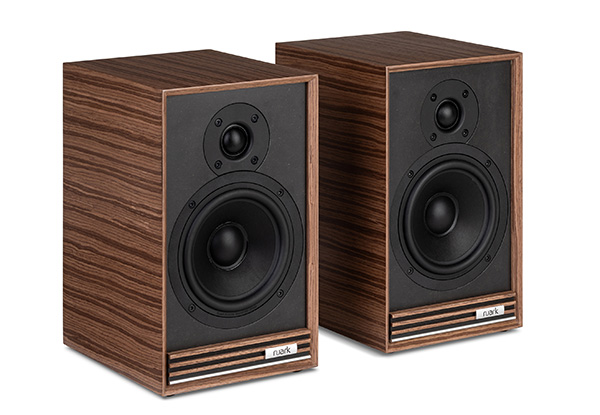
Ruark's return to passive speaker production in 2024 marked a significant moment, reaching back to the brand's origins. Ruark's very first speaker, the Sabre, was launched in 1986 and proved instrumental in establishing the company. Forty years after that initial success, the legacy continues with the new Sabre-R ($999/pair).
Introduced in May 2024 at High End Munich, the Sabre-R appeared at AXPONA 2025 as well. I reported then, "Ruark's room featured a full lineup, but it was the compact Sabre-R speakers ... that stood out—surprisingly powerful and musically engaging. Paired with the R610 streaming amp, the Sabre-R speakers delivered a bold, full-range sound that belied their price. Without a subwoofer, they handled everything from Daft Punk to Yello with weight, grip, and sparkle up top. Each recording retained its character, yet the presentation remained consistently compelling.
"The Sabre-R uses a damped, wood-composite cabinet," I continued in that post, "a 26mm silk-dome tweeter, and a 15cm treated natural-fiber woofer." Both drivers are produced by Ruark. Sensitivity is rated at 86dB/2.83V/m with a 6 ohm nominal impedance. The specified frequency response is 50Hz–20kHz. At showtime they cost $899/pair; I called them "competitively priced and seriously capable." Today they're a little more expensive at $999/pair, but that's still a fine value.
Ruark's operation, including R&D, is split between its 20-person headquarters in Southend-on-Sea, Essex, UK, a marketing crew in Ireland, and a 20-year manufacturing partnership with Taiwanese-owned Meiloon Industrial Co., of Dongguan, China, which produces Ruark's drivers and cabinets. Meiloon works with many audio brands including Elac, Fyne, Tannoy, and Canton.
 Handsome and tidy
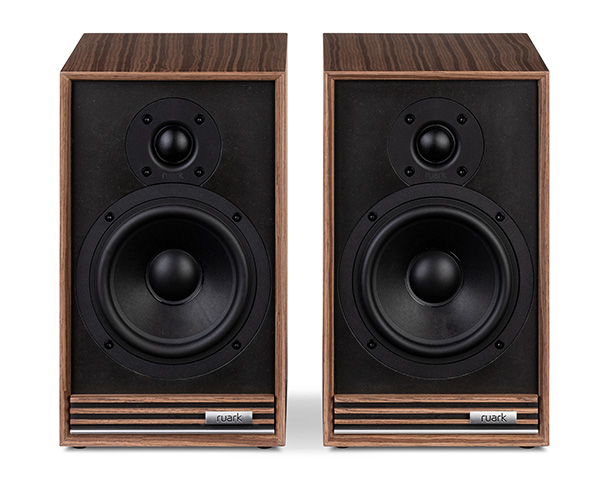
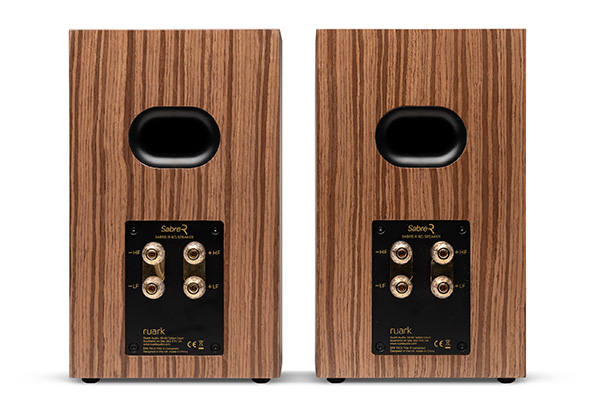
The Sabre-R is a small, bass-reflex speaker standing 11.4" high, 6.88" wide, and 8.46" deep. Each speaker weighs a scant 11lb. That 1" Ruark-made silk-dome tweeter has a neodymium-magnet–based motor system and an aluminum heatsink. The 5.9" Ruark-made midwoofer uses a natural fiber cone woofer, a 30mm, four-layer voice coil, and a long-throw motor with cast chassis. The Sabre-R's port is interesting. It's formed injection-molded plastic, oval shaped and flared at both ends. To maximize length, it extends inside the cabinet and curves up and around, almost reaching the inside of the back panel—roughly a "G" shape but inside out and backward. "Its diameter and tuning frequency"—53Hz—"meant that a straight port would be too long to fit inside the cabinet," O'Rourke wrote, "so it has a double curve and is flared at both ends to reduce turbulence, which creates unwanted noise at the tuning frequency, commonly known as chuffing."
This British tot's drivers cross over at 2.2kHz. As implied by the sensitivity specification mentioned above, its nominal impedance is 6 ohms, with a 4.2 ohm minimum. The speaker's veneer is functional; it gets the job done.
"The Sabre-R was designed to deliver a natural, musical, and engaging sound, with seamless integration between drivers and an aesthetic that matches Ruark's modern systems," Alan O'Rourke told me in an email. "The team at Ruark has always had a strong view on what good sound is and applies the same design principles to all their products.
"[We] aimed for clarity and musicality, with controlled and extended bass for the modest size of the speakers," O'Rourke continued. "Their tight bass response also makes them easily tuneable to most rooms by experimenting with the position of the speakers"—specifically the distance from the wall behind them. "We recommend 5–10" as a starting point, but closer or farther is fine, depending on the room acoustics and user taste."
The Ruark Audio website notes that the Sabre-R was "tuned and optimized." What does that mean? O'Rourke told me that in "the early stages of development, we use CAD to explore the responses we are looking to achieve. This involves experimenting with speaker, cabinet, and tuning parameters until we are near our desired goal. We then produce physical drivers and cabinets so we can hear, test, and experiment further. CAD allows us to do lots of 'what-if ' scenarios, but final tuning is always performed by ear until we reach our desired sound goal."
The original Sabre, from 1986, was also a bookshelf speaker, but it was quite different: substantially larger with a sealed-box—not ported—design. It was produced for 10 years through two versions. It was replaced by the Ruark Sceptre in 1996. A Mk3 Sabre was released in 2005, O'Rourke said. "In design terms, the Sabre-R is closest to the Mk3 with its more compact dimensions and bass-reflex design. Although well-reviewed in our home market, the Sabre Mk3 was only produced for a couple of years, as our radios and all-in-one systems quickly took us in a new direction."
The Sabre-R cabinet combines 15mm and 18mm MDF with offset, figure-eight bracing. The cabinets are lightly damped with acoustic wadding. "All items were carefully selected and optimized during development to provide a low-distortion housing for the speaker drivers," O'Rourke stated.
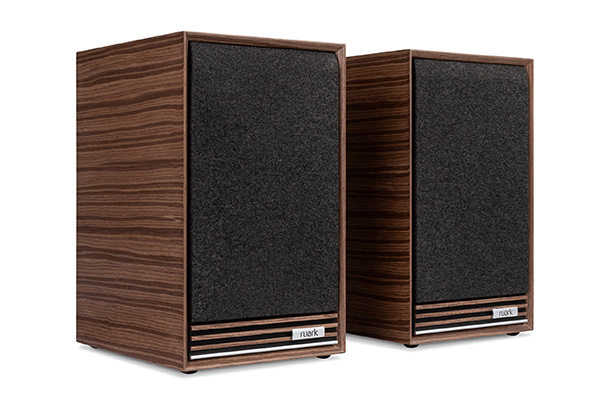 This is a basic speaker, but its cosmetics are somewhat refined. At the base of the baffle, four thin slats, three wood and one metal, span the width of the cabinet, adding, I thought, a distinctive touch, as did the cabinet's beveled edges, which allow the magnetized (and sonically necessary) grilles to snap into place with a satisfying zzzzp! Some of these cosmetic features are mirrored in the matching electronics including the R-CD100 CD player and the R610 music console, a combination streaming source and amplifier.
"Both the slats and the veneer that covers the Sabre-R are man-made and produced from sustainable plantations where natural timber is cut, spliced, and reconstituted," O'Rourke wrote. "The resulting grain patterns closely match slow-growing hardwoods but without the ecological impact."
The Sabre-R's treated-paper-cone midwoofer appears to have a rubber roll surround. O'Rourke likes paper cones for their "natural, smooth sound, fast energy absorption, and good damping characteristics, which can be further tailored with coatings."
The midwoofer employs a ferrite magnet and a four-layer, copper-coated aluminum voice coil. The four-layer coil reportedly provides a more rigid and stable assembly and increases power handling and linearity.
O'Rourke also prefers "the natural and realistic sound [of ] soft dome tweeters, such as silk. ... Hard dome tweeters may work in AV systems, but for music reproduction, we think soft is the only option."
The crossover in the Sabre-R is a second order, which, "combined with the natural rolloffs of the drivers, provides an 18dB/octave rolloff for each," O'Rourke stated. "The Sabre-R employs audio-grade polypropylene capacitors in the signal path, audio-grade electrolytics elsewhere. Chokes are all low resistance and air-cored, and resistors are ceramic. All components are tied, bonded, and soldered to a custom PCB with thick copper tracks."
Like the speaker's drivers, the Sabre-R's binding posts are custom made by Meiloon; internally, the Sabre-Rs are wired with multistrand oxygen-free copper cable. The Sabre-R is biwireable, surprising at this price.
Near wall? Front wall?
This is a basic speaker, but its cosmetics are somewhat refined. At the base of the baffle, four thin slats, three wood and one metal, span the width of the cabinet, adding, I thought, a distinctive touch, as did the cabinet's beveled edges, which allow the magnetized (and sonically necessary) grilles to snap into place with a satisfying zzzzp! Some of these cosmetic features are mirrored in the matching electronics including the R-CD100 CD player and the R610 music console, a combination streaming source and amplifier.
"Both the slats and the veneer that covers the Sabre-R are man-made and produced from sustainable plantations where natural timber is cut, spliced, and reconstituted," O'Rourke wrote. "The resulting grain patterns closely match slow-growing hardwoods but without the ecological impact."
The Sabre-R's treated-paper-cone midwoofer appears to have a rubber roll surround. O'Rourke likes paper cones for their "natural, smooth sound, fast energy absorption, and good damping characteristics, which can be further tailored with coatings."
The midwoofer employs a ferrite magnet and a four-layer, copper-coated aluminum voice coil. The four-layer coil reportedly provides a more rigid and stable assembly and increases power handling and linearity.
O'Rourke also prefers "the natural and realistic sound [of ] soft dome tweeters, such as silk. ... Hard dome tweeters may work in AV systems, but for music reproduction, we think soft is the only option."
The crossover in the Sabre-R is a second order, which, "combined with the natural rolloffs of the drivers, provides an 18dB/octave rolloff for each," O'Rourke stated. "The Sabre-R employs audio-grade polypropylene capacitors in the signal path, audio-grade electrolytics elsewhere. Chokes are all low resistance and air-cored, and resistors are ceramic. All components are tied, bonded, and soldered to a custom PCB with thick copper tracks."
Like the speaker's drivers, the Sabre-R's binding posts are custom made by Meiloon; internally, the Sabre-Rs are wired with multistrand oxygen-free copper cable. The Sabre-R is biwireable, surprising at this price.
Near wall? Front wall?
I started with the Sabre-Rs near the front wall, as recommended by the manual, on a pair of 26"-high wood stands I bought online years ago. The Sabre-R gave its richest, most bass-plentiful performance when positioned about 7" from the front wall, but bringing them a few inches farther out into the room was necessary to achieve sufficient treble clarity. It took much trial and error involving various cables and listening positions to find the sweet spot where they truly began to sing. Biwiring proved mandatory, unlocking a level of detail and openness that surpassed that of many floorstanders I've had in-house. Though I could've monkeyed around forever, final positioning found the Sabre-Rs 11" from the front wall, 57" apart, and 94" from my listening chair, a 1970s relic with a soiled oak frame and crusty leather cushions. Many speakers, especially larger ones, need space—distance—in order for the drivers to coalesce. Not so the Sabre-Rs: The closer I got to them, the better they sounded. I tried a few different speaker cables. I ended up with Gingko Audio Danacables attached to the lower binding posts and AudioQuest William Tells attached to the top pair, linking, variously, the Unison Research S6 Black Edition, AVM Evolution AS 5.3 Tube Hybrid (in for review), and Heed Elixir integrated amplifiers.
 London calling
A British loudspeaker demands British music. I brought to the party Procol Harum's Home (LP, A&M SP 4261), The Beatles' Magical Mystery Tour (LP, Hör Zu SHZE 327), Massive Attack's Mezzanine (CD, Virgin 7243 8 45599 2 2), Underworld's A Hundred Days Off (CD, V2 63881-27137-2), The Chemical Brothers' Singles 93-03 (CD, Virgin 724359314228), Boards of Canada's In a Beautiful Place Out in the Country (LP, Warp 144r), and Faces' A Nod Is As Good As a Wink ... (LP, Warner Bros. 2574). The German edition of Magical Mystery Tour (LP, Hör Zu SHZE 327) provided a series of surprises through the Sabre-R. On MMT, the Sabre-R's clean treble extracted brilliant detail from the mop tops' massed-harmony vocals and delivered energizing music within a soundstage that was large for such small speakers. Especially gobsmacking was Paul McCartney's bass in "Baby, You're a Rich Man"; the bass notes went so low, with such depth and power, that it could've easily been a larger speaker. I expected Macca's low bass plucks to disappear, but I heard the opposite: immense, subterranean, and weighty, if ill-defined. The large(ish) soundstage and substantial bass were the first ways the Sabre-R upended my expectations. Tracks from Procol Harum's Home and Faces' A Nod Is As Good As a Wink ... were appropriately crunchy and ragged—appropriate given their '70s pedigree—but the life force, energy, and chunk were pushed to the maximum. The Sabre-Rs convinced me that small speakers can deliver high-octane rock roughage.
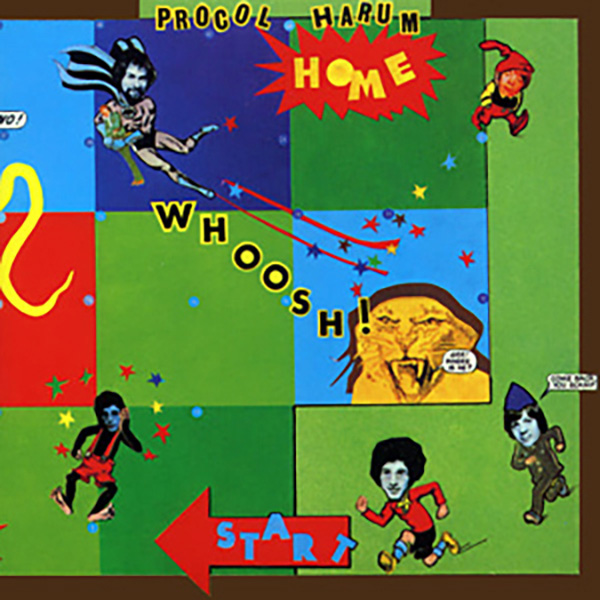 Driven by the Pear Audio turntable (in for review at AnalogPlanet.com) and Allnic and Unison Research amplification, these little Ruarks boogied hard. The pairing offered revelations: drummer B.J. Wilson's whip-crack–clean cowbell pattern, bassist Chris Copping's oily riffs, and guitarist Ron Wood's skronk-edged guitar all delivered heart-stopping jolts of pub-worthy kinetic thump. Bass continued to prove ample and party-riffic—consistently satisfying.
The dark, trawling-for-bodies mood of Boards of Canada's In a Beautiful Place ... reveled in the Ruarks' big soundstage. Throbbing and pulsing, this woozy electronic music was like a sonic enclosure, encasing me in cracking beat samples, mysterious vocal fragments, and oceanic bass. The Sabre-R delivered the album with succulent, dark, highly engaging tone. Although the stage was diffuse and the imaging confused, these very characteristics somehow enhanced and aided BOC's weird, spectral spell.
Moving on to the Underworld and Massive Attack CDs, the Ruark's characteristic crisp treble and big and warm bass continued, but music now bloomed into my listening space with larger intent. The CD's even more abundant bass turned chez Micallef into Greenwich Village party central. The fine detail and separation of vinyl was replaced with a sense of urgency and energy that the Ruarks ate for dinner, causing a riot in the streets. Almost.
Driven by the Pear Audio turntable (in for review at AnalogPlanet.com) and Allnic and Unison Research amplification, these little Ruarks boogied hard. The pairing offered revelations: drummer B.J. Wilson's whip-crack–clean cowbell pattern, bassist Chris Copping's oily riffs, and guitarist Ron Wood's skronk-edged guitar all delivered heart-stopping jolts of pub-worthy kinetic thump. Bass continued to prove ample and party-riffic—consistently satisfying.
The dark, trawling-for-bodies mood of Boards of Canada's In a Beautiful Place ... reveled in the Ruarks' big soundstage. Throbbing and pulsing, this woozy electronic music was like a sonic enclosure, encasing me in cracking beat samples, mysterious vocal fragments, and oceanic bass. The Sabre-R delivered the album with succulent, dark, highly engaging tone. Although the stage was diffuse and the imaging confused, these very characteristics somehow enhanced and aided BOC's weird, spectral spell.
Moving on to the Underworld and Massive Attack CDs, the Ruark's characteristic crisp treble and big and warm bass continued, but music now bloomed into my listening space with larger intent. The CD's even more abundant bass turned chez Micallef into Greenwich Village party central. The fine detail and separation of vinyl was replaced with a sense of urgency and energy that the Ruarks ate for dinner, causing a riot in the streets. Almost.
 Cueing up The Chemical Brothers' CD immediately showcased the Ruarks' raw capability, significantly expanding the sense of bass tonnage and soundstage size. The sheer energy of the music rattled the floor below and the roof above—a sonic assault that undoubtedly drew hateful beams from my shy French neighbor.
The Ruarks drove hard, rumbled mightily, and successfully fire-started the Chemicals' head-crushing, body-surfing, psychedelic dance music. While the soundstage remained diffuse with this recording, the speakers' ability to deliver unquestioned energy and dynamic bursts of sonic mayhem was the defining feature.
Heed Elixir
Cueing up The Chemical Brothers' CD immediately showcased the Ruarks' raw capability, significantly expanding the sense of bass tonnage and soundstage size. The sheer energy of the music rattled the floor below and the roof above—a sonic assault that undoubtedly drew hateful beams from my shy French neighbor.
The Ruarks drove hard, rumbled mightily, and successfully fire-started the Chemicals' head-crushing, body-surfing, psychedelic dance music. While the soundstage remained diffuse with this recording, the speakers' ability to deliver unquestioned energy and dynamic bursts of sonic mayhem was the defining feature.
Heed Elixir
I swapped out the Unison Research S6 Black Edition for the Heed Audio Elixir, at $2000 a more likely match for speakers that cost less than $1000/pair. I lost some sparkle, liquidity, and expansive depth. To optimize the soundstage and overall presentation, pulling the speakers a bit farther into the room improved the system's coherence.
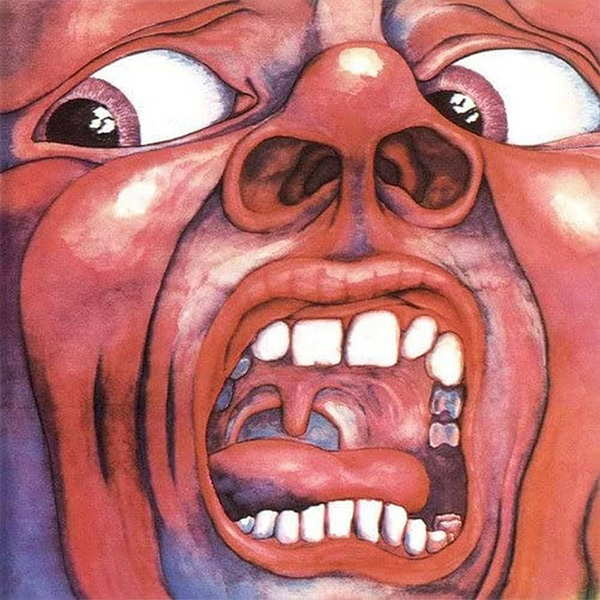
The next test track, from King Crimson's In the Court of the Crimson King (CD, DGM0501), was reproduced with a slight sonic veil, yet I still heard satisfying detail, pumping dynamics, and a generous soundstage.
 With the Heed, the Ruarks projected a stage size comparable to the Unison Research setup, but the stage was darker. This wasn't the best sound I heard, but it demonstrates a good thing about these speakers: They're good enough to communicate the character of source components and amplification without coloration or exaggeration.
The only small speaker I had available for comparison, the Quad S2 ($999/pair), lacked the Ruark's powerful bass. Its stage was more opaque, but subjectively, the treble was better.
Chuffed
With the Heed, the Ruarks projected a stage size comparable to the Unison Research setup, but the stage was darker. This wasn't the best sound I heard, but it demonstrates a good thing about these speakers: They're good enough to communicate the character of source components and amplification without coloration or exaggeration.
The only small speaker I had available for comparison, the Quad S2 ($999/pair), lacked the Ruark's powerful bass. Its stage was more opaque, but subjectively, the treble was better.
Chuffed
I was chuffed to bits, feeling wicked, and keen as mustard during my review period with the Ruark Sabre-R. Its strengths are many, including dramatic bass response and a fat soundstage, if not that deep. It played fast and lavish with the truth of vinyl and CDs, with surprising transparency to sources. It doesn't do imaging well, and its treble was occasionally hard, depending on source material. There are many opportunities in the $1000/pair-and-under standmount speaker category. The Ruarks should top your short list of auditions.
Ruark arrivesRuark was founded in 1985 by father Brian and son Alan O'Rourke. Alan O'Rourke remains the managing director of Ruark Acoustics, still a family-owned business. Sometime in the mid-2000s, this producer of amplifiers and speakers seemed to disappear from the face of the audio earth. "Ruark didn't disappear entirely; it shifted focus," Alan O'Rourke wrote in an email. "In 2006, the company stopped making passive loudspeakers and concentrated on products like premium radios and all-in-one music systems, starting with the original R1 released later that same year. This was due to market trends favouring AV and compact systems over traditional hi-fi. As a hi-fi and music enthusiast, AV was not a sector that appealed much to me or our team, but I always loved radio, so the decision was made to try a new avenue, which quickly proved popular, particularly in Ruark's home, UK market."
Handsome and tidyThe Sabre-R is a small, bass-reflex speaker standing 11.4" high, 6.88" wide, and 8.46" deep. Each speaker weighs a scant 11lb. That 1" Ruark-made silk-dome tweeter has a neodymium-magnet–based motor system and an aluminum heatsink. The 5.9" Ruark-made midwoofer uses a natural fiber cone woofer, a 30mm, four-layer voice coil, and a long-throw motor with cast chassis. The Sabre-R's port is interesting. It's formed injection-molded plastic, oval shaped and flared at both ends. To maximize length, it extends inside the cabinet and curves up and around, almost reaching the inside of the back panel—roughly a "G" shape but inside out and backward. "Its diameter and tuning frequency"—53Hz—"meant that a straight port would be too long to fit inside the cabinet," O'Rourke wrote, "so it has a double curve and is flared at both ends to reduce turbulence, which creates unwanted noise at the tuning frequency, commonly known as chuffing."
This is a basic speaker, but its cosmetics are somewhat refined. At the base of the baffle, four thin slats, three wood and one metal, span the width of the cabinet, adding, I thought, a distinctive touch, as did the cabinet's beveled edges, which allow the magnetized (and sonically necessary) grilles to snap into place with a satisfying zzzzp! Some of these cosmetic features are mirrored in the matching electronics including the R-CD100 CD player and the R610 music console, a combination streaming source and amplifier.
"Both the slats and the veneer that covers the Sabre-R are man-made and produced from sustainable plantations where natural timber is cut, spliced, and reconstituted," O'Rourke wrote. "The resulting grain patterns closely match slow-growing hardwoods but without the ecological impact."
The Sabre-R's treated-paper-cone midwoofer appears to have a rubber roll surround. O'Rourke likes paper cones for their "natural, smooth sound, fast energy absorption, and good damping characteristics, which can be further tailored with coatings."
I started with the Sabre-Rs near the front wall, as recommended by the manual, on a pair of 26"-high wood stands I bought online years ago. The Sabre-R gave its richest, most bass-plentiful performance when positioned about 7" from the front wall, but bringing them a few inches farther out into the room was necessary to achieve sufficient treble clarity. It took much trial and error involving various cables and listening positions to find the sweet spot where they truly began to sing. Biwiring proved mandatory, unlocking a level of detail and openness that surpassed that of many floorstanders I've had in-house. Though I could've monkeyed around forever, final positioning found the Sabre-Rs 11" from the front wall, 57" apart, and 94" from my listening chair, a 1970s relic with a soiled oak frame and crusty leather cushions. Many speakers, especially larger ones, need space—distance—in order for the drivers to coalesce. Not so the Sabre-Rs: The closer I got to them, the better they sounded. I tried a few different speaker cables. I ended up with Gingko Audio Danacables attached to the lower binding posts and AudioQuest William Tells attached to the top pair, linking, variously, the Unison Research S6 Black Edition, AVM Evolution AS 5.3 Tube Hybrid (in for review), and Heed Elixir integrated amplifiers.
London callingA British loudspeaker demands British music. I brought to the party Procol Harum's Home (LP, A&M SP 4261), The Beatles' Magical Mystery Tour (LP, Hör Zu SHZE 327), Massive Attack's Mezzanine (CD, Virgin 7243 8 45599 2 2), Underworld's A Hundred Days Off (CD, V2 63881-27137-2), The Chemical Brothers' Singles 93-03 (CD, Virgin 724359314228), Boards of Canada's In a Beautiful Place Out in the Country (LP, Warp 144r), and Faces' A Nod Is As Good As a Wink ... (LP, Warner Bros. 2574). The German edition of Magical Mystery Tour (LP, Hör Zu SHZE 327) provided a series of surprises through the Sabre-R. On MMT, the Sabre-R's clean treble extracted brilliant detail from the mop tops' massed-harmony vocals and delivered energizing music within a soundstage that was large for such small speakers. Especially gobsmacking was Paul McCartney's bass in "Baby, You're a Rich Man"; the bass notes went so low, with such depth and power, that it could've easily been a larger speaker. I expected Macca's low bass plucks to disappear, but I heard the opposite: immense, subterranean, and weighty, if ill-defined. The large(ish) soundstage and substantial bass were the first ways the Sabre-R upended my expectations. Tracks from Procol Harum's Home and Faces' A Nod Is As Good As a Wink ... were appropriately crunchy and ragged—appropriate given their '70s pedigree—but the life force, energy, and chunk were pushed to the maximum. The Sabre-Rs convinced me that small speakers can deliver high-octane rock roughage.
Driven by the Pear Audio turntable (in for review at AnalogPlanet.com) and Allnic and Unison Research amplification, these little Ruarks boogied hard. The pairing offered revelations: drummer B.J. Wilson's whip-crack–clean cowbell pattern, bassist Chris Copping's oily riffs, and guitarist Ron Wood's skronk-edged guitar all delivered heart-stopping jolts of pub-worthy kinetic thump. Bass continued to prove ample and party-riffic—consistently satisfying.
The dark, trawling-for-bodies mood of Boards of Canada's In a Beautiful Place ... reveled in the Ruarks' big soundstage. Throbbing and pulsing, this woozy electronic music was like a sonic enclosure, encasing me in cracking beat samples, mysterious vocal fragments, and oceanic bass. The Sabre-R delivered the album with succulent, dark, highly engaging tone. Although the stage was diffuse and the imaging confused, these very characteristics somehow enhanced and aided BOC's weird, spectral spell.
Moving on to the Underworld and Massive Attack CDs, the Ruark's characteristic crisp treble and big and warm bass continued, but music now bloomed into my listening space with larger intent. The CD's even more abundant bass turned chez Micallef into Greenwich Village party central. The fine detail and separation of vinyl was replaced with a sense of urgency and energy that the Ruarks ate for dinner, causing a riot in the streets. Almost.
Cueing up The Chemical Brothers' CD immediately showcased the Ruarks' raw capability, significantly expanding the sense of bass tonnage and soundstage size. The sheer energy of the music rattled the floor below and the roof above—a sonic assault that undoubtedly drew hateful beams from my shy French neighbor.
The Ruarks drove hard, rumbled mightily, and successfully fire-started the Chemicals' head-crushing, body-surfing, psychedelic dance music. While the soundstage remained diffuse with this recording, the speakers' ability to deliver unquestioned energy and dynamic bursts of sonic mayhem was the defining feature.
Heed ElixirI swapped out the Unison Research S6 Black Edition for the Heed Audio Elixir, at $2000 a more likely match for speakers that cost less than $1000/pair. I lost some sparkle, liquidity, and expansive depth. To optimize the soundstage and overall presentation, pulling the speakers a bit farther into the room improved the system's coherence.
With the Heed, the Ruarks projected a stage size comparable to the Unison Research setup, but the stage was darker. This wasn't the best sound I heard, but it demonstrates a good thing about these speakers: They're good enough to communicate the character of source components and amplification without coloration or exaggeration.
The only small speaker I had available for comparison, the Quad S2 ($999/pair), lacked the Ruark's powerful bass. Its stage was more opaque, but subjectively, the treble was better.
I was chuffed to bits, feeling wicked, and keen as mustard during my review period with the Ruark Sabre-R. Its strengths are many, including dramatic bass response and a fat soundstage, if not that deep. It played fast and lavish with the truth of vinyl and CDs, with surprising transparency to sources. It doesn't do imaging well, and its treble was occasionally hard, depending on source material. There are many opportunities in the $1000/pair-and-under standmount speaker category. The Ruarks should top your short list of auditions.