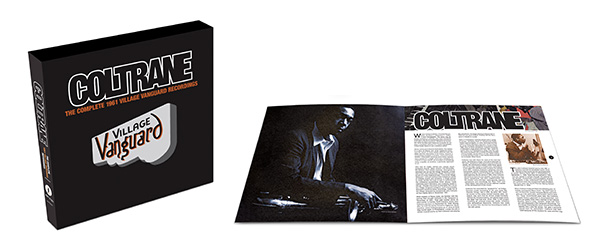
As I listened to the newly remastered edition of John Coltrane's Complete 1961 Village Vanguard Recordings, I read through some critics' takes, which make it apparent just how far critics tend to trail the musicians they cover, the great ones at least.
The most malicious response to this music came from DownBeat's John Tynan, who called the music, Eric Dolphy's solos in particular, "musical nonsense being peddled in the name of jazz" and "a horrifying demonstration of what appears to be a growing anti-jazz trend." Apparently, Tynan had overdosed on Mitch Miller or Dave Brubeck and his brain had turned to mush.
Sixty-five years later, what's most striking about the live Vanguard set isn't Coltrane's and Dolphy's harrowing, groundbreaking solos but the conventional rhythm-section approach by McCoy Tyner on piano, Elvin Jones on drums, and either Jimmy Garrison or Reggie Workman on bass. There's no free jazz shredding, no odd meters (à la Brubeck), no overwhelming Sunny Murray cacophony to match the frontline's blistering explorations. The rhythm section swings incredibly hard—its power approaches the profound—but compared to the cathartic solos of Coltrane and Dolphy, the rhythm section plays it cool. In that way, this live document bridges the stylistic worlds that lie between Coltrane's Impulse! releases such as Africa/Brass and Crescent with the more avant-garde and challenging Ascension and Expression.
Listening to this music through the lens of this fresh remastering, it also becomes clear that this is the groundwork for today's spiritual revelers including Idris Ackamoor, Isaiah Collier, and Zoh Amba.
This box set, pressed at RTI, documents nearly every note from the week of November 1, 1961. Featuring "analog tape restoration and lacquer remastering by Kevin Reeves at East Iris Studios, Nashville," the limited, seven-LP set includes a 20-page booklet with essays, photos, and curious illustrations. Rudy Van Gelder's live recording is outstanding, especially considering its date.
Taken together, the set is a study (or several studies) in meditation and release: spiraling vamps and blistering solos floating on dark, storm-filled clouds. Beauty abounds.
Live recordings capture an artist's evolution in ways commercial recordings—typically compromises between artistic vision and producer demands, between the demands of the music and the demands of the sound—cannot. Just a month after the Village Vanguard performances, Coltrane's quartet recorded Ballads; its shimmering, sultry moods make a stark contrast with the Vanguard's torrid explorations. Live marks the dividing line between Coltrane's past and future: a standard jazz quartet on the brink of galactic innovation. Africa/Brass, which was recorded during this period (almost exactly a year after Coltrane's Sound and Coltrane Plays the Blues), offered only a faint glimpse of the revolution ahead.
The Complete 1961 Village Vanguard Recordings captures the raw beauty, scorching intensity, and ruminative genius of Coltrane's quartet with Eric Dolphy. (Given Dolphy's early demise less than three years later, it poses a "what if?" of the most agonizing sort; footnote 1.) These performances implode standard jazz architecture then reassemble it to encompass not just bop's urban landscape but the cosmos. This is jazz reaching beyond the possible, demanding exploration of the universe.
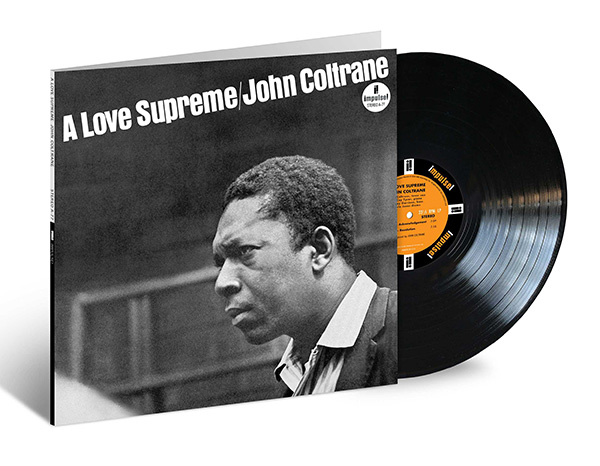 Some albums demand mono. Frank Sinatra's Come Fly with Me is one. Then there's Eddie "Lockjaw" Davis's Cookbook albums and Please Please Me by the Beatles. Mono's density, force, and focus fire the music forward like a pistol shot. But: A Love Supreme? Recorded in December 1964, A Love Supreme is often called Coltrane's masterwork. It's a suite of religious devotion performed by 'Trane's regular, historic quartet—McCoy Tyner, Jimmy Garrison, Elvin Jones—but the music transcends such sparse instrumentation. Turn it up and the scale feels orchestral—monumental.
That grandeur seems made for stereo's spatial detail and panoramic soundstage. The original recording (also made at Van Gelder's studio) was also in stereo; the album was released in 1965 in stereo and mono, but the mono was a fold down from stereo tapes.
The press release says that the album was mastered from original analog tapes by Ryan K. Smith at Sterling Sound, pressed at RTI, and "housed in a tip-on gatefold jacket." Which tapes? Smith would have used the same stereo master—a second-generation tape made by Van Gelder himself and sent to EMI in the UK—used for a stereo release earlier last year, folding it down during mastering just as Van Gelder did. In mono, each instrument is tangible, with clarity and impact. Of course there's no true soundstage, but there are layers: 'Trane out front, Tyner and Garrison slightly behind, Jones at the back of the stage. Dynamics are natural and engaging. This mono reissue doesn't deliver the bass punch and depth of original Impulse! or Prestige pressings, but it doesn't lack power or immediacy: 'Trane's galvanic tenor; Jones's sizzling drum solo. Tyner's playing is lovely and enormous all at once. The album has that affirming life force that to me is the essence of earlier mono pressings.
My UHQR 45rpm stereo version offers bigger images, more detail, and a soundstage, but in stereo, this music floats as much as it punches, more ethereal than visceral. The mono release hits head and body hard. The two versions offer different windows into one of jazz's enduring masterpieces. Buy them both.
Some albums demand mono. Frank Sinatra's Come Fly with Me is one. Then there's Eddie "Lockjaw" Davis's Cookbook albums and Please Please Me by the Beatles. Mono's density, force, and focus fire the music forward like a pistol shot. But: A Love Supreme? Recorded in December 1964, A Love Supreme is often called Coltrane's masterwork. It's a suite of religious devotion performed by 'Trane's regular, historic quartet—McCoy Tyner, Jimmy Garrison, Elvin Jones—but the music transcends such sparse instrumentation. Turn it up and the scale feels orchestral—monumental.
That grandeur seems made for stereo's spatial detail and panoramic soundstage. The original recording (also made at Van Gelder's studio) was also in stereo; the album was released in 1965 in stereo and mono, but the mono was a fold down from stereo tapes.
The press release says that the album was mastered from original analog tapes by Ryan K. Smith at Sterling Sound, pressed at RTI, and "housed in a tip-on gatefold jacket." Which tapes? Smith would have used the same stereo master—a second-generation tape made by Van Gelder himself and sent to EMI in the UK—used for a stereo release earlier last year, folding it down during mastering just as Van Gelder did. In mono, each instrument is tangible, with clarity and impact. Of course there's no true soundstage, but there are layers: 'Trane out front, Tyner and Garrison slightly behind, Jones at the back of the stage. Dynamics are natural and engaging. This mono reissue doesn't deliver the bass punch and depth of original Impulse! or Prestige pressings, but it doesn't lack power or immediacy: 'Trane's galvanic tenor; Jones's sizzling drum solo. Tyner's playing is lovely and enormous all at once. The album has that affirming life force that to me is the essence of earlier mono pressings.
My UHQR 45rpm stereo version offers bigger images, more detail, and a soundstage, but in stereo, this music floats as much as it punches, more ethereal than visceral. The mono release hits head and body hard. The two versions offer different windows into one of jazz's enduring masterpieces. Buy them both.
Footnote 1: Dolphy was on tour in Germany. He was diabetic and arrived at the hospital in a coma. German doctors assumed the cause was drugs; after all, he was black and a jazz musician. But Dolphy didn't use drugs. Could they have saved him? Who knows?
Some albums demand mono. Frank Sinatra's Come Fly with Me is one. Then there's Eddie "Lockjaw" Davis's Cookbook albums and Please Please Me by the Beatles. Mono's density, force, and focus fire the music forward like a pistol shot. But: A Love Supreme? Recorded in December 1964, A Love Supreme is often called Coltrane's masterwork. It's a suite of religious devotion performed by 'Trane's regular, historic quartet—McCoy Tyner, Jimmy Garrison, Elvin Jones—but the music transcends such sparse instrumentation. Turn it up and the scale feels orchestral—monumental.
Footnote 1: Dolphy was on tour in Germany. He was diabetic and arrived at the hospital in a coma. German doctors assumed the cause was drugs; after all, he was black and a jazz musician. But Dolphy didn't use drugs. Could they have saved him? Who knows?