As a music teacher, I can think of no better learning experience than what trumpeter Donald Byrd did in the early 1970s for a group of his music students. To quote the band's current website, "Byrd envisioned taking active students at Howard University in Washington, DC, on a real-world field trip which would expose them to ins and outs of the music business."
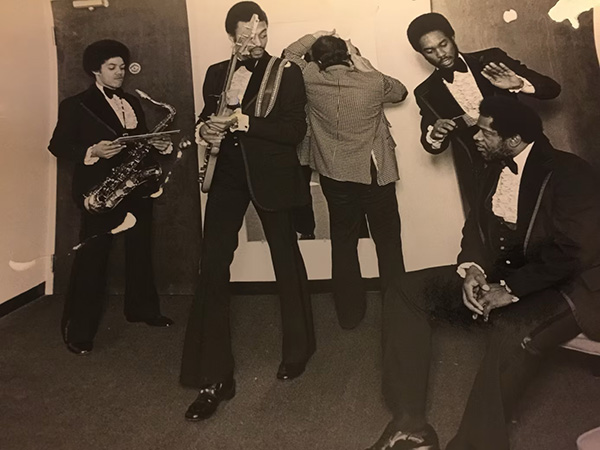
Leveraging his music-business connections and salting the adventure with his own compositions, Byrd set his students up as a funky musical act to, in his own words, "bridge the gap between academia and the real world." The experiment, with vocalist/drummer Keith Killgo, percussionist Pericles "Perk" Jacobs, saxophonist Allan Barnes, guitarist Barney Perry, keyboardist Kevin Toney, and bass guitarist Joe Hall, was an instant success, starting in 1974 with a pair of studio albums, The Blackbyrds and Flying Start. "Walking in Rhythm," from Flying Start, which was written by Perry, sold a million copies, hit #6 on the Billboard Hot 100, and was nominated for the Best Rhythm & Blues Song Grammy.
This considerable favor for his students aligned with the artistic direction in his own career. He'd started recording for Blue Note in the mid-1950s, left post-bop, and ventured into making some of the most influential soul jazz ever recorded. Even today, Byrd's soulful albums—Electric Byrd (1970), Ethiopian Knights (1972), Black Byrd (1973), Places and Spaces (1975), and Stepping into Tomorrow (1975)—are sneered at by jazz purists, but all are classics of the now-revered soul jazz subgenre.
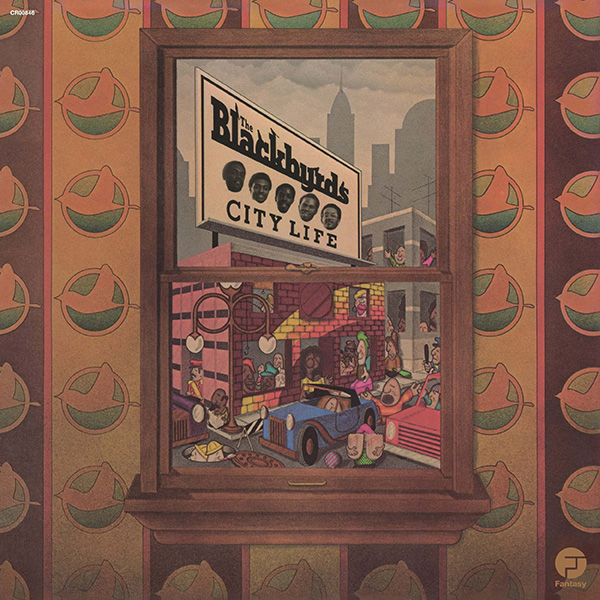
For four long players (including the soundtrack Cornbread, Earl and Me), Byrd's plan for his protegees worked out better than anyone dared hope. While their first album, The Blackbyrds—the one with the Van Gogh painting on the cover—is nearly as potent and together, the peak of the band's creative career is their fourth album, 1975's City Life, now remastered and reissued on 180gm vinyl in Craft Recordings' Jazz Dispensary Top Shelf series.
City Life's small advantage over the Blackbyrds debut comes down to two factors. The band had grown, adding guitarist Orville Saunders and saxophonist Stephen Johnson, but it's the guests on City Life (meriting a mere "very special thanks" in the album credits) who are so key to its sound. Gary Bartz and Ernie Watts add saxophone voices. Patrice Rushen adds keyboards. And the always impressive Merry Clayton adds her impassioned singing to the album's singles, "Rock Creek Park" and "Happy Music."
In addition, while Byrd earned a producer's credit, the producers of his own soul jazz albums, brothers Fonce and Larry Mizell, also Howard alums, had a hand in the presentation. They also wrote (and undoubtedly arranged) the album's closing funk workout, "Hash and Eggs."
In the 1970s, the Mizells became a hit-making production team for Motown, producing such hits as the Jackson 5's "ABC" and "I Want You Back" before moving on from Motown to produce A Taste of Honey's eponymous album and monster disco hit "Boogie Oogie Oogie" for Capitol in 1978.
 The other factor that makes City Life the Blackbyrds' most essential recording comes down to its hits. City Life opens with "Rock Creek Park," the most influential track of their career. Written by the band, this funky jam's carefree story gets right to the point: "Doing it in the park/Doing it after dark." Its rolling, musically infectious groove made it a hit on release and a big part of the reason the album hit #1 on Billboard's US jazz chart and #3 on Billboard's R&B chart. "Rock Creek Park" has subsequently become an essential sample, featuring in hip hop tracks by De La Soul, Massive Attack, Nas, Grandmaster Flash & the Furious Five, and Wiz Khalifa, among others. Title track "City Life" hit #4 on the US "Disco Singles" chart, which was based on club-deejay set lists.
The other hit here, "Happy Music," the only track on the album written by Byrd, is a preview of the disco-era sound that was just around the corner.
Beyond that lies some appealing variety. Kevin Toney's instrumental "All I Ask" has a harmonica that sounds like Stevie Wonder. And the guitar-led "Thankful 'Bout Yourself " mixes a driving rhythm with a soprano saxophone and early electronic keyboards.
Recorded at The Sound Factory by engineers Val Garay, Dave Hassinger, and Jim Nipar, City Life has been remastered by Kevin Gray at Cohearent Audio. To my ear, the remaster is always crisp, with above-average sonic detail. It has slightly better separation but could still use more low-end thump. The vinyl was pressed at RTI, and the tip-on jackets are glossy and impressively heavy. The streaming (hence digital) edition includes five bonus tracks, including a disco mix of "Happy Music," an extended 12" mix of "Rock Creek Park," and a previously unreleased long version of "All I Ask."
A scorching live set by Byrd and The Blackbyrds together, Cookin' with Blue Note at Montreux, was released on Blue Note Records in 2022. In 1978, Blackbyrd Barney Perry recorded a solo album, Night Life, under the nom de vinyl Blair. It became a favorite of deejays, and until a recent reissue was one of the most highly sought after and expensive disco albums on the used-vinyl market.
The Blackbyrds soldiered on after City Life, making four more albums, including a 2012 comeback attempt, Gotta Fly, which sounds very dated. They never recaptured the joy and funk, the near-perfect mix of polish and grit that is City Life.
The other factor that makes City Life the Blackbyrds' most essential recording comes down to its hits. City Life opens with "Rock Creek Park," the most influential track of their career. Written by the band, this funky jam's carefree story gets right to the point: "Doing it in the park/Doing it after dark." Its rolling, musically infectious groove made it a hit on release and a big part of the reason the album hit #1 on Billboard's US jazz chart and #3 on Billboard's R&B chart. "Rock Creek Park" has subsequently become an essential sample, featuring in hip hop tracks by De La Soul, Massive Attack, Nas, Grandmaster Flash & the Furious Five, and Wiz Khalifa, among others. Title track "City Life" hit #4 on the US "Disco Singles" chart, which was based on club-deejay set lists.
The other hit here, "Happy Music," the only track on the album written by Byrd, is a preview of the disco-era sound that was just around the corner.
Beyond that lies some appealing variety. Kevin Toney's instrumental "All I Ask" has a harmonica that sounds like Stevie Wonder. And the guitar-led "Thankful 'Bout Yourself " mixes a driving rhythm with a soprano saxophone and early electronic keyboards.
Recorded at The Sound Factory by engineers Val Garay, Dave Hassinger, and Jim Nipar, City Life has been remastered by Kevin Gray at Cohearent Audio. To my ear, the remaster is always crisp, with above-average sonic detail. It has slightly better separation but could still use more low-end thump. The vinyl was pressed at RTI, and the tip-on jackets are glossy and impressively heavy. The streaming (hence digital) edition includes five bonus tracks, including a disco mix of "Happy Music," an extended 12" mix of "Rock Creek Park," and a previously unreleased long version of "All I Ask."
A scorching live set by Byrd and The Blackbyrds together, Cookin' with Blue Note at Montreux, was released on Blue Note Records in 2022. In 1978, Blackbyrd Barney Perry recorded a solo album, Night Life, under the nom de vinyl Blair. It became a favorite of deejays, and until a recent reissue was one of the most highly sought after and expensive disco albums on the used-vinyl market.
The Blackbyrds soldiered on after City Life, making four more albums, including a 2012 comeback attempt, Gotta Fly, which sounds very dated. They never recaptured the joy and funk, the near-perfect mix of polish and grit that is City Life.
The other factor that makes City Life the Blackbyrds' most essential recording comes down to its hits. City Life opens with "Rock Creek Park," the most influential track of their career. Written by the band, this funky jam's carefree story gets right to the point: "Doing it in the park/Doing it after dark." Its rolling, musically infectious groove made it a hit on release and a big part of the reason the album hit #1 on Billboard's US jazz chart and #3 on Billboard's R&B chart. "Rock Creek Park" has subsequently become an essential sample, featuring in hip hop tracks by De La Soul, Massive Attack, Nas, Grandmaster Flash & the Furious Five, and Wiz Khalifa, among others. Title track "City Life" hit #4 on the US "Disco Singles" chart, which was based on club-deejay set lists.
The other hit here, "Happy Music," the only track on the album written by Byrd, is a preview of the disco-era sound that was just around the corner.