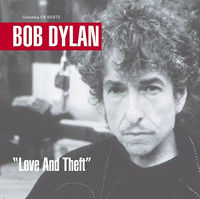
BOB DYLAN: "Love and Theft"
Columbia (85975) (CD). 2001. Jack Frost, prod.; Chris Shaw, engs. Jeremy Welch, asst. eng. AAD? TT: 57:35
Performance ****1/2
Sonics **** To say that Bob Dylan has been on a roll for the last four years has now officially become a gross understatement. Ever since the now-60-year-old music icon and producer Daniel Lanois managed to right yet another down period in his career with 1997's Time Out of Mind, easily his most coherent artistic statement since the Lanois-helmed Oh Mercy of 1989, the man has been unstoppable.
For proof, look no further than this new album. Instead of a complete makeover, or an unfortunate downshift like Under the Red Sky (the listless disaster that followed Oh Mercy), with "Love and Theft" Dylan sharpens the angles of what he began on Time Out of Mind: songwriting and singing strong enough to cast its nets far and wide over a variety of styles. Nearly every American roots music imaginable—from swing to blues to the kind of jacked-up electric rock'n'roll that got him in hot water at Newport years ago—here gets its due. Best of all, Dylan's stylistic adventurism this time comes off with more swagger than the careful stepping and open space that made Time so flavorful. Here, confidence is the fuel, and my, does it ever burn sweetly. The spark to this sizzle is the fact that, despite having been in the music business for 40 years, during which time he's waxed an impossible 43 albums, Dylan is again getting high from being on the road. In the four years since he pulled down a Grammy for Album of the Year with Time Out of Mind, he and the band heard here have played more than 450 concert dates. Not surprisingly, from the fade-in of the first track, "Tweedle Dee & Tweedle Dum," it's obvious that this act has been honed on the whetstone of live performance.
This ain't the first or even the 20th time these guys have been through these songs. Larry Campbell and Charlie Sexton are equally skilled on guitar, providing fit background acoustic support in the album's tenderest tune, "Po Boy," while also nailing rock fills with resourceful aim in its most upbeat rocker, "Honest With Me." Bassist Toni Garnier and drummer David Kemper are a supple, adaptable foundation. Like Time's, the sound of "Love and Theft" is raw and visceral, but reasonably well-recorded for a rock album. Ever the vain thespian fond of changing masks, Dylan currently sports a natty dusting of mustache. But that's about the biggest change here. And when it comes to singing a straight-ahead swing tune like "Summer Days," Dylan is all business: focused, determined, and seemingly having a lot of fun. In "Bye and Bye," even though he's "walking on briars" and isn't even "acquainted with his own desires," he can't help getting sentimental, almost goofy at points, as in the opening couplet: "Bye and Bye / I'm breathing a lover's sigh." The ever-present side of Dylan that loves being in love can still flash that ol' optimism. More sentimental yet is "Floater (Too Much to Ask)," a snappy number accented with fiddle and ukulele that wouldn't be out of place "down on the levee;';'; and "Moonlight," in which Dylan actually croons the word "levee."
When Dylan turns serious, as in "Mississippi," his ragged shred of a voice summons waves of wistfulness as he airs his doubts and punctures his own legend with more of a clear eye than any bitter recrimination: I was raised in the country
I've been working in the town
I've been in trouble ever since
I sat my suitcase down.Got nothing for ya
Had nothing before
Don't even have anything
For myself anymore
All my powers of expression
I thought so sublime
Could never do you justice
In reason or rhyme.
Reason and certainly rhyme have always been the guiding lights, good and bad, of Bob Dylan's career. Judging by the music and passion on "Love and Theft", both are now more focused, at least in terms of recent Dylan history, than they have been in a long time.—Robert Baird
Columbia (85975) (CD). 2001. Jack Frost, prod.; Chris Shaw, engs. Jeremy Welch, asst. eng. AAD? TT: 57:35
Performance ****1/2
Sonics **** To say that Bob Dylan has been on a roll for the last four years has now officially become a gross understatement. Ever since the now-60-year-old music icon and producer Daniel Lanois managed to right yet another down period in his career with 1997's Time Out of Mind, easily his most coherent artistic statement since the Lanois-helmed Oh Mercy of 1989, the man has been unstoppable.
 |  |
|
I've been working in the town
I've been in trouble ever since
I sat my suitcase down.Got nothing for ya
Had nothing before
Don't even have anything
For myself anymore
All my powers of expression
I thought so sublime
Could never do you justice
In reason or rhyme.