Sidebar 3: Measurements
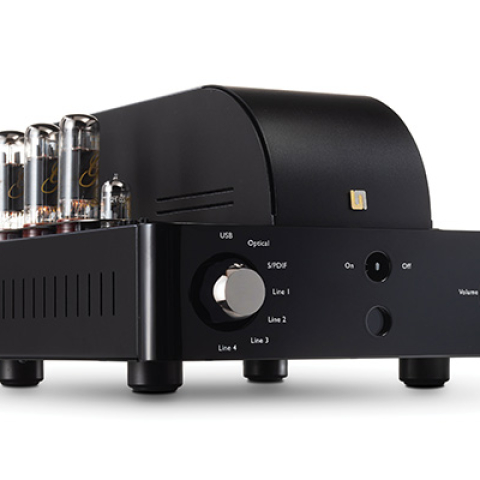
I performed a complete set of measurements on the PrimaLuna EVO 300 Hybrid with my Audio Precision SYS2722 system. I preconditioned the amplifier by following the CEA's recommendation of operating it at one-eighth the specified power into 8 ohms for 30 minutes before I started the testing. At the end of that time, the amplifier's side-mounted heatsinks were almost too hot to touch, at 135.1°F (57.3°C). The temperature of the top panel was 101.8°F (38.8°C). This amplifier needs plenty of ventilation.
The review sample wasn't fitted with the optional moving magnet phono stage.
The EVO 300 Hybrid preserved absolute polarity from all its outputs, loudspeaker, headphone, HomeTheater, and subwoofer. PrimaLuna specifies the EVO 300's single-ended input impedance as a usefully high 34k ohms; I measured 44k ohms at 20Hz and 1kHz and 38k ohms at 20kHz. The maximum voltage gain at 1kHz from the loudspeaker outputs into 8 ohms was negligibly higher than the specified 37.2dB, at 37.45dB. The maximum gain from the headphone output was 20.9dB. The maximum gain from the subwoofer output depended on whether this was set to Stereo or Mono. (Set to Mono, the output is only sent from the right-channel jack.) In Stereo mode, the gain was 0.7dB; in Mono mode, it was twice that, at 6.7dB, due to the fact that the two channels are now summed.
Channel separation was >70dB below 3kHz in both directions, decreasing to 50dB at the top of the audioband. The unweighted, wideband signal/noise ratio, taken with the single-ended inputs shorted to ground and the volume control set to the maximum, was a good 73.8dB ref. 1W into 8 ohms. This ratio improved slightly to 76.2dB, left channel, and 80.5dB, right, when the measurement bandwidth was restricted to 22Hz–22kHz. Inserting an A-weighting filter into the measurement circuit respectively increased these ratios to 80.0dB, left, and 82.6dB, right.
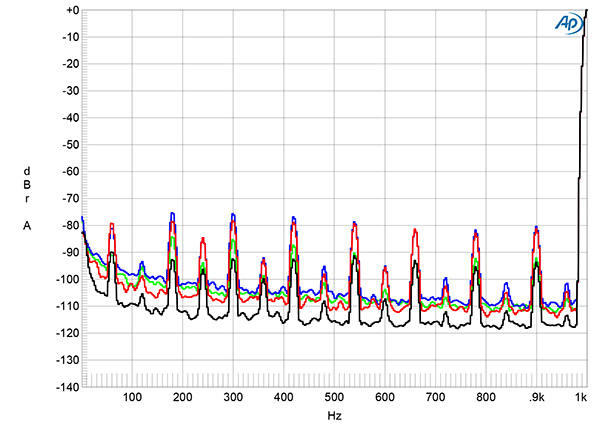
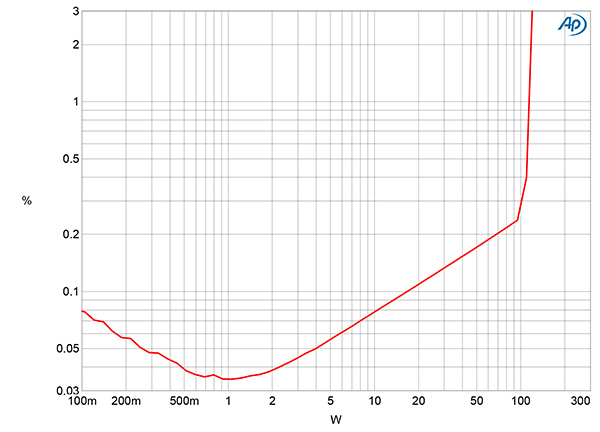
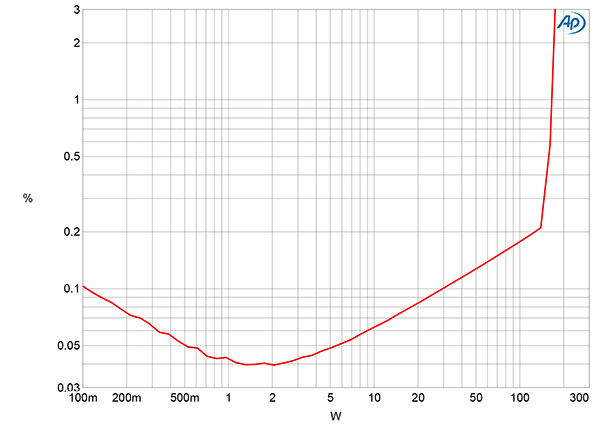
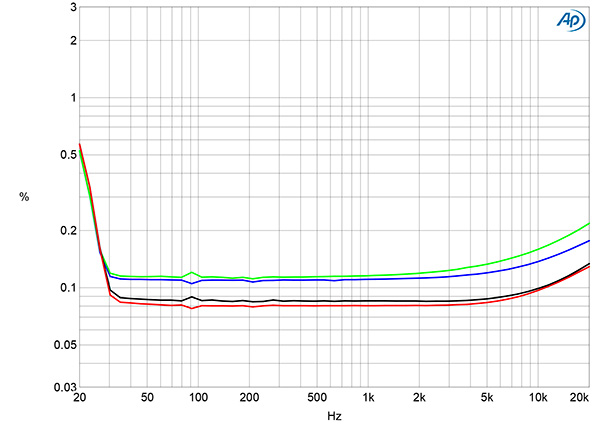
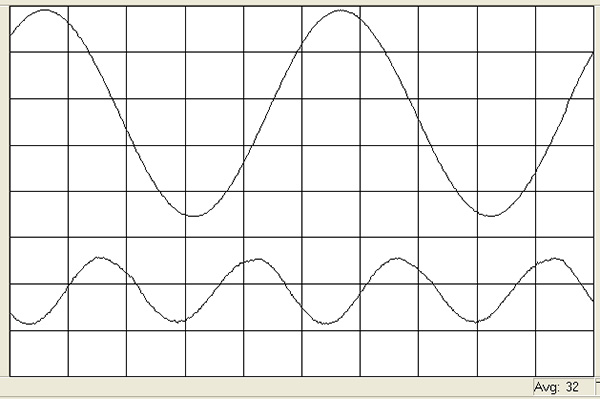
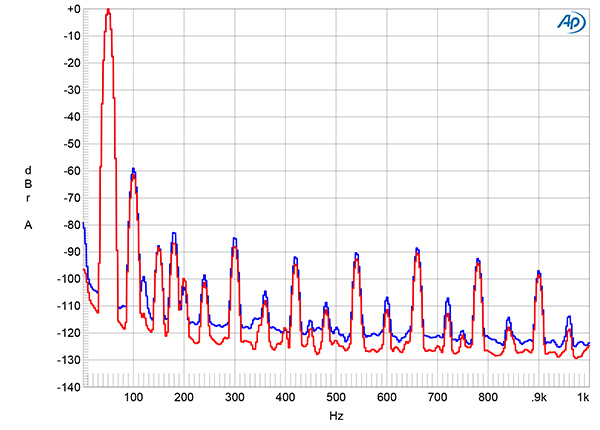
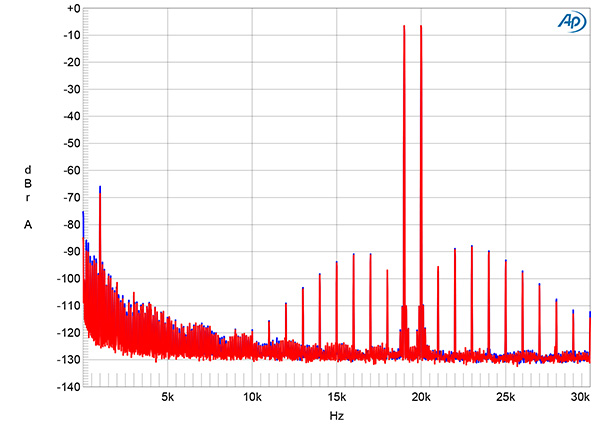
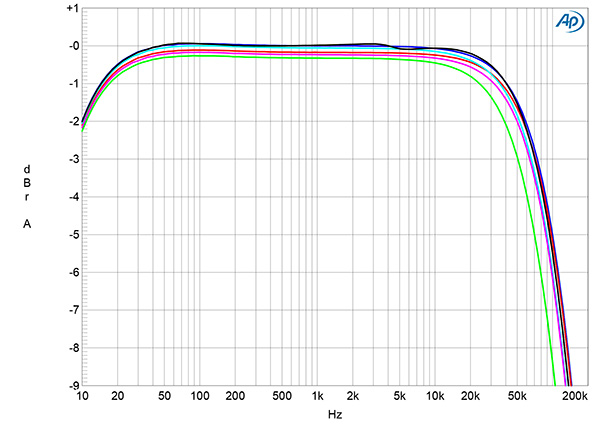
Fig.1 PrimaLuna EVO 300 Hybrid, frequency response at 2.83V into: simulated loudspeaker load (gray), 8 ohms (left channel blue, right red), 4 ohms (left cyan, right magenta), and 2 ohms (green) (1dB/vertical div.).
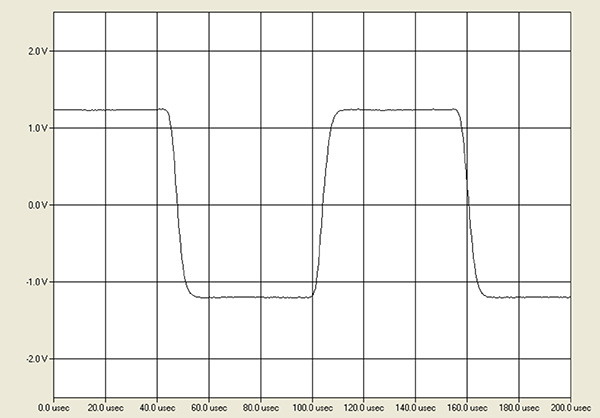
Fig.2 PrimaLuna EVO 300 Hybrid, small-signal 10kHz squarewave into 8 ohms.
The output impedance from the headphone jack was an appropriately low 5 ohms; that from the subwoofer output was 146 ohms. The loudspeaker output impedance was an extremely low 0.05 ohms at 20Hz and 1kHz, rising to 0.09 ohms at 20kHz. As a result, the variation in the frequency response with our standard simulated loudspeaker (fig.1, gray trace) was minimal. The response into 8 ohms (blue and red traces), 4 ohms (cyan, magenta), and 2 ohms (green trace) was flat from 30Hz to 20kHz, with the 8 ohm output down by 3dB at 75kHz. Fig.1 was taken with the volume control set to its maximum; the response and close channel matching were preserved at lower volume settings and from the headphone and subwoofer outputs. (An external crossover is required with the last.) A 10kHz squarewave (fig.2) was reproduced with short risetimes and no overshoot or ringing.
Fig.3 PrimaLuna EVO 300 Hybrid, spectrum of 1kHz sinewave, DC–1kHz, at 1Wpc into 8 ohms with volume control set to the maximum (left channel blue, right red) and to –12dB (left green, right gray) (linear frequency scale).
Spectral analysis of the low-frequency noisefloor while the PrimaLuna drove a 1kHz tone at 1Wpc into 8 ohms (fig.3) revealed power-supply–related spuriae at 60Hz and its odd-order harmonics, due to magnetic interference from the power transformers, perhaps being picked up by the steel pins of the tubes in the preamplifier circuit. The blue and red traces in this graph were taken with the volume control set to the maximum; reducing the volume by 12dB and increasing the input signal by the same 12dB so that the output was still 1W into 8 ohms dropped the levels of the supply-related spuriae by 12dB (green and gray traces) and those of the random noise components by around 8dB.
Fig.4 PrimaLuna EVO 300 Hybrid, distortion (%) vs 1kHz continuous output power into 8 ohms.
Fig.5 PrimaLuna EVO 300 Hybrid, distortion (%) vs 1kHz continuous output power into 4 ohms.
The PrimaLuna's maximum power into 8 ohms is specified as >100W (20dBW) and typically 115W (20.6dBW). Into 4 ohms, the specified power is >150W (18.75dBW) and typically 170W (19.3dBW). Stereophile defines an amplifier's clipping power as being when the THD+noise reaches 1%. With that criterion and with both channels driven, the EVO 300 clipped at 115Wpc into 8 ohms (fig.4) and 170Wpc into 4 ohms (fig.5). PrimaLuna states that the THD+N is 0.2% at 100W into 8 ohms; my measured percentage was very close to that figure, at 0.25%.
Fig.6 PrimaLuna EVO 300 Hybrid, THD+N (%) vs frequency at 12.67V into: 8 ohms (left channel blue, right red) and 4 ohms (left green, right gray).
The distortion in figs.4 and 5 is very low at low powers. I therefore examined how the THD+N percentage varied with frequency at 12.67V, equivalent to 20W into 8 ohms or 40W into 4 ohms. The THD+N was 0.11% into both loads over most of the audioband in the left channel (fig.6, blue and green traces) and 0.08% in the right channel (red, gray traces). The percentage rose slightly above 8kHz, but more so below 20Hz.
Fig.7 PrimaLuna EVO 300 Hybrid, 1kHz waveform at 20W into 8 ohms, 0.11% THD+N (top); distortion and noise waveform with fundamental notched out (bottom, not to scale).
Fig.8 PrimaLuna EVO 300 Hybrid, spectrum of 50Hz sinewave, DC–1kHz, at 40Wpc into 4 ohms (linear frequency scale).
Fig.9 PrimaLuna EVO 300 Hybrid, HF intermodulation spectrum, DC–30kHz, 19+20kHz at 40Wpc peak into 4 ohms (linear frequency scale).
With a 1kHz signal at 20Wpc into 8 ohms, the distortion waveform was predominantly the subjectively benign second harmonic at 0.11% (fig.7), with the third harmonic almost 30dB lower in level, even into 4 ohms (fig.8). With an equal mix of 19 and 20kHz tones at the same peak power into 4 ohms (fig.9), the second-order difference product at 1kHz lay close to –66dB (0.05%). The higher-order intermodulation products all lay at or below –90dB (0.003%).
The PrimaLuna EVO 300 Hybrid's measured performance is very good overall, with only that distortion signature hinting at "tube sound."—John Atkinson