 The previous evening, as part of an East Coast tour of small to medium-sized theaters, Summers had put on more of a multimedia show than a straight-on concert. Aside from solo instrumentals, including versions of "Roxanne" and "Message in a Bottle," the performance was augmented with some of the excellent photographs he's been taking since he bought his first film camera in New York in 1979. He'd also told stories from his life during and after the Police. A rock raconteur who combines depth and humor, Summers is the author of One Train Later, one of the best music-industry memoirs I've read. It's full of honest self-reflection, well-crafted in terms of style and narrative flow. He doesn't spare his former bandmates (not that there's anything shocking about learning that Sting has a big ego), but the picture that emerges is one of dual emotions: gratitude and wistfulness. Here's the final passage, about how Summers felt after Sting disbanded the Police in agonizing slow motion (footnote 4).
"The experience of having been in the Police and achieving that kind of success was not easily discarded, because it was replete with intensity, striving, and the endless struggle in public to be the best that you can possibly be. An adventure like that—if remaining unresolved—sticks inside you like a stone in the throat. Despite my being able to move forward in a very happy way with my family and career, the memory of the group still felt like an open wound, something that would take years to heal, if ever. For a long time I dreamed about the band as if somehow trying to rebuild it, or reclaim something stolen, or make it whole again. Somewhere on the subconscious level there was need for a closure maybe impossible to obtain, and the only alternative was to live with it, do other work, and hope that maybe in time the wound would heal.
"The problem with the demise of our group is that we didn't play out all our potential; we were not washed up, finished, or on a downward spiral. ...
The previous evening, as part of an East Coast tour of small to medium-sized theaters, Summers had put on more of a multimedia show than a straight-on concert. Aside from solo instrumentals, including versions of "Roxanne" and "Message in a Bottle," the performance was augmented with some of the excellent photographs he's been taking since he bought his first film camera in New York in 1979. He'd also told stories from his life during and after the Police. A rock raconteur who combines depth and humor, Summers is the author of One Train Later, one of the best music-industry memoirs I've read. It's full of honest self-reflection, well-crafted in terms of style and narrative flow. He doesn't spare his former bandmates (not that there's anything shocking about learning that Sting has a big ego), but the picture that emerges is one of dual emotions: gratitude and wistfulness. Here's the final passage, about how Summers felt after Sting disbanded the Police in agonizing slow motion (footnote 4).
"The experience of having been in the Police and achieving that kind of success was not easily discarded, because it was replete with intensity, striving, and the endless struggle in public to be the best that you can possibly be. An adventure like that—if remaining unresolved—sticks inside you like a stone in the throat. Despite my being able to move forward in a very happy way with my family and career, the memory of the group still felt like an open wound, something that would take years to heal, if ever. For a long time I dreamed about the band as if somehow trying to rebuild it, or reclaim something stolen, or make it whole again. Somewhere on the subconscious level there was need for a closure maybe impossible to obtain, and the only alternative was to live with it, do other work, and hope that maybe in time the wound would heal.
"The problem with the demise of our group is that we didn't play out all our potential; we were not washed up, finished, or on a downward spiral. ...
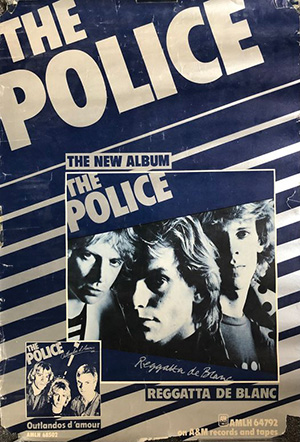 Inevitably, the Police is part of his musical DNA. It's a legacy he neither obsessively clings to nor renounces. After this brief solo tour, he says, he's off to South America to play two dozen shows in nine different countries with Call the Police, a trio he formed with two Brazilian colleagues (drummer João Barone of the popular reggae and rock band Os Paralamas do Sucesso, and singer/bassist Rodrigo Santos, formerly of Barão Vermelho). Though the repertoire is pretty much all Police all the time, Summers demurs when anyone calls it a cover band. "I'm the original, so 'cover band' sounds a bit silly," he says. "You could say I'm there to authenticate the group." He's excited that he'll play in El Salvador for the first time, at the end of the tour. Besides, he grins, that should make the flight home to Los Angeles relatively quick.
That's no typo: Andy Summers is 82. Nine years older than Sting, 12 years older than Stewart Copeland. It never looked that way during the band's heyday, when the three of them appeared to be contemporaries. Since then, Summers has somehow kept cheating time. He could easily pass for 20 years younger. His tousled hair is full, his gait without frailty, his creative flame undiminished. I had to remind myself that he was born in the same year as Jimi Hendrix, Wilson Pickett, and Charlie Watts. That means he's old enough to have played in a '50s skiffle group (the Midnighters) as well as a groovy '60s psychedelic band (Dantalian's Chariot).
 I ask him what kind of music he loves these days. Anything from the last decade or two? Several of Billie Eilish's songs impress him, Summers says. "Her music is interesting, and now she's finally stepped up to stardom, going from this mousy girl in a bedroom to ... you know, it's like the butterfly emerged from the chrysalis." He also fondly mentions Julian Lage, a 30-something Californian jazz guitarist. "Great tone and technique. I would love to do something together."
Summers listens to a lot of music on the ECM label, he says. "There's an oud player on ECM who is amazing, this guy called ..." He blanks on the name. Anouar Brahem, I offer. "Exactly," he says, smiling. "I have at least six of his albums. A lot of the music on ECM has been huge for me. I almost got on that label myself, but it's led by a very strange man."
He means label boss and producer Manfred Eicher, with whom he had a minor kerfuffle eight or nine years ago. "I recorded a beautiful album called Triboluminescence, and I recorded it right, with all the necessary care and musicianship. Someone I knew contacted Eicher and said, 'Wouldn't you like to put out this record by Andy?' And Eicher was interested, but he essentially said, 'You must come and record it again.' My feeling was, 'Fuck off, it's already done.' He felt he had to be in charge—could be a very German thing I suppose. I don't make records with someone like that. But I would've felt at home there, I think. ECM has super musicians like [Norwegian saxophonist] Jan Garbarek, so I thought, that's where I belong. But it didn't come to pass, and I'm not crying in my milk about it."
I ask him what kind of music he loves these days. Anything from the last decade or two? Several of Billie Eilish's songs impress him, Summers says. "Her music is interesting, and now she's finally stepped up to stardom, going from this mousy girl in a bedroom to ... you know, it's like the butterfly emerged from the chrysalis." He also fondly mentions Julian Lage, a 30-something Californian jazz guitarist. "Great tone and technique. I would love to do something together."
Summers listens to a lot of music on the ECM label, he says. "There's an oud player on ECM who is amazing, this guy called ..." He blanks on the name. Anouar Brahem, I offer. "Exactly," he says, smiling. "I have at least six of his albums. A lot of the music on ECM has been huge for me. I almost got on that label myself, but it's led by a very strange man."
He means label boss and producer Manfred Eicher, with whom he had a minor kerfuffle eight or nine years ago. "I recorded a beautiful album called Triboluminescence, and I recorded it right, with all the necessary care and musicianship. Someone I knew contacted Eicher and said, 'Wouldn't you like to put out this record by Andy?' And Eicher was interested, but he essentially said, 'You must come and record it again.' My feeling was, 'Fuck off, it's already done.' He felt he had to be in charge—could be a very German thing I suppose. I don't make records with someone like that. But I would've felt at home there, I think. ECM has super musicians like [Norwegian saxophonist] Jan Garbarek, so I thought, that's where I belong. But it didn't come to pass, and I'm not crying in my milk about it."
Footnote 4: After the Police's August 1983 Shea Stadium concert, Sting felt that the group had reached "Everest," and soon started working on his first solo album. Only in the summer of 1986 did the split become official—when Copeland broke his collarbone right before what would have been the group's last attempt to record a new album, and after it became clear that Sting had no intention of writing more songs for the Police.