Sidebar 3: Measurements
I used DRA Labs' MLSSA system, a calibrated DPA 4006 microphone, and an Earthworks microphone preamplifier to measure the quasi-anechoic frequency- and time-domain behavior of one of the McIntosh ML1 Mk IIs—serial number BBB1256—in the farfield. The manual doesn't mention the preferred listening axis. However, although the tweeter is a low 31.75" from the floor with the loudspeaker sitting on its stand, the stand's slight tiltback will aim the tweeter at the ears of a typical seated listener. I therefore performed the farfield measurements on the tweeter axis. I used an Earthworks QTC-40 microphone, which has a ¼" capsule, for the nearfield responses, examined the loudspeaker's impedance with Dayton Audio's DATS V2 system, and investigated the enclosure's resonant modes with a plastic-tape accelerometer.
With its old-fashioned appearance, wide baffle, horizontal midrange array, and that bulky grille, it shouldn't be surprising that the McIntosh ML1 Mk II's measured performance is, for want of a better word, idiosyncratic. The results suggest that experimenting with the grilles on or off and not toeing the speakers in to the listening position will give a tonal balance that's more neutral than suggested by the on-axis behavior.—John Atkinson
Footnote 1: EPDR is the resistive load that gives rise to the same peak dissipation in an amplifier's output devices as the loudspeaker. See "Audio Power Amplifiers for Loudspeaker Loads," JAES, Vol.42 No.9, September 1994, and stereophile.com/reference/707heavy/index.html.
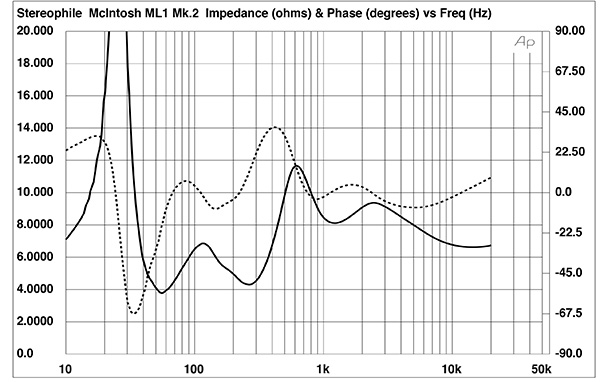
Fig.1 McIntosh ML1 MkII, electrical impedance (solid) and phase (dashed) (2 ohms/vertical div.).
McIntosh specifies the sensitivity of the ML1 Mk II as 85dB/2.8V/m. My B-weighted estimate of the ML1's voltage sensitivity, measured on the tweeter axis, was within experimental error of that figure, at 85.4dB(B)/2.83V/m. The McIntosh ML1's nominal impedance is specified as 8 ohms. The impedance magnitude (fig.1, solid trace) remains above 8 ohms from the upper midrange through the mid-treble region, though it drops below 6 ohms in the lower midrange and upper bass. The minimum impedances were 3.77 ohms at 55Hz and 4.3 ohms at 264Hz. The electrical phase angle (fig.1, dotted trace) is occasionally high, which means that the effective resistance, or EPDR (footnote 1), drops below 3 ohms between 32Hz and 62Hz and between 256Hz and 443Hz. The minimum EPDR values are 1.54 ohms at 42Hz and 2.15 ohms at 332Hz. Although the EPDR lies above 5 ohms above 545Hz, the ML1 will still be a relatively demanding load for the partnering amplifier, exacerbated by the lower-than-average sensitivity.
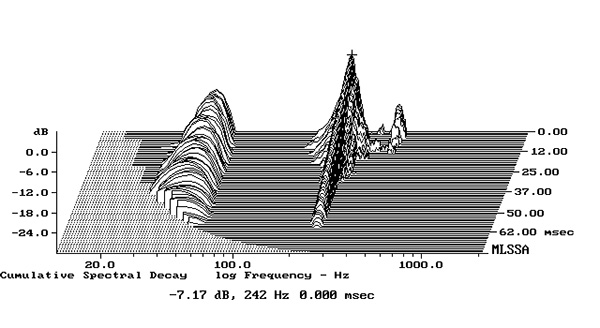
Fig.2 McIntosh ML1 MkII, cumulative spectral-decay plot calculated from output of accelerometer fastened to sidewall level with the midrange units (MLS driving voltage to speaker, 7.55V; measurement bandwidth, 2kHz).
The impedance traces are free from the small discontinuities that would imply the presence of cabinet resonances. Nevertheless, I found a strong resonance at 242Hz on the back wall and sidewalls level with the midrange unit (fig.2), and a lower-level mode at 441Hz on the sidewalls level with the woofer. The highest-level mode has a high Q (Quality Factor), which will work against it having audible consequences.
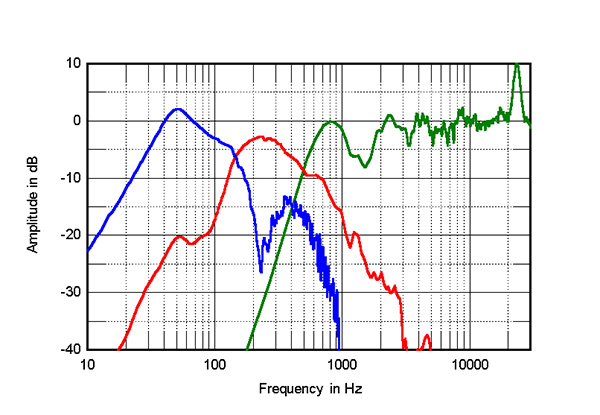
Fig.3 McIntosh ML1 MkII, acoustic crossover on tweeter axis at 50", corrected for microphone response, with the nearfield responses of the lower midrange units (red) and woofer (blue), respectively plotted below 350Hz and 950Hz.
The peak centered on 26Hz in the impedance magnitude trace suggests that this is the tuning frequency of the sealed-box–loaded woofer, below which the output will roll off at 12dB/octave. The blue trace in fig.3 shows the woofer's response measured in the nearfield. The peak between 30Hz and 90Hz is due to the nearfield measurement technique, which assumes that the baffle extends to infinity in both horizontal and vertical planes. Even so, the McIntosh ML1 offers extended low frequencies.
The woofer crosses over the two lower-midrange units (fig.3, red trace; measured in the farfield above 355Hz and in the nearfield below that frequency) at 150Hz and on to the upper-midrange driver (green trace) at the specified 500Hz. However, the output of the lower-midrange cones is slightly lower than that of the upper-midrange dome. The farfield response of the upper-midrange unit and the tweeter, taken without the grille, was generally even in the treble, though there is a strong suckout between 1kHz and 2kHz and smaller suckouts higher in frequency. The tweeter's primary dome resonance results in a response peak at 23.5kHz.
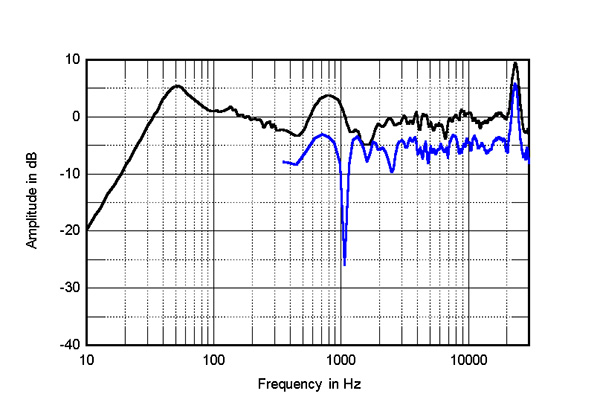
Fig.4 McIntosh ML1 MkII, anechoic response on tweeter axis at 50", averaged across 30° horizontal window and corrected for microphone response, with the grille (black) and without the grille (blue), with the complex sum of the lower midrange and woofer nearfield responses plotted below 310Hz.
The black trace in fig.4 shows the complex sum of the woofer's and lower-midrange units' nearfield responses, spliced at 310Hz to the ML1's farfield response averaged across a 30° horizontal window centered on the tweeter axis and taken without the grille. (SM told me he preferred the sound of the McIntosh speakers without the grilles.) The blue trace in this graph repeats the spatially averaged farfield response measurement with the grille, offset by –4dB for clarity. The treble balance is even in both cases, and while the suckout between 1kHz and 2kHz is almost eliminated with the grille in place, there is now a very narrow, very deep response notch centered on 1065Hz. This notch might compensate to some extent for the excess of energy at the bottom of the upper-midrange unit's output, which is fully developed without the grille.
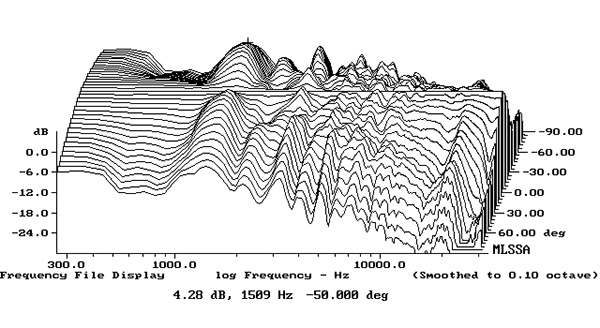
Fig.5 McIntosh ML1 MkII, lateral response family at 50" without grille, normalized to response on tweeter axis, from back to front: differences in response 90–5° off axis, reference response, differences in response 5–90° off axis.
Predicting the effect of this response anomaly on perceived sound quality is difficult, because this will also depend on the speaker's horizontal dispersion. This, taken without the grille and normalized to the response on the tweeter axis, which therefore appears as a straight line, is shown in fig.5. This graph suggests that the upper-midrange and low-treble output evens out to the ML1's sides, though the output of the lower-midrange drops at extreme off-axis angles. Higher in frequency, the raised "lips" on the sides of the baffle without the grille results in a complicated radiation pattern, and the wide baffle narrows the tweeter's dispersion in the top two octaves. Repeating the horizontal dispersion measurements with the grille in place (not shown) results in a considerably more complex radiation pattern throughout the treble, though the notch just above 1kHz in the tweeter-axis response tends to fill in more than 10° to the speaker's sides.
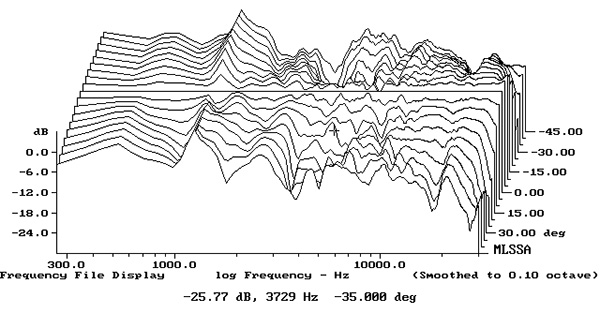
Fig.6 McIntosh ML1 MkII, vertical response family at 50" without grille, normalized to response on tweeter axis, from back to front: differences in response 45–5° above axis, reference response, differences in response 5–45° below axis.
Fig.6 shows the ML1's dispersion in the vertical plane, taken without the grille and again normalized to the response on the tweeter axis. This plot is difficult to interpret, but it suggests that the lack of energy between 1kHz and 2kHz on the tweeter axis fills in slightly 10° above the tweeter axis and 15° below. The cursor position in this graph indicates that the crossover between the upper-midrange unit and the tweeter lies closer to 3.7kHz than to the specified 4.5kHz.
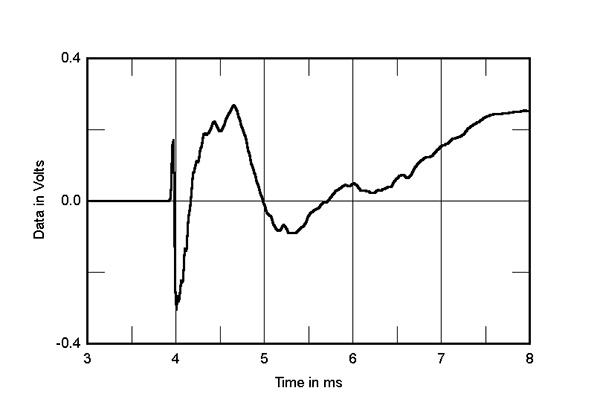
Fig.7 McIntosh ML1 MkII, step response on tweeter axis at 50" without grille (5ms time window, 30kHz bandwidth).
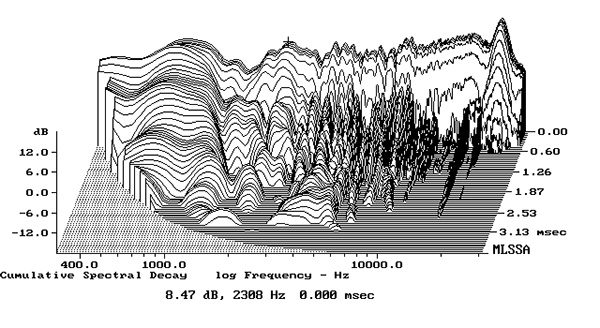
Fig.8 McIntosh ML1 MkII, cumulative spectral-decay plot on tweeter axis at 50" without grille (0.15ms risetime).
In the time domain, the ML1's step response (fig.7) indicates that the tweeter, the lower-midrange units, and the woofer are all connected in positive acoustic polarity. The tweeter's output arrives first at the microphone and while the upper-midrange unit is connected in inverted polarity; the start of its step cleanly merges with the negative-going decay of the tweeter's step. In turn, the decay of the dome unit's step cleanly merges with the positive-going step of the lower midrange units, which indicates an optimal crossover topology. The McIntosh's step response, measured without the grille, is overlaid with small reflections. These result in ridges of delayed energy in the ML1's cumulative spectral-decay (waterfall) plot (fig.8), though this is relatively clean in the region covered by the tweeter. This was not the case with the waterfall graph taken with the grille in place (not shown), presumably due to strong reflections of the tweeter's output from the grille.
Footnote 1: EPDR is the resistive load that gives rise to the same peak dissipation in an amplifier's output devices as the loudspeaker. See "Audio Power Amplifiers for Loudspeaker Loads," JAES, Vol.42 No.9, September 1994, and stereophile.com/reference/707heavy/index.html.