 Mettler:
 They might become better known after this. I also love how you describe the Tyne (footnote 6) in the title track. It's a river you crossed many times growing up, and you've given us great visual cues without overdescribing it. Same thing with "This One's Not Going to End Well." You don't over-tell what's going on, so we get to fill in some of the blanks as we listen.
Knopfler: Well, maybe that's because I'm not capable of it! [
laughs heartily] But, yeah, I'm glad about you picking up on that.
Mettler: There's a line on your previous album (footnote 7), "one song at a time," right? Wasn't that a phrase Chet Atkins said to you at some point?
Knopfler: Yep. Yeah, he did. He told me about being so poor he couldn't afford a coat to get to school in the wintertime. He said he picked his way out of poverty on the guitar, one song at a time. That's when I first heard that phrase.
Mettler: Was it your idea to have
One Deep River mixed in Atmos?
Knopfler: It really wasn't. It's just that my studio, British Grove, and Guy have become kind of advanced pioneers of quality Atmos mixing. I was expecting not to be too impressed, to be honest with you. But I have to say, certainly from hearing it in British Grove, it's just been beautiful. It's like
heightened stereo. It's a heightened awareness.
Mettler: That's the perfect phrase for it. On a track like "Watch Me Gone," your vocals are a little higher up in the soundfield in Atmos than in the stereo mix, and some of Greg Leisz's pedal-steel lines float outwards a little bit more, too, almost as if it was intended to give us a visual cue of where you guys were situated in the studio together while you were recording. Was that the intention?
Knopfler: Yes, that's it! In Atmos, you have a box to put your characters into. It's not like you're putting them on a flat screen—you're putting them onto a stage, or whatever you like. That's the difference in that it's not one-dimensional like a screen. You're looking into something with perspective. It's extraordinary, as long as it's in the right hands. [
chuckles] I'm sure a lot of people are going to do it badly, though.
Mettler: Was there one track Guy played for you in Atmos that sold it to you? Like, "Okay, I get it now—this is the thing that works for me in this format"?
Knopfler: Honestly, I got it straightaway because I knew that
he got it. Guy's too clever. He's not going to go and "mystify" it. He's not going to try and invest a song with things it doesn't have. So, to me, it was just a no-brainer. I just—it was wonderful. And to have it incorporated into the studio, it's even more so. In fact, there's a music-editing suite upstairs in British Grove where music goes onto film, but now there are Atmos speakers installed in Studio 2, so we can do the whole thing right there.
Mettler: That's exciting.
Knopfler: It
is exciting! It really is. And, again, I didn't expect it to be. I expected it to be resolutely non-thrilling. [
MM laughs] I was expecting
not to be thrilled, and I'm delighted to report that I
am thrilled.
Mark Knopfler's guitars.
Mettler: Now that you're sold on it, will you have Guy go back and do your entire catalog in Atmos, including all Dire Straits albums and the entirety of your solo work? No pressure on Guy (footnote 8). [
laughs]
Knopfler: Yeah. I mean, poor old Guy! [
chuckles] One thing's for sure—he's gonna have his work cut out. I've got some other things I'm thinking about, so he's going to have work to do for the next few years, or more.
Mettler: I like hearing about that, because we do have those 5.1 mixes of
Brothers in Arms Chuck Ainlay did almost, what, 20 years ago (footnote 9), so to get that whole album expanded into Atmos would be something else.
Knopfler: I know! Actually, I'm really looking forward to getting together with Chuck at some point—well, with Guy and Chuck together, and comparing where they both are with Atmos.
I'm very excited for it now because, like I said, I was so nonexcited, and then I was so excited to find myself excited! [
both laugh] Also, I think it can only be a good thing for the hi-fi people—the people who were stereophiles at one time who may now be getting back into it. I know what it's like to own the studio and to be in the studio where it all happens, and now I'm also hearing music in the best possible way. There's a whole other thing going on with Atmos, so
I maybe have to start thinking of myself as more of an audiophile now.
Mettler: Come back on in—the audiophile waters are just fine! [
both laugh]
Knopfler: Yeah, okay! The other thing is, in my place, British Grove, you don't have to be in a sweet spot to get it. That's another beautiful thing about it. There's no one magical cubic foot that your head has to be in to get the effect. You can be in the front of the room, the back of the room, or standing at the door. It is just astonishing that way.
The room I'm talking about is a fantastic control room. Actually, [legendary producer/engineer] Glyn Johns says it's the best control room in the world. He's just a smart individual—a very smart man who knows good sound when he hears it. And he can tell a good room when he hears it, too.
Mettler: Atmos mixes can get you further inside the music than you may have thought possible—as long as they're done the right way.
Knopfler: Yeah, isn't that a great thing? I hope, in a way, it's like radio at its best rather than TV just giving you a picture all the time. There's something about being able to concentrate on only the audio that heightens the experience. If you're going to make it visual as well, I don't know—you lose something that way. Being on the receiving end of where you're showing it, as well as telling it—it's just too much.
Mettler: Agreed. Another thing I have to give you and your production team credit for is that you're very good about doing double vinyl. You've also reissued your entire catalog—both the Straits material and your solo work—on upgraded vinyl, and in box-set form too. Do you get test pressings to check things out and make notes about whether something needs to change?
Knopfler: Absolutely! We have a great little test place at British Grove. Miles Showell, from Abbey Road, does that for us, and we don't mess around. Everyone's involved in putting the final thing together. Everybody is very interested in the process of how we arrive at choosing the actual finished product—and choosing the master is
very important.
We've got some very experienced heads who listen for everything. Our head tech is Graham Meek, who was head tech at Decca, and we also have David Harries, who was head tech at EMI, so we've got some very, very experienced hands. And we bring along the youngsters [the studio's apprentice engineers] in their company, so they're learning from the best. And the youngsters learn how to edit tape as well as edit digital.
Mettler: I love that using tape is still important to you as an artist.
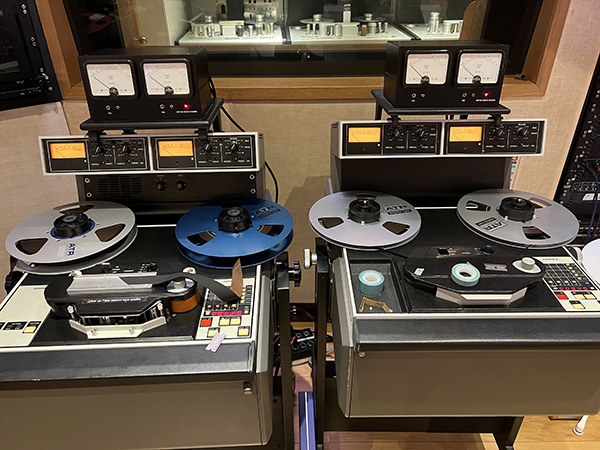
A pair of dualing Ampex tape machines—1" on left ¼" on right—doing what tape machines do.
Knopfler: Oh, we use tape all the time. We also master three different formats of tape—quarter-, half-, and one-inch. Enjoying the different mastering mediums is part of it, and it always will be. My only talent is that I always know—I
always know—what I want, no matter which medium. It's difficult to beat a one-inch master, but some songs will just take to the quarter-inch like a duck to water. But you have to be there to hear it, to recognize it, and to recommend it. And you have to have the respect of the mastering engineer so that he will know that you know what you are talking about. He has to understand why you've chosen the quarter-inch. There has to be a mutual respect there—and I like to think that those guys respect my judgment.
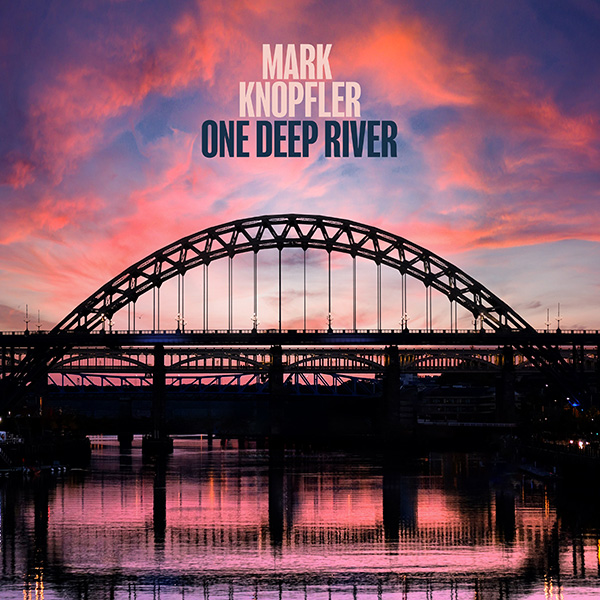
Footnote 6: The River Tyne is in North East England. The Tyne Bridge shown on the cover of
One Deep River is located at Newcastle upon Tyne, right near where Knopfler grew up.
Footnote 7: That album would be 2018's
Down the Road Wherever.
Footnote 8: In 2022, Fletcher remixed Dire Straits' 1988 compilation album
Money for Nothing in Atmos, which is currently available on Apple Music, and he confirmed with me directly that he's open to remixing as much of the artist's group and solo catalog in Atmos as Knopfler wants.
Footnote 9: Chuck Ainlay's 5.1 mixes of
Brothers in Arms appeared on both SACD (on Vertigo) and DVD-Audio (on Warner Bros.) in 2005 for what was termed the "20th Anniversary Edition."