Sidebar 3: Measurements
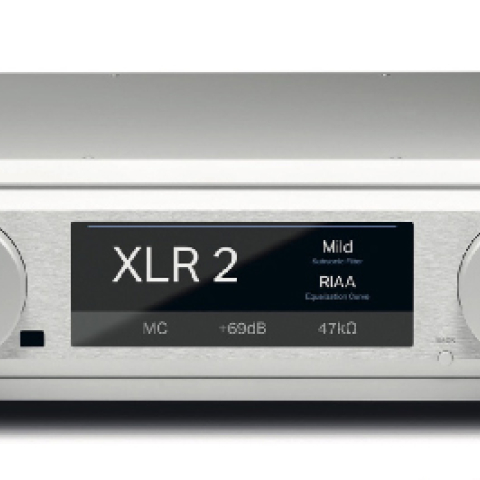
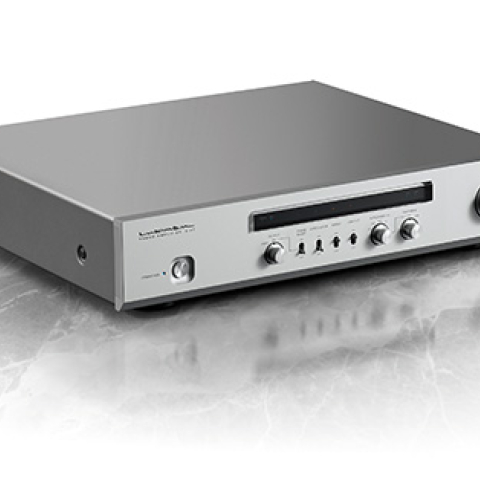
I measured the Luxman E-07 phono preamplifier with my Audio Precision SYS2722 system. To minimize noise, I connected wires from each channel's grounding terminals on the preamplifier's rear panel to the analyzer's ground. I left the Articulator function turned off for the testing.
The E-07 has two single-ended inputs and one balanced input; the balanced inputs can be used only for MC cartridges. With the single-ended inputs, absolute polarity was preserved from both the balanced and single-ended outputs with the front-panel Phase Invert switch set to "Off," which the manual says will have pin 2 of the XLR jack connected to "Cold" rather than "Hot," the opposite of the AES standard. Polarity was inverted, though, from the balanced inputs. In MM mode (via the single-ended inputs only), the gain was identical for the balanced and unbalanced outputs, at the specified 38dB. The MC mode can be set to MC-High, with gain specified as 57dB, or MC-Low, with gain specified as 68dB (footnote 1). Using the single-ended inputs, my gain estimates were slightly lower, at 52.25dB and 64dB at both balanced and single-ended outputs. The MC-High gain with the balanced MC input was the specified 57dB, however; the MC-Low gain with the balanced input was the same as via the single-ended inputs, at 64dB.
The preamp's source impedance was 297 ohms single-ended and 594 ohms balanced, both values consistent from 20Hz to 20kHz and very close to the specified output impedances of 300 ohms and 600 ohms.
The unbalanced input impedance in MM mode can be set to nominal values of 34k ohms, 47k ohms, 56k ohms, and 100k ohms. My estimated values were 33k ohms, 44k ohms, 51.5k ohms, and 85.7k ohms, respectively, with all these values consistent from 20Hz to 20kHz. (The capacitance was set to 0pF for these measurements.) In MC mode, the input impedances can be set to 4.7 ohms, 10 ohms, 40 ohms, 100 ohms, 300 ohms, and 1000 ohms. I measured 10 ohms, 12 ohms, 27 ohms, 288 ohms, and 773 ohms, respectively, for the signal-ended input at 1kHz and 819 ohms at 1kHz for the balanced input impedance when it was set to 1000 ohms. Peculiarly, the input impedance at 20Hz remained the same at the various MC-High impedance settings, at 84 ohms.
Footnote 1: It appears that the MC-High and MC-Low listed on the manual's Specifications page are not related to the gain but to the nominal output voltages of the moving-coil cartridges that are used with each set of impedances.
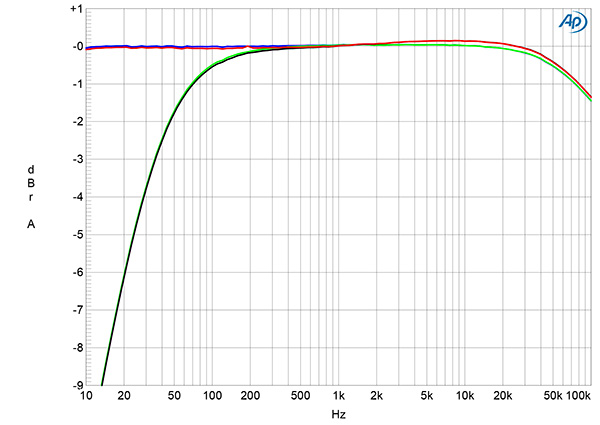
Fig.1 Luxman E-07, response with RIAA correction into 100k ohms (left channel blue, right red) and with Low Cut engaged (left green, right gray) (1dB/vertical div.).
The error in the E-07's RIAA equalization (fig.1, blue and red traces) was impressively low, with superb channel matching. With Low Cut engaged, the response started to roll off below 200Hz and was down by 1dB at 70Hz and by 6dB at 20Hz (green and gray traces). This graph was taken in MM mode; in MC mode, the high-frequency response was flat up to 100kHz. Channel separation (not shown) was 80–90dB in both directions across the audioband.
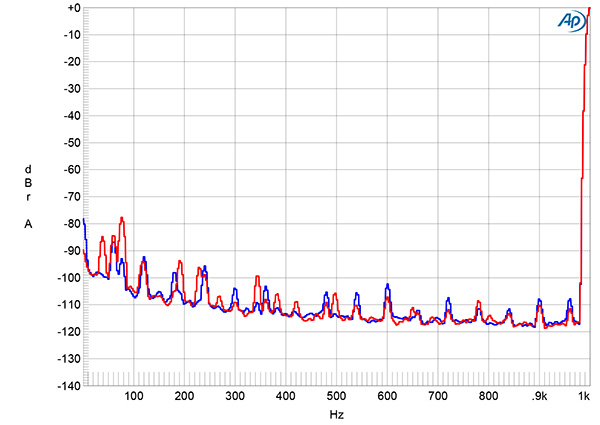
Fig.2 Luxman E-07, MM mode, spectrum, DC-1kHz, of output ref. 5mV input (left channel blue, right red, linear frequency scale, 20dB/vertical div.).
In MM mode, the Luxman preamp's unweighted, wideband S/N ratio, measured at the balanced outputs with the single-ended inputs shorted to ground and ref. 1kHz at 5mV, was a superb 81.6dB (average of both channels). Restricting the measurement bandwidth to 22Hz–22kHz increased the ratio to 84.6dB, while the A-weighted ratio was an astonishingly high 90.2dB. In MC mode, the ratios were approximately 9–10dB lower than in MM mode; this is still a very low level of noise. Spectral analysis of the E-07's low-frequency noisefloor in MM mode ref. 1kHz at 5mV (fig.2) revealed that both the random noise and the supply-related spuriae were very low in level.
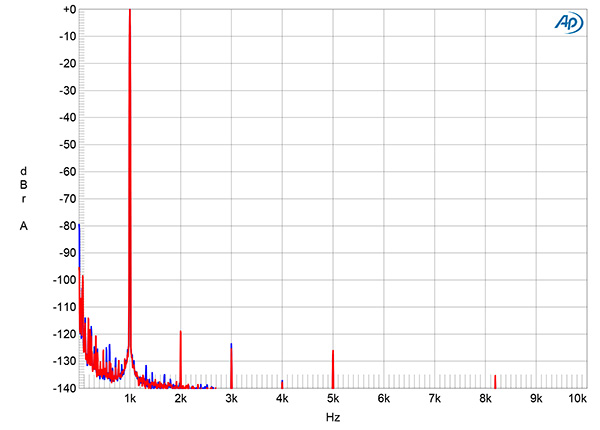
Fig.3 Luxman E-07, MM mode, spectrum of 1kHz sinewave, DC-10kHz, into 100k ohms for 61mV input (left channel blue, right red, linear frequency scale, 20dB/vertical div.).
The E-07's overload margins in both MC and MM modes, ref. 1kHz at the standard MC level of 500µV and the standard MM level of 5mV, were excellent, at 28dB from 20Hz to 20kHz. The E-07 offered very low distortion. Fig.3 shows the spectrum of the preamplifier's balanced output reproducing 1kHz at a level just 6dB below the MM input overload voltage. The only distortion harmonics that can be seen above the noisefloor are the second, at –120dB (0.0001%), the third, at –124dB (0.00006%), and the fifth, at –126dB (0.00005%). These very low levels were identical when I repeated the analysis at the single-ended output; the second harmonic remained at the same level when I reduced the load impedance to the current-demanding 600 ohms, though the third harmonic rose to a still-negligible –116dB (0.00015%).
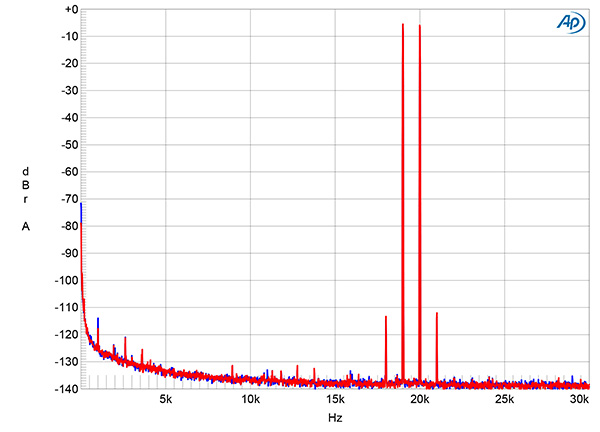
Fig.4 Luxman E-07, MM mode, HF intermodulation spectrum, DC-30kHz, 19+20kHz into 100k ohms for 620mV peak input (left channel blue, right red, linear frequency scale, 20dB/vertical div.).
Intermodulation distortion with an equal mix of 19kHz and 20kHz tones at a peak input level 6dB below the MM clipping voltage at 20kHz was superbly low (fig.4). The difference product at 1kHz and the higher-order products all lay close to –114dB (0.0002%).
The Luxman E-07's measured performance was superb, with extremely accurate RIAA equalization, vanishingly low levels of noise and distortion, and overload-proof input and output stages. The E-07 is one of the best-measuring phono preamplifiers I have encountered.—John Atkinson
Footnote 1: It appears that the MC-High and MC-Low listed on the manual's Specifications page are not related to the gain but to the nominal output voltages of the moving-coil cartridges that are used with each set of impedances.