Sidebar 4: Measurements
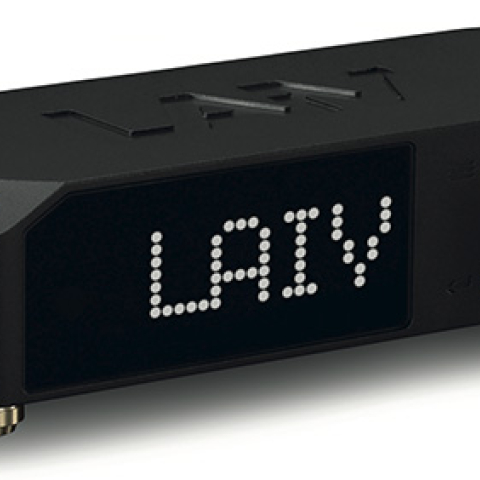
I performed a full set of measurements on the LAiV Harmony µDAC using my Audio Precision SYS2722 system. The coaxial S/PDIFand optical TosLink inputs both accepted data sampled at rates up to 192kHz. Apple's AudioMIDI utility revealed that the USB port accepted 32-bit integer data sampled at all rates from 44.1kHz to 1536kHz! The USB Prober app identified the Harmony µDAC as "LAIV Harmony DAC" from "LAIV Audio" and indicated that the USB port operated in the optimal isochronous asynchronous mode. I used optical S/PDIF data for the testing as well as USB data sourcedfrom my MacBook Pro. The Harmony µDAC's chassis became warm during the testing. The top panel's temperature stabilized at 102.2°F (39°C).
The LAiV DAC's maximum output level with a 1kHz signal at 0dBFS was 4.013V, sourced from a low balanced output impedance of 84.9 ohms from 20Hz to 20kHz. The µDAC preserved absolute polarity, ie, was noninverting, with the Phase set to Positive.
Footnote 1: See, for example, fig.3 here.
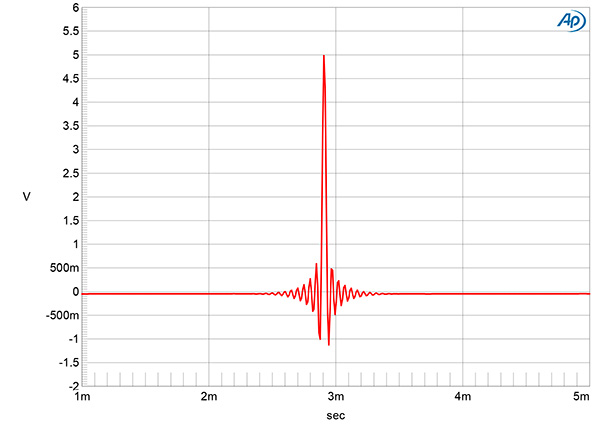
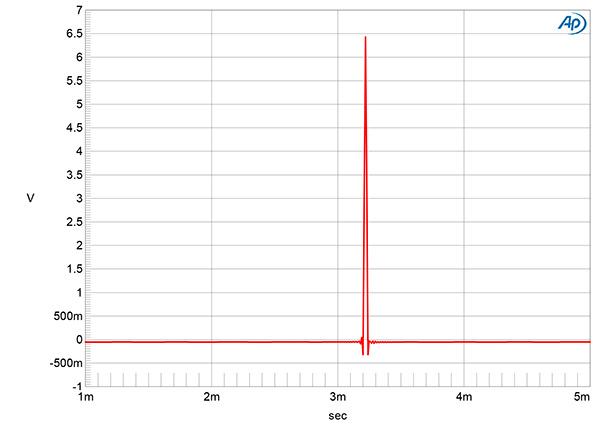
Fig.1 LAiV Harmony µDAC, OS mode, impulse response with one sample at 0dBFS, 44.1kHz data, 4ms time window).
Fig.2 LAiV Harmony µDAC, NOS mode, impulse response with one sample at 0dBFS, 44.1kHz data, 4ms time window).
The Harmony µDAC can be operated in two modes, OS and NOS. The impulse response in OS mode is shown in fig.1; it is typical of a long linear-phase reconstruction filter, with equal amounts of ringing surrounding the single sample at 0dBFS. Fig.2 shows the impulse response in NOS mode. There is just a single cycle of ringing before and after the single sample, which suggests that in this mode there is no reconstruction filter. With sinewave data, the waveform in NOS mode had a staircase shape rather than what, when filtered, would be a perfect sinewave (footnote 1).
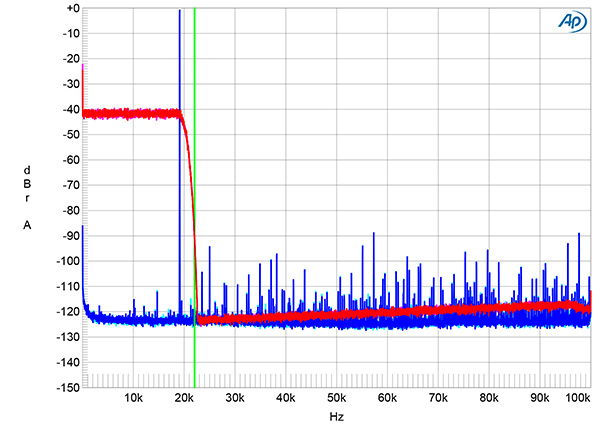
Fig.3 LAiV Harmony µDAC, OS mode, wideband spectrum of white noise at –4dBFS (left channel red, right magenta) and 19.1kHz tone at 0dBFS (left blue, right cyan) into 100k ohms with data sampled at 44.1kHz (20dB/vertical div.).
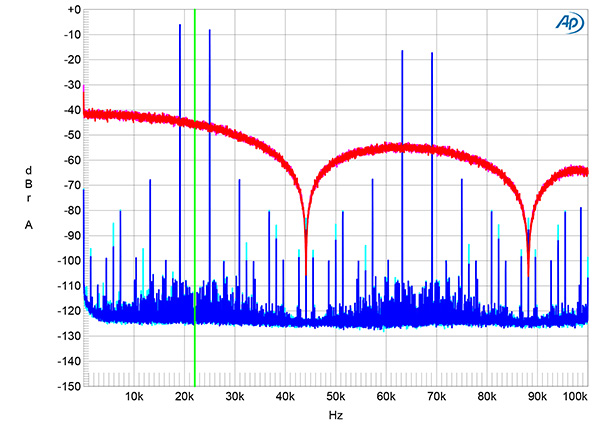
Fig.4 LAiV Harmony µDAC, NOS mode, wideband spectrum of white noise at –4dBFS (left channel red, right magenta) and 19.1kHz tone at –3dBFS (left blue, right cyan) into 100k ohms with data sampled at 44.1kHz (20dB/vertical div.).
The magenta and red traces in fig.3 show the LAiV's wideband spectrum with 44.1kHz white noise data at –4dBFS in OS mode. The response rolls off sharply above the audioband, with full stopband attenuation reached just above half the sample rate, this indicated by the green vertical line. The image at 25kHz of a full-scale 19.1kHz tone (cyan, blue traces) is suppressed by 95dB, and the harmonics of the tone are very low in level, though many spurious tones are present in the ultrasonic noisefloor. Fig.4 shows the result of the same test in NOS mode. As expected from the impulse response in this mode, the lack of a reconstruction filter means that the ultrasonic rolloff with white noise data is very slow, with nulls at 44.1kHz and 88.2kHz. With a 19.1kHz tone at –3dBFS, a large number of aliased products are present, in the audioband and above. The image at 25kHz of the tone is attenuated by just 3dB.
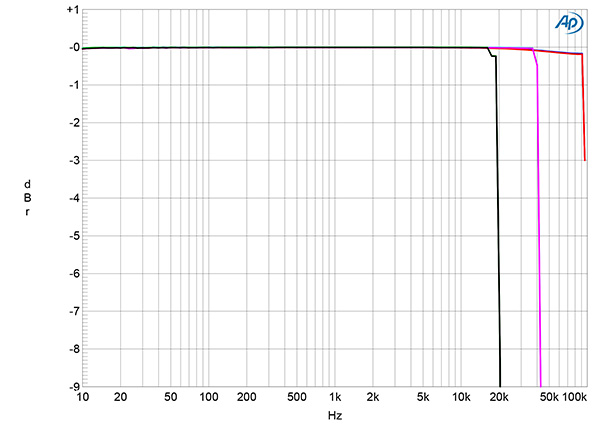
Fig.5 LAiV Harmony µDAC, OS mode, frequency response at –12dBFS into 100k ohms with data sampled at: 44.1kHz (left channel green, right gray), 96kHz (left cyan, right magenta), and 192kHz (left blue, right red) (1dB/vertical div.).
The LAiV Harmony µDAC's frequency response in OS mode with 44.1kHz, 96kHz, and 192kHz data (fig.5) was flat in the audioband and followed the same basic shape at all three sample rates, with a very sharp rolloff just below half of each rate. I haven't shown the frequency responses in NOS mode because the rolloff at each sample rate was corrupted by the presence of aliased energy.
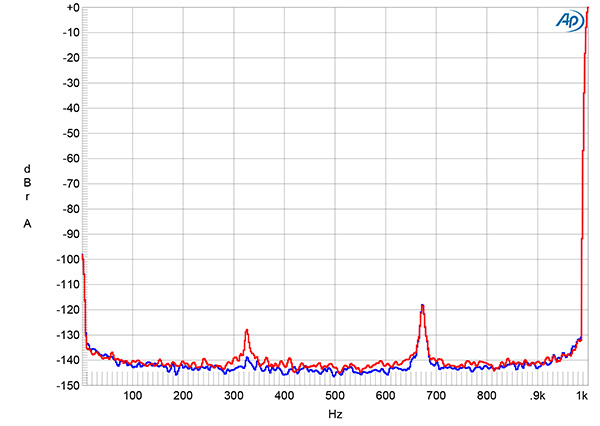
Fig.6 LAiV Harmony µDAC, OS mode, spectrum of 1kHz sinewave, DC–1kHz, at 0dBFS (left channel blue, right red, linear frequency scale).
Channel separation was superb, at >110dB in both directions below 4kHz and still 95dB at the top of the audioband. The low-frequency noisefloor (fig.6) was very low in level and was free from power supply–related spuriae. However, low-level tones of unknown origin are present at 348Hz and 672Hz.
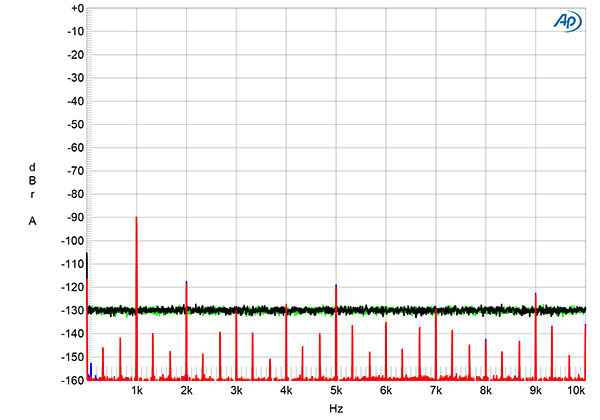
Fig.7 LAiV Harmony µDAC, OS mode, spectrum with noise and spuriae of dithered 1kHz tone at –90dBFS with 16-bit data (left channel green, right gray) and 24-bit data (left blue, right red) (20dB/vertical div.).
Fig.7 shows the Harmony µDAC's output spectra with 16- and 24-bit dithered data representing a 1kHz tone at –90dBFS in OS mode. (The spectra were identical in NOS mode.) The increase in bit depth lowered the noisefloor by 30dB, which would suggest a measured resolution of 21 bits. However, the 24-bit spectrum is corrupted by high levels of harmonic distortion, as well as spuriae at the frequencies noted in fig.6 and their multiples. The odd-order harmonics are due to one or more of the 24-bit LSBs being truncated; the even-order harmonics are due to asymmetry of the recreated waveform.
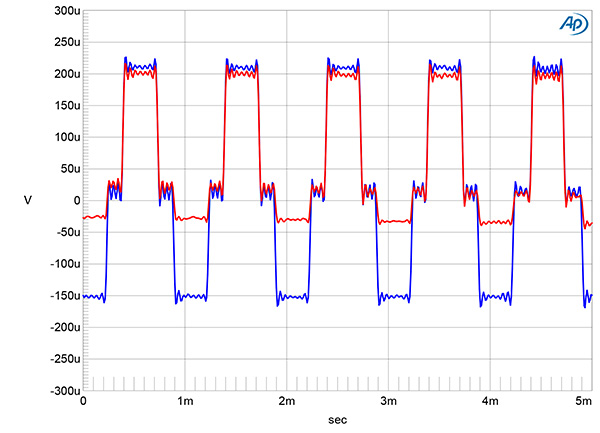
Fig.8 LAiV Harmony µDAC, NOS mode, waveform of undithered 16-bit, 1kHz sinewave at –90.31dBFS (left channel blue, right red).
This asymmetry can be seen in fig.8, which shows the waveform of undithered data representing a tone at exactly –90.31dBFS, consisting of data at –1 least significant bit (LSB), digital zero, and +1 LSB. In the twos-complement encoding used by 16-bit digital audio, –1 LSB is represented by 1111 1111 1111 1111, digital zero by 0000 0000 0000 0000, and +1 LSB by 0000 0000 0000 0001. If the undithered waveform is symmetrical, changing all 16 bits in the digital word gives exactly the same change in the analog output level as changing just the LSB. Fig.8 shows that this was true for the left channel (blue trace) but not the right (red trace). This behavior was identical in both OS and NOS modes.
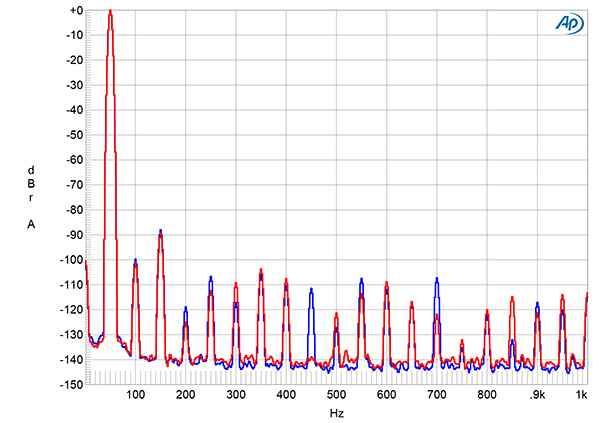
Fig.9 LAiV Harmony µDAC, OS mode, spectrum of 50Hz sinewave, 24-bit data, at 0dBFS, DC–1kHz, into 100k ohms (left channel blue, right red; linear frequency scale).
The LAiV Harmony µDAC's distortion primarily comprised the second and third harmonics (fig.9), but these were low in level, lying at –100dB (0.001%) and –89dB (0.003%) respectively. These were joined by a regular series of higher-order harmonics. Fig.9 was taken into 100k ohms; when I repeated the spectral analysis into 600 ohms, the levels of all the harmonics increased by 20dB but were still relatively low.
Fig.10 LAiV Harmony µDAC, OS mode, HF intermodulation spectrum (DC–30kHz), 19+20kHz, 24-bit data, at 0dBFS into 100k ohms (left channel blue, right red; linear frequency scale).
Fig.11 LAiV Harmony µDAC, NOS mode, HF intermodulation spectrum (DC–30kHz), 19+20kHz, 24-bit data, at 0dBFS into 100k ohms (left channel blue, right red; linear frequency scale).
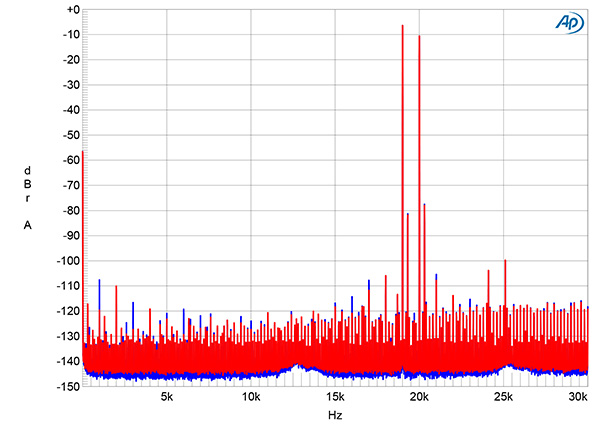
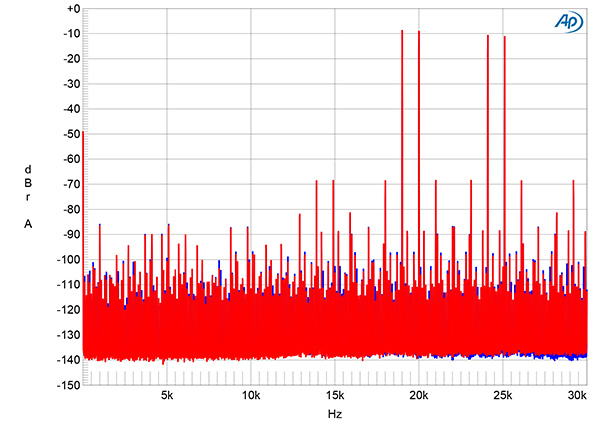
Intermodulation distortion with 24-bit data representing an equal mix of 19 and 20kHz tones, each at –6dBFS, was low in level, the difference product at 1kHz lying at –110dB (0.0003%, fig.10). However, a large number of spurious tones are present in this graph. As expected, even more spurious tones were present in NOS mode, primarily aliased images (fig.11).
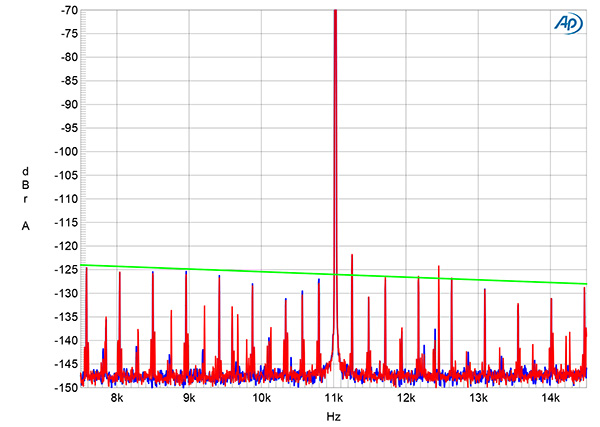
Fig.12 LAiV Harmony µDAC, 16-bit optical data, high-resolution jitter spectrum of analog output signal, 11.025kHz at –6dBFS, sampled at 44.1kHz with LSB toggled at 229Hz (left channel blue, right red). Center frequency of trace, 11.025kHz; frequency range, ±3.5kHz.
I examined the Harmony µDAC's rejection of data-related jitter. While the odd-order harmonics of the undithered low-frequency, LSB-level, 16-bit squarewave all lay close to the correct levels, shown by the green line in fig.11, many spurious tones and sidebands are present that are not related to the signal frequency of 11.025kHz. The highest levels of these lay at ±1.434kHz.
The LAiV Harmony µDAC's measured performance in OS mode was respectable; that in NOS mode was affected by the lack of a reconstruction filter. However, I was concerned by the right channel's truncation of 24-bit data and the presence of spurious tones in the audioband noisefloor, even in OS mode.—John Atkinson
Footnote 1: See, for example, fig.3 here.