Sidebar 3: Measurements
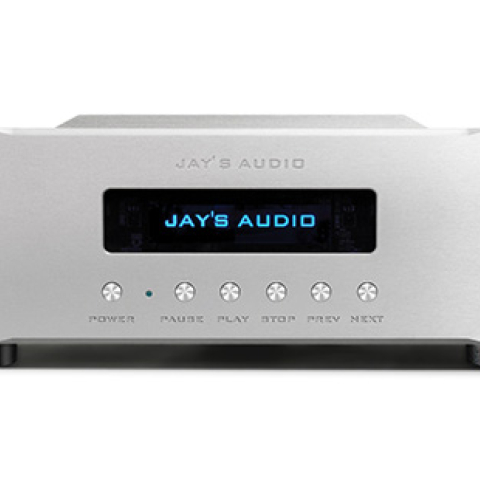
The most meaningful test of a CD player or transport is of how well it deals with disc errors. I examined the Jay's Audio CDT3-MK3's performance with the Pierre Verany Digital Test CD, which has tracks with single or double gaps in the data spiral. It successfully played tracks with gaps up to 1mm in length, but when the gap was 1.5mm or longer, there were audible glitches. The Compact Disc standard requires only that a player cope with gaps of up to 0.2mm. The Jay's transport copes well with damaged CDs.
Next, I examined the amount of timing uncertainty—jitter—in the CDT3-MK3's AES3 output by looking at the datastream's "eye pattern." I overlaid successive snapshots of the CDT3-MK3's AES3 output, taken over a 60s time window, with my Audio Precision SYS2722 system's digital oscilloscope function. The data, played back from a CD-R, represented the 16-bit Miller-Dunn J-Test signal, with the Jay's rear-panel switch set to a 44.1kHz output sample rate. With an ideal transmission system, all the pulse transitions in the datastream overlay one another to produce an image of a wide-open "eye" with just one trace visible.

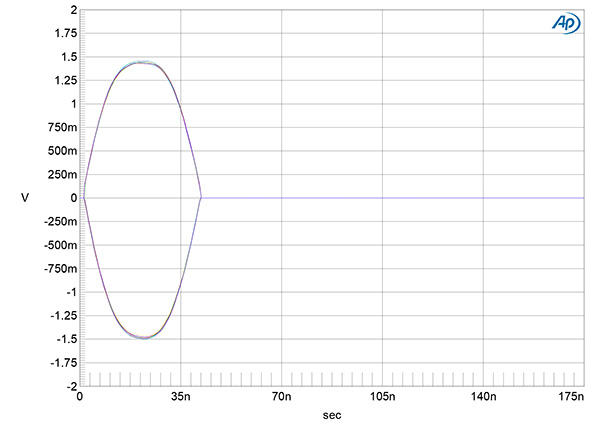
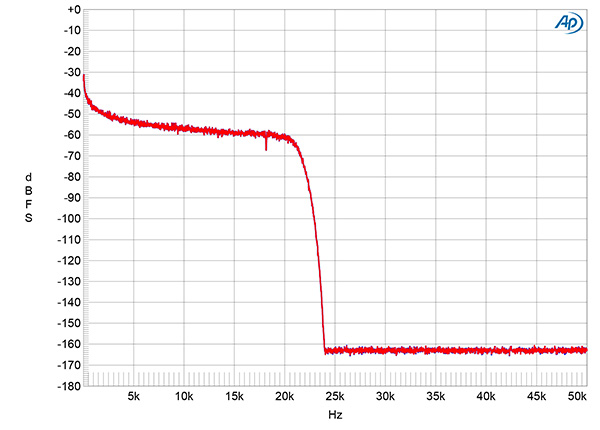
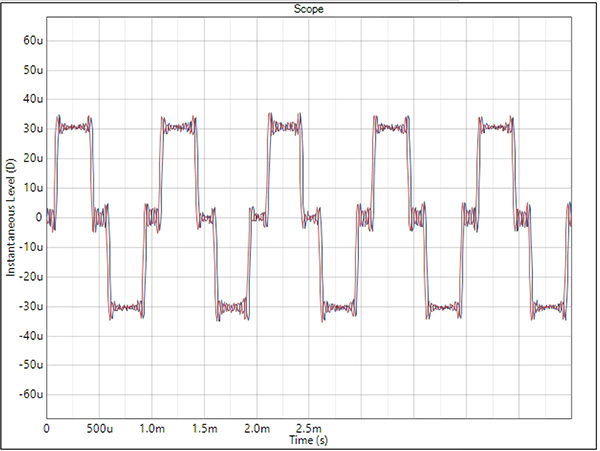
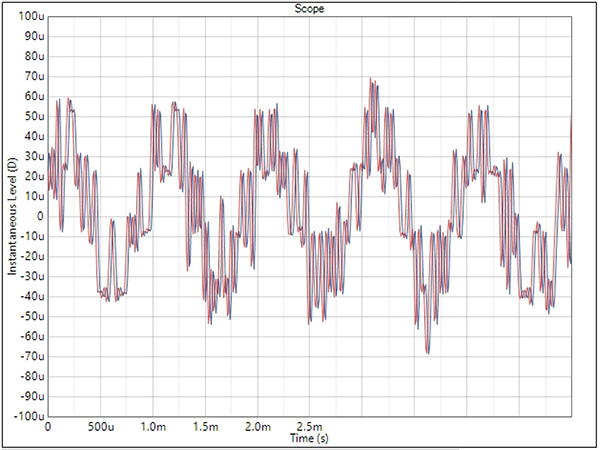
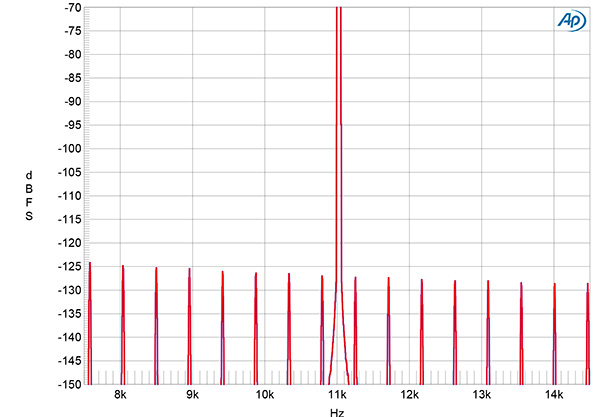
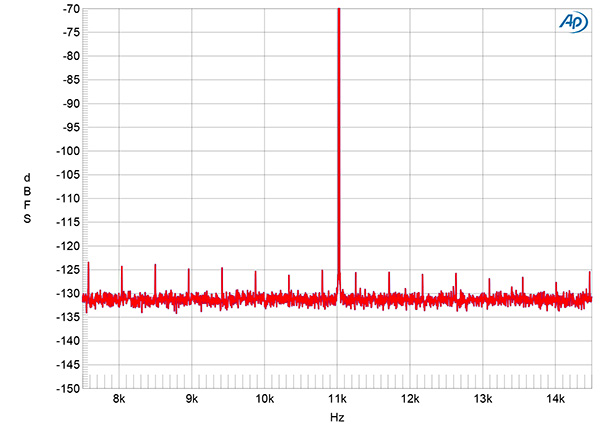
Fig.1 Jay's Audio CDT3 Mk.3, eye pattern of AES3 data output carrying 16-bit, 44.1kHz J-Test data, no upsampling (±2V vertical scale, 175ns horizontal scale).
Fig.1 was plotted over one "unit cycle" from the AES3 output. The eye is superbly wide open, with no blurring of the leading or trailing edges; the pattern was equally good from the transport's coaxial S/PDIF output. The average jitter level, assessed with a 50Hz–100kHz bandwidth, was a low 389.2 picoseconds (ps).
Fig.2 Jay's Audio CDT3 Mk.3, eye pattern of AES3 data output carrying 16-bit, 44.1kHz J-Test data upsampled to 24 bits and 176.4kHz (±2V vertical scale, 175ns horizontal scale).
Fig.2 shows the eye pattern with the Jay's transport set to output upsampled 176.4kHz data. There is still no blurring. The average jitter level with 176.4kHz data was 535.1ps. Repeating this test with CD data representing a 1kHz tone at 0dBFS reduced the jitter with upsampled data to 437.8ps. Interestingly, while the Audio Precision's Digital I/O panel indicated that the expected 16 bits were active with 44.1kHz, all 24 bits in the AES3 stream were active when the data were upsampled to 176.4kHz.
Fig.3 Jay's Audio CDT3 Mk.3, digital-domain spectrum of pink noise at –20dBFS, upsampled to 176.4kHz, DC–50kHz (left channel blue, right red).
To confirm that the Jay's Audio CDT3-MK3's upsampling doesn't change audioband data extracted from CDs, fig.3 shows a wide-bandwidth spectral analysis of the pink noise track on Stereophile's Editor's Choice CD, analyzed in the digital domain, with no D/A conversion. The spectrum of the noise rolls off above 20kHz as expected, though it reaches full stopband attenuation at 24kHz rather than the expected 22.05kHz.
Fig.4 Jay's Audio CDT3 Mk.3, digital-domain waveform of undithered 1kHz sinewave at –90.31dBFS, 16-bit, 44.1kHz data upsampled to 176.4kHz (left channel blue, right red).
Fig.5 Jay's Audio CDT3 Mk.3, digital-domain waveform of undithered 1kHz sinewave at –90.31dBFS, 16-bit, 44.1kHz data (left channel blue, right red).
What I was not expecting was that while the Jay's Audio transport's upsampled output correctly reproduced the waveform of an undithered 1kHz tone at exactly –90.31dBFS analyzed in the digital domain (fig.4; the small amount of pre- and post-ringing on the waveform's leading edges will be due to the CDT3-MK3's upsampling filter), the 44.1kHz output behaved differently (fig.5). Here, the three DC voltage levels described by the data in fig.4 are overlaid with high-frequency noise. The direct and upsampled measurements were made from the AES3 output and confirmed via the S/PDIF output, which gave identical results.
Fig.6 Jay's Audio CDT3 Mk.3, digital-domain spectrum of 11.025kHz at –6dBFS, with LSB toggled at 229.6875Hz, sampled at 44.1kHz and upsampled to 176.4kHz (left channel blue, right red). Center frequency of trace, 11.025kHz; frequency range, ±3.5kHz.
It appears that the CDT3-MK3's 44.1kHz output adds dither at the level of the least-significant bit. I confirmed this by performing digital-domain spectral analyses of the transport's AES3 output while it played the Miller-Dunn J-Test track. With upsampled data (fig.6), the odd-order harmonics of the Fs/192 LSB-level squarewave all lie at the correct levels and there is no noisefloor between the harmonics.
Fig.7 Jay's Audio CDT3 Mk.3, digital-domain spectrum of 11.025kHz at –6dBFS, with LSB toggled at 229.6875Hz, sampled at 44.1kHz with no upsampling (left channel blue, right red). Center frequency of trace, 11.025kHz; frequency range, ±3.5kHz.
While the odd-order harmonics of the low-frequency squarewave are still at the correct level with the 44.1kHz output (fig.7), random noise is now present just below –130dBFS. (Remember that, as this spectrum was taken by analyzing the transport's digital output, there is no analog circuitry in the signal path that could add noise.) The level of this noise is typical of 16-bit, LSB-level dither.
I don't know what effect this dither will have on the performance of D/A processors that are connected to the Jay's CDT3-MK3, but it will limit the effective resolution of CDs played with the transport to closer to 15 bits rather than the 16 available on disc. By contrast, the upsampled output is bit-perfect with 16-bit CD data. Both types of output offer low jitter and well-resolved eye patterns, coupled with excellent error correction.—John Atkinson