Sidebar 3: Measurements

As the Diablo 333 has no balanced preamplifier output, the performance of the DAC3 can only be measured via its single-ended (RCA) tape buffer which offers a maximum 1.04V output from a 97 ohm source impedance (re. 1kHz/0dBFs input). Again, odd-order harmonics dominate the "character" of the module's distortion and while these figures are merely moderate they are still at least 10× higher than might otherwise be achieved with the new ES9039PRO DAC. Over the top 10dB or so of the DAC3's range, this distortion is a feature of the class-A analog line output stage rather than a reflection of "digital distortion"—a measure of the DAC's handling of quantization errors—inherent in the ES9039PRO itself. Then again, the quest for vanishingly low THD is not top of Gryphon's design agenda . . .
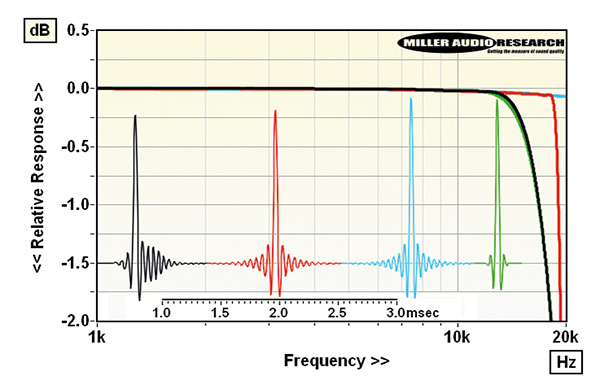
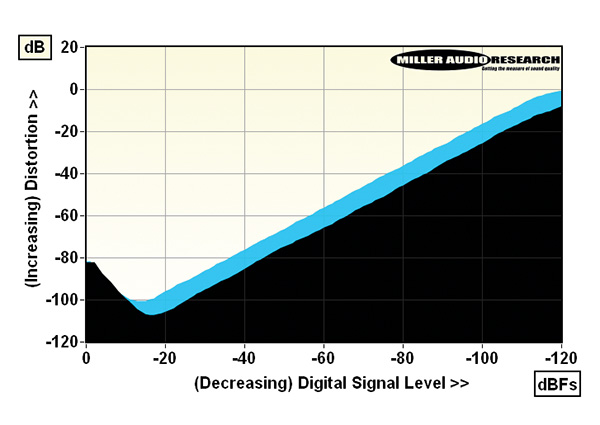
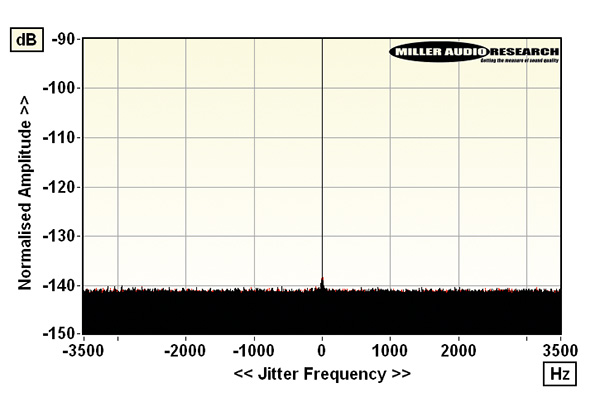
Fig.1 Distortion versus time at 1kHz/10W/8 ohms over one hour (3600 seconds) after switch on (left, black; right, red). Maximum heatsink temperature was 43°C/109.4°F after this warmup period.
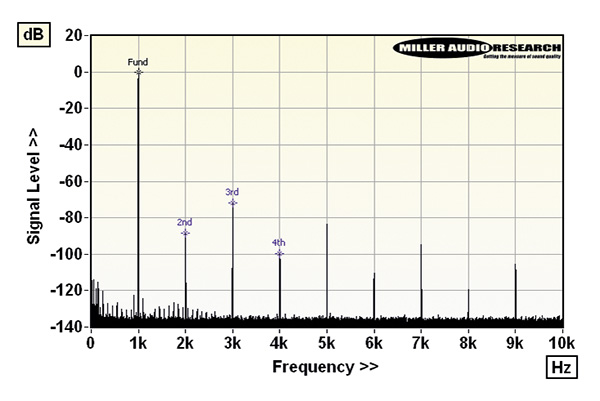
Typically, though not exclusively, amplifiers employing reduced levels of corrective feedback may also exhibit some thermal drift, a "feature" more common still when the amplifier is also generously- biased. Gryphon's very substantial Diablo 333 is a case in point as distortion (1kHz/10W) gradually reduces from approximately 0.07% immediately after switch on to a minimum of 0.014% after some 50 minutes (fig.1). The case temperature increases by some 25°C/45°F over this period, distortion rising very slightly again as the chassis and key components reach an equilibrium. This is not to suggest that so basic a test directly correlates with any change in sound quality during warmup, but it is illustrative of both change and "character" in general. As, for example, are the extended patterns of harmonics that appear in both power and line/tape output distortion tests (fig.2).
Fig.2 Illustrative distortion spectrum with 2nd–4th harmonics marked (ref. 1kHz at 10W/8 ohms). Hum, noise and PSU intermodulation is very low by comparison.
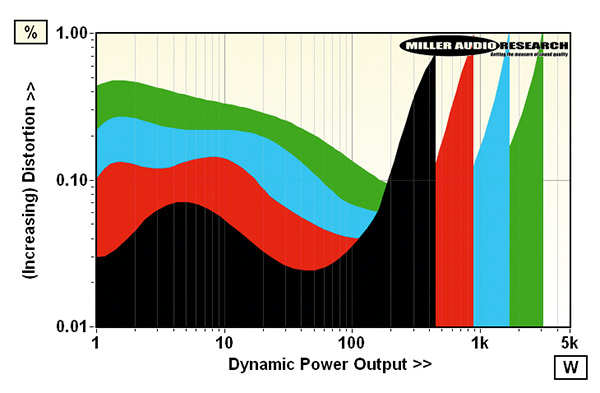
More on how Gryphon has so artfully judged distortion versus level and frequency later. For now, I'll cut to the chase and answer the burning question—just how powerful is the new Diablo 333? In practice while the claimed doubling of the latest Diablo's 333W/8ohm output to 666W into 4 ohms (both equivalent to 25.2dBW) is not quite met under "continuous" conditions, this massive integrated is still exceedingly powerful and offers exceptional (speaker) load tolerance. In practice, it delivers closer to 360Wpc into 8 ohms (25.56dBW) and 650Wpc into 4 ohms (25.1dBW), although this increase into the lower impedance is still indicative of decently "stiff" PSU regulation. This resilience is particularly evident under dynamic conditions where the Diablo 333 has headroom for 451W, 895W, 1.75kW and 3.05kW into 8, 4, 2 and 1 ohm loads (1% THD), respectively (fig.3).
Fig.3 Dynamic power output (1kHz/10ms/1% THD) versus distortion into 8 ohms (black), 4 ohms (red), 2 ohms (blue), and 1 ohm (green).
No electronic protection was triggered during these tests where the amplifier's 55.2A maximum current was limited only by duration (10ms) and distortion (to 1% THD). Fig.3 also clearly shows that the Diablo 333 does not clip abruptly but possesses a more progressive trend to maximum output. Either way, this latest Diablo will not be fazed by difficult loudspeaker loads . . .
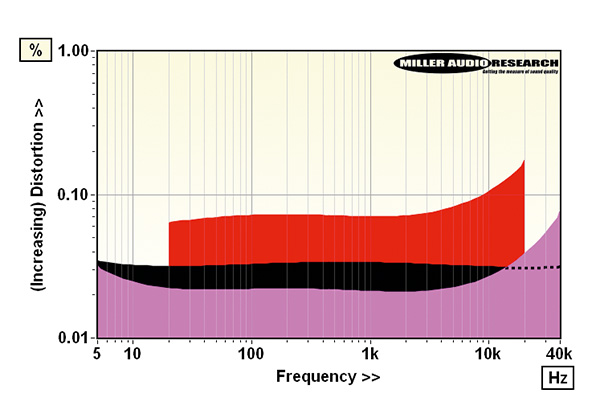
Fig.4 Distortion versus frequency into 8 ohms at 1W (black) and 10W (pink) from 5Hz–40kHz, and 100W (red) from 20Hz–20kHz.
Distortion is lowest at approximately 0.01% at 30W into 8 ohms, increasing at lower and higher power (0.04%/1W and 0.05%/100W, all 1kHz/8 ohms) but these trends also change under dynamic conditions (again, see fig.3). Here distortion not only increases with decreasing load (as expected) but is also higher around its suggested class-A to class-AB transition (approximately 0.06%/10W/8 ohms) than under continuous output conditions (~0.025%). This is shown in fig.4 where distortion falls between 1W (black trace) and 10W (pink trace) before rising again to ~0.07% at 100W. The key takeaway here is not the slight change in THD with level but the uniformity of this distortion, and its harmonic complement, with frequency. This latter quality is often associated with the finer sounding amplifiers.
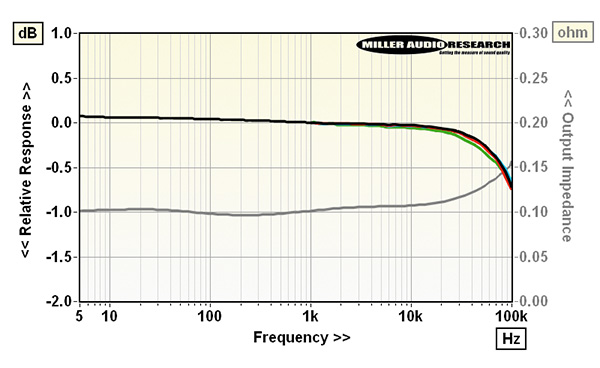
Fig.5 Frequency response from 5Hz–100kHz into 8 ohms (black), 4 ohms (red), 2 ohms (blue) and 1 ohm loads (green). Plotted against output impedance (gray).
The frequency response is equally flat and extended (just –0.7dB at 100kHz) and, despite maintaining this into non-reactive 8, 4, 2, and 1 ohm loads (fig.5, black, red, blue and green traces, respectively), the Diablo's ~0.1 ohm output impedance may still introduce some slight modification in system response depending on variations in the load (versus frequency) of "real world" loudspeakers.
Meanwhile, overall gain is a sensible +38.1dB (balanced XLR input), the A-wtd S/N ratio clocks in at a creditable 92.8dB (ref. 0dBW), and stereo separation is held to a wide >95dB (20Hz–20kHz) by the dual- mono layout.
Fig.6 DAC3 module: time (impulse) and frequency responses over a 1kHz–20kHz range. Minimum phase (black), Apodizing (red), Linear phase fast (blue), and Linear phase slow (green).
The Danish engineers have enabled access to ESS's customary seven user-selectable digital filters, however. The flattest response is achieved by the Minimum Fast and Linear Fast filters at –0.07dB/20kHz, –0.6dB/45kHz and –1.5dB/90kHz with 48kHz, 96kHz, and 192kHz digital files, respectively. These are longer-tap filters that also offer a usefully deep stopband rejection (80.6dB and 73.5dB, respectively) at the expense of extended post- and pre/post-"echoes," respectively, in the time domain (Linear Fast–blue traces, fig.6). The Apodizing filter (red traces, fig.6) all but erases any stopband images with >110dB suppression but this is traded for extended (acausal) pre-echoes in the time domain and a slightly premature –3dB/19.5kHz HF cut-off with CD-resolution media and 43kHz/–3dB (–20dB/45kHz) with 96kHz files.
The two Slow filter options offer much reduced ringing but also far poorer 8dB stopband suppression—these filters are arguably better suited to higher sample rate files (96kHz+). Responses are –4.2dB/20kHz and –5.4dB/45kHz with 48kHz and 96kHz media, for example. Interestingly, Gryphon's default "Minimum Phase" filter (black traces, fig.6) offers the same hybrid time domain behavior as the "Minimum Phase Slow/Low Dispersion" type. Both also offer the same gentle HF roll-off reaching –4.2dB/20kHz with CD/48kHz media but diverge after this—the Minimum Phase filter combining a flat –0.5dB/45kHz response with 74dB stopband rejection versus –5.5dB/45kHz and a mere 8dB rejection for the Low Dispersion type.
Fig.7 Distortion versus 24-bit digital level over a 120dB dynamic range (1kHz, black; 20kHz, blue) via USB input/single- ended tape output.
Otherwise, the 102.5dB A-weighted S/N ratio is rather limited by the 1V/0dBV tape output but distortion, while certainly low enough with a minimum of 0.00045% over the top 30dB of its dynamic range (black trace, fig.7), still shows the 3rd harmonic seen in the main amplifier itself. That said, distortion is, again, remarkably unaffected by frequency, holding firm at 0.009–0.01% at peak output (20Hz–20kHz), while low-level resolution is good to ±0.8dB over a full 100dB dynamic range. Again, this is noise-related as the ES9039 DAC is capable of a 118dB A-wtd S/N and ±0.1dB resolution over a 110dB range when implemented in a 6V balanced preamp circuit with higher levels of compensation (feedback) at work.
Fig.8 High resolution jitter spectrum with 48kHz/24-bit data (left, black; right, red) via USB input/single-ended tape output.
I've left the DAC3's ultimate claim to fame to last... Jitter is fabulously low here at 5ps with 24-bit data over all sample rates (S/PDIF and USB inputs). Low jitter is a given courtesy of ESS's proprietary "Hyperstream" architecture but some implementations still do not realize this potential—phase noise, seen as an uncorrelated very low-rate/noise-like jitter can still creep in. Not so here, as evidenced by the sharpness of the main test signal (fig.8). Correct windowing of this measurement is vital if a small "skirt" near the base of the peak is not to be confused with random clock noise in the player or DAC. So phase noise is entirely absent in the DAC3—necessary for pin-sharp imaging—while stereo separation is very wide at >120dB midband. As with the Diablo 333 itself, Gryphon has seemingly engineered the DAC3 to achieve a specific combination of technical and subjective qualities, and the results suggest it's at the top of its game.—Paul Miller