 HE-R10P
In Herbworld, HiFiMan's HE-R10P closed-back wood-cupped planar magnetics are performing at a level equal to or above that of every other model in my headphone herd. In daily use, their comfort and grainless presentation conspire to make them disappear. The R10P's focus and resolve (and $5499 price) are almost equal to HiFiMan's $6000 Susvara. Its transparency is almost at the Abyss AB-1266 level. The 83dB-sensitive Susvara are open-back. When my room is quiet, they exhibit a blacker background than the 30 ohm, 99dB-sensitive R10Ps, where I can always hear the vibrating walls of their wood cups. The walls of these head-mounted wood cups also form the boundaries of the R10P's soundspace, but that doesn't bother me. I don't want a distracting puppet show in front of my forehead. If the performers can't be full size between my floorspeakers, which they rarely are, I want them correctly sized between my ears. I need headphones to start off by placing my mind inside the recording, then follow that by morphing my attentions to dream places inspired by the music. And the R10Ps do that better than any headphone I know. More than that, they present explicitly textured harmonic energy in a manner that is beautiful because it's grainless and refined. It is also eerily close to what I experience with my Koss 950 electrostatics. The 950's toaster glow is absent, but its scintillating detail and haunting atmospheres are there in full force. To my delight, the Feliks Envy enhanced the R10P's electrostaticness.
 Bahamian folk singer and master guitarist Joseph Spence (1910–1984) mumbles while he plays, and I love it when I can make out what he's mumbling about, which I did easily with the R10Ps driven by the Feliks Envy. I repeatedly played "Coming In on a Wing and a Prayer," from a Spence anthology album called The Spring of Sixty-Five (16/44.1 FLAC Rounder/Tidal), because it spurred memories of my childhood and Bing Crosby's famous version. Reproduction was so clear and delectably detailed that I suddenly felt an urge to replace them with Feliks's standard Electro-Harmonix 300Bs, to see how different the standard Envy might sound.
I admit upfront to being partial to Russian-manufacture Electro-Harmonix Gold 300Bs. To me, these modestly priced, ruggedly built tubes sound a lot like 1950s Western Electric 300Bs but a touch warmer and more diffuse. Like the TJ Full Music 300Bs, they present recordings in a relaxed, full-toned, engaging manner. As usual, sequence is everything, and after spending weeks with the Full Music 300Bs, I concluded that some users might prefer the E-H's earthbound realism over the slightly fuller, marginally more fantastic-sounding Full Music 300Bs. I used Electro-Harmonix's Gold tubes to play my current most-played album, Stravinsky: Histoire du Soldat (24/96 FLAC, Harmonia Mundi/Qobuz), by my current favorite violinist, Isabelle Faust. With the E-H 300Bs, the sound of this recording was suave and colorful to the max, with a nice triode aura. Dominique Horwitz's engaging narration was the best part: It showed an uncanny sense of artfulness, with high-corporality and standard-setting transparency. Horwitz's voice was less boldly physical with the TJ Full Music 300Bs, and there was less glow around the tones, but once again the TJ sound was flesh and bone human and emotionally approachable.
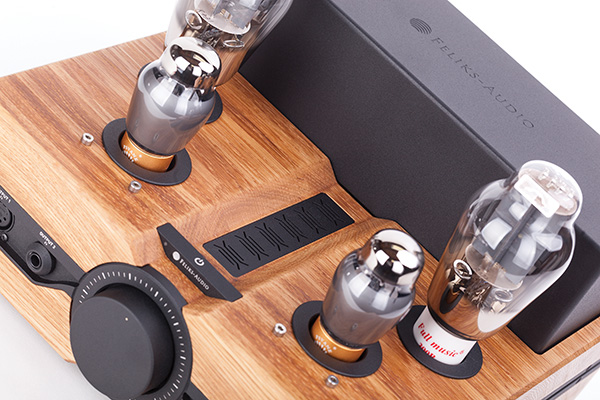
I have owned and used Western Electric 300Bs from every decade since they were introduced, as well as a pair of 300As from cinema's pre-code era ca 1937. Not one of them has sounded anything but bell-clear and Technicolor—never warm or cool or soft or impure. Outer-space–level clarity is the main sonic trait of Western Electric 300Bs, which is also the Envy's most obvious trait. The Envy's stock, Chinese-manufactured TJ 300Bs performed flawlessly and never seemed anything but liquid clear and beguiling, but I could not resist seeing if the Envy's transparency would be upgraded with Western Electric's new, US-manufactured 300Bs ($1499/matched pair).
 Western Electric's 300Bs took three hours to sound what I considered normal, but I could tell right away that the change would be interesting to observe. During the Western Electric's fifth hour, I played Tchaikovsky: Ballet Suites with the Berlin Philharmonic under the guidance of Mstislav Rostropovich (24/96 FLAC, Deutsche Grammophon/Qobuz). What I heard was intriguing because the change was mostly textural. Compared to the TJ Full Music 300B SEs, the air was cleaner between the instruments, and their outlines seemed more distinct, but my attentions were continually drawn to how minutely textured the sound was. Sound energy appeared to be made of smaller elements, like a shirt made with finer threads. The WE300B's pure, finely textured sound made Tchaikovsky's Ballet Suites seem almost analog. Contrasts were distinctly more life-like with the Western Electrics, but music seemed more relaxed and approachable with both the TJs and the Electro-Harmonix. I think Feliks made a wise decision to use the base-model TJs, and I imagine many tube-rolling users will have a hard time finding a 300B they like better.
LTA Z10e
Western Electric's 300Bs took three hours to sound what I considered normal, but I could tell right away that the change would be interesting to observe. During the Western Electric's fifth hour, I played Tchaikovsky: Ballet Suites with the Berlin Philharmonic under the guidance of Mstislav Rostropovich (24/96 FLAC, Deutsche Grammophon/Qobuz). What I heard was intriguing because the change was mostly textural. Compared to the TJ Full Music 300B SEs, the air was cleaner between the instruments, and their outlines seemed more distinct, but my attentions were continually drawn to how minutely textured the sound was. Sound energy appeared to be made of smaller elements, like a shirt made with finer threads. The WE300B's pure, finely textured sound made Tchaikovsky's Ballet Suites seem almost analog. Contrasts were distinctly more life-like with the Western Electrics, but music seemed more relaxed and approachable with both the TJs and the Electro-Harmonix. I think Feliks made a wise decision to use the base-model TJs, and I imagine many tube-rolling users will have a hard time finding a 300B they like better.
LTA Z10eLinear Tube Audio's $6950 Z10e integrated headphone amplifier is the centerpiece of my everyday desktop system. It's anchored there because it can drive my Dynaudio Excite X14 speakers, has three line-level inputs, and has outputs for every type of headphone, including electrostatics.
HeadAmp's GS-X Mini solid state headphone amplifier/preamplifier is similar to the Feliks Envy and the LTA Z10e in that it was designed to power even difficult-to-drive headphones like the Abyss 1266 and HiFiMan Susvara, but it is not similar in price: It sells for $1795. Alternating between my floor and desk systems, I've used the slender GS-X Mini for many hundreds of hours; the only times it makes me wish for something better are when I itch for some 300B pleasure, beyond the GS-X's straightforward presentation. I was curious how it would match up with Feliks's no-feedback 300B amp. A fun part of audio reviewing is how rarely I know what will happen in a comparison. This one made me smile big, because damn me if the GS-X Mini didn't make HiFiMan's HE-R10P planar magnetic headphones sound like those Koss 950 electrostatics. As I wrote at the beginning of this column, that's the midrange I'm always looking for. Plus, the HeadAmp seemed more alive and microdynamically nuanced than it did with its usual partner, the Denafrips Aries II DAC. I suspect the HoloAudio Spring 3 DAC was the cause of this awakening, as jump, glow, and vigor are also its chief traits.
 The GS-X Mini out-bassed its tubed competition playing Swedish singer, composer, and pipe organist Anna von Hausswolf's The Truth, the Glow, the Fall (Live at Montreux) (24/96 FLAC, Southern Lord/Qobuz). With the GS-X Mini, she came through like a giant of nature. It was fun watching how the HeadAmp's bass capabilities made this album feel bigger, stronger, and more dramatic than it did with the LTA and Feliks offerings.
It was less fun noticing how "solid state" the Mini sounded. After weeks with the Envy's luxurious-sounding no-feedback triodes, the GS-X Mini made music feel unnecessarily tight and tidy in a way that limited expansiveness and atmosphere. The Mini is extremely transparent and handles reverb very nicely, but it hits that old "transistor ceiling" when reproducing tone color, microtextures, and the empty spaces between sounds. But that shouldn't surprise anyone.
In contrast, what the Feliks Envy did with Anna was make her live performance seem more live—like I was there at the recording venue—than it did with the HeadAmp amp. The Envy made Anna von Hausswolff feel like a thinking, feeling person that was performing on the other side of the microphones.
The GS-X Mini out-bassed its tubed competition playing Swedish singer, composer, and pipe organist Anna von Hausswolf's The Truth, the Glow, the Fall (Live at Montreux) (24/96 FLAC, Southern Lord/Qobuz). With the GS-X Mini, she came through like a giant of nature. It was fun watching how the HeadAmp's bass capabilities made this album feel bigger, stronger, and more dramatic than it did with the LTA and Feliks offerings.
It was less fun noticing how "solid state" the Mini sounded. After weeks with the Envy's luxurious-sounding no-feedback triodes, the GS-X Mini made music feel unnecessarily tight and tidy in a way that limited expansiveness and atmosphere. The Mini is extremely transparent and handles reverb very nicely, but it hits that old "transistor ceiling" when reproducing tone color, microtextures, and the empty spaces between sounds. But that shouldn't surprise anyone.
In contrast, what the Feliks Envy did with Anna was make her live performance seem more live—like I was there at the recording venue—than it did with the HeadAmp amp. The Envy made Anna von Hausswolff feel like a thinking, feeling person that was performing on the other side of the microphones.
I admit to being taken by the Feliks Envy's bold but tasteful style. It looks like it was designed to sit on a smart person's desk, beckoning constantly to be used. With every headphone I tried, it performed as though it had been engineered to present recordings in the most vivid manner possible, be 100% musically satisfying, and be the last headphone amplifier any of us might need to own. My advice: Do not go to a CanJam without auditioning this extraordinarily high-performance machine. It's top-of-the-world wonderful. My other advice: Try tripping into the fantastic world of electrostatic midrange with a Koss ESP/950 headphone kit. It comes with a lifetime warranty and may be all the headphone gear you'll ever need.