When I flipped the Mighty's deck-mounted switches to engage triode operation, the sound with the Falcons became more pure by several notches—and also more color-saturated.
 In UL mode, Chesky Records' first release, Hector Berlioz's Symphonie Fantastique: Opus 14 performed by The Royal Philharmonic conducted by Massimo Freccia, recorded by Kenneth Wilkinson in 1962 for a Reader's Digest box set (LP CR-1), sounded powerful and micro-focused but also grayed and a little brittle.
In triode mode, the Mighty's pentodes made the strings of The Royal Philharmonic glow. I could feel the volume of their massed energy bouncing off the walls of Waltham Forest Town Hall. Sounds that in UL mode had been brittle and bright were now supple and sensuous. Colors came out of hiding. Transparency was a notch down compared to the directly heated triodes, but only a touch. It was a "Bravo! I love orchestra recordings" moment.
Compared to the Elekit TU-8600S
In UL mode, Chesky Records' first release, Hector Berlioz's Symphonie Fantastique: Opus 14 performed by The Royal Philharmonic conducted by Massimo Freccia, recorded by Kenneth Wilkinson in 1962 for a Reader's Digest box set (LP CR-1), sounded powerful and micro-focused but also grayed and a little brittle.
In triode mode, the Mighty's pentodes made the strings of The Royal Philharmonic glow. I could feel the volume of their massed energy bouncing off the walls of Waltham Forest Town Hall. Sounds that in UL mode had been brittle and bright were now supple and sensuous. Colors came out of hiding. Transparency was a notch down compared to the directly heated triodes, but only a touch. It was a "Bravo! I love orchestra recordings" moment.
Compared to the Elekit TU-8600S
The first amplifier I compared Lab12's Mighty to was Elekit's TU-8600S 300B single-ended ($1880 plus the cost of tubes). The Elekit was using the Linlai Cossor WE300B tubes. The first thing I noticed after the changeover was how much softer, larger, and calmer the energy field had become. With the Linlai 300Bs, bass notes seemed more expansive and more harmonically developed than with the Mighty in either mode. Played through the Elekit with the Linlai tubes, on Julia Wolfe's Soõ Percussion album Forbidden Love (24/96 FLAC, Cantaloupe Music/Qobuz), low-frequency reverb tails were more spacious and much longer. It was not subtle. In both UL and triode modes, the EL34 Mighty played with crisper, more conspicuously detailed clarity, which distributed charged energy across a well-constructed, shallower sound matrix. With the Mighty, the quantity and aesthetic quality of reverb was always good but sometimes a little short-tailed and never the main attraction. With the Elekit, reverb was the tasty sauce of the main course. The chief difference between the 300B amp and the EL34 amp was this: The Mighty made my Falcons sound precise, like mastering-lab monitors; the TU-8600S made them sound relaxed, like horn speakers.
The Mighty and the Elekit sounded more alike when I switched from Linlai's "Western Electric Replica" tubes to new-manufacture (2021) Western Electric 300Bs. The Western Electric tubes sharpened the Elekit's focus, added density and clarity, and sparked up all forms of dynamics to something closer to the Mighty in UL mode, which threw punches like a fit middleweight.
I was raised in a German-speaking household by a Teutonic father who played Gustav Mahler and organ music by Bach almost exclusively. My Dad passed decades ago, so sometimes I feel a need for day-long doses of German lieder to remind me how a German voice sounds. When I do this, the first recordings I reach for are songs sung by Dietrich Fischer-Dieskau.
 I already knew that the Western Electric–tubed Elekit amplifier preserved Fischer-Dieskau's tone better than any other amp in my herd, so I was revved to see how the Mighty would handle that godlike baritone. I played my Made-in-Germany "tulips" pressing (Deutsche Grammophon LP SLPM 138 117) of Fischer-Dieskau singing Ein Schubert-Gothe-Liederaband, first through the Elekit and then through the Lab12 Mighty in triode mode.
With the Elekit equipped with Western Electric tubes, Fischer-Dieskau's voice came out of the Falcons with gripping volume, power, and old-school German manner. The only thing missing with the 300Bs was the rugged high-relief texture of the baritone's upper registers—and that's exactly what the Lab12 in triode mode delivered, along with a wet, glowing transparency I never thought I'd hear from a pentode.
I don't want to say the Elekit and the triode-wired Mighty sounded alike, but mostly they did. The chief difference was in how the triode-wired Mighty emphasized the immediacy and raw texture of the upper octaves while the Elekit directed my attention to beauties in the baritone's mid and lower octaves.
Yet another bias: I was sure there was zero chance that a triode-connected EL34 could play with as much explicitness as a directly heated power triode. Once again, the Mighty rebuked my preconceptions, reminding me to judge amplifiers slowly by listening to the sounds coming from my speakers and not by the voices in my head. In triode mode, playing Goethe's "An Schwager Kronos," the Mighty showed me the size of the recital hall and rocked my small room literally with 80dB average levels, 94dB peaks, and no signs of clipping or gasping for current.
With Klipsch RP-600M
I already knew that the Western Electric–tubed Elekit amplifier preserved Fischer-Dieskau's tone better than any other amp in my herd, so I was revved to see how the Mighty would handle that godlike baritone. I played my Made-in-Germany "tulips" pressing (Deutsche Grammophon LP SLPM 138 117) of Fischer-Dieskau singing Ein Schubert-Gothe-Liederaband, first through the Elekit and then through the Lab12 Mighty in triode mode.
With the Elekit equipped with Western Electric tubes, Fischer-Dieskau's voice came out of the Falcons with gripping volume, power, and old-school German manner. The only thing missing with the 300Bs was the rugged high-relief texture of the baritone's upper registers—and that's exactly what the Lab12 in triode mode delivered, along with a wet, glowing transparency I never thought I'd hear from a pentode.
I don't want to say the Elekit and the triode-wired Mighty sounded alike, but mostly they did. The chief difference was in how the triode-wired Mighty emphasized the immediacy and raw texture of the upper octaves while the Elekit directed my attention to beauties in the baritone's mid and lower octaves.
Yet another bias: I was sure there was zero chance that a triode-connected EL34 could play with as much explicitness as a directly heated power triode. Once again, the Mighty rebuked my preconceptions, reminding me to judge amplifiers slowly by listening to the sounds coming from my speakers and not by the voices in my head. In triode mode, playing Goethe's "An Schwager Kronos," the Mighty showed me the size of the recital hall and rocked my small room literally with 80dB average levels, 94dB peaks, and no signs of clipping or gasping for current.
With Klipsch RP-600M
Another bias-defeating shift occurred when I switched from the relatively compressed BBC sound of my reference Falcons to the wider-open, more fluid and immediate-sounding Klipsch RP-600M speakers. With the Mighty driving the easy-to-drive Klipsch playing one of the great recordings of all time, Argerich & Ricci: 1961 Leningrad Recital II (16/44.1 FLAC DOREMI/Qobuz), the sound seemed raw, stripped bare of hazy impediments, distinctly more vibrant, there, and uncompressed than it does through my beloved Falcons. These almost-free ($769/pair) bookshelf speakers do not project sound with the same levels of descriptive precision and refined tone as the Falcon Gold Badges, but, on the other hand, the Gold Badges do not wake up the room and approach the listener with as much scintillating energy as the RP-600M. Every time I use these cool-looking Klipschs, I love them more. In the best sense of the expression, Lab12's Mighty amp powering Klipsch's RP-600M speakers was the bleacher-level ticket to the triode-horn experience. I have long said everything I ever mocked, I've become. It continues to be true. I never imagined a single EL34 wired in triode could satisfy at the same level as a "real" triode—I always assumed that it couldn't—but my experiences with Lab12's Mighty proved that assumption to be wrong. Likewise, I never thought I'd be an apologist for Ultralinear operation, but here I am loving the extraordinary focus and vibrancy of the Mighty in UL mode. The Mighty is an exciting-to-use, paradigm-shifting treat.
Another Lab12 component: the Lab12 Pre1
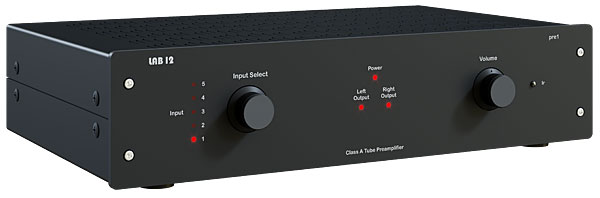
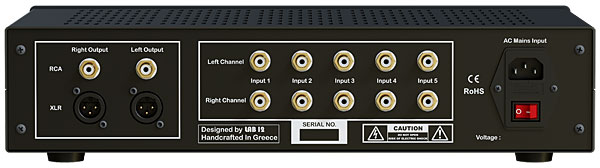
Besides its timeless, recording-studio look, the first thing I noticed about Lab12's Pre1 preamplifier is that it uses one medium-mu (33) E88CC twin-triode per channel to develop 21dB (!) of gain with no feedback. Typically, line stages deliver 6–12dB of gain. The potential is there: With no feedback and those high-transconductance E88CCs, I should get clarity, microdetail, and high-revving dynamic excitements. And that's what I got. The Pre1 has five line-level (RCA) inputs and two outputs: one RCA, the other XLR. When I looked at the manual, I noticed that the Pre1's input impedance is specified as 50k ohms, its output impedance as 900 ohms, which means the Pre1 should interface well with most sources and power amplifiers, at least in terms of those basic electrical parameters. It measures 17" × 4.3" × 11.4" and weighs 15.4lb. It costs $2290 and uses solid state rectifiers, generic, hard-rubber footers, and a motorized, made-in-Japan Alps Blue Velvet volume control. When driving its Mighty stablemate, the Pre1 took all the Mighty's strong points and improved them, emphasizing speed, clarity, detail, and momentum. The Pre1's transparency-sparkle factor was off the charts.
When I switched to the Pre1 from the most invisible preamp I've found, HoloAudio's KTE Serene, I was impressed to notice that the Pre1's clarity/transparency/ invisibility was equal to that of the higher-priced Serene ($3098). That doesn't mean that they sound the same. The main difference listening-wise between the Serene and the Pre1 was in the contrasting, tube-vs-transistor character of their transparencies. The Serene presents recordings with a startling lack of coloration backed by force and urgency. The Pre1 does that, too, but the Pre1's transparency is less stark than the Serene's, breathier and more vibrant with a slight, just-right aura of tube radiance.
 The ultimate "Wow!"
When I realized the Pre1 has 21dB of gain, I couldn't wait to pair it with the First Watt F8, a two-stage, single-ended, no-feedback JFET amp that's gain-challenged, making only 15dB. With the Serene, which makes about 6dB, the F8 was quiet and extremely pure of tone but low on bright-light vividness and jump factor.
The Pre1 fixed those shortcomings. Fed by the Pre1, First Watt's F8 became a full-power dynamo, driving some of that British reserve out of the Gold Badges. Even more than the Serene, the Pre1 sparked the F8 into full animation and all-out peacock-color glory. I never imagined the F8 was capable of that much tight bass or dynamic athleticism. I felt like: This is it! All I'll ever need!
Compared to the PrimaLuna EVO 400
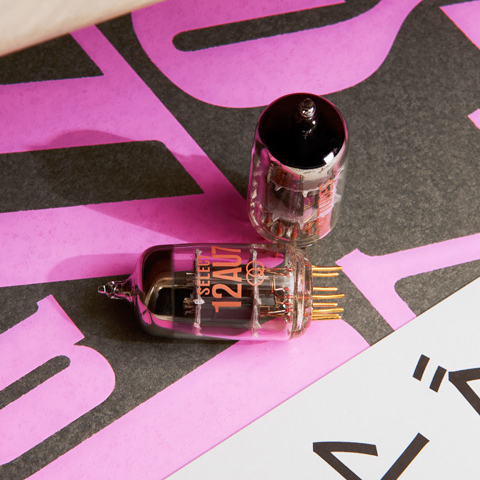
Speaking of "all I'll ever need," I have in the bunker some products that I have reviewed but have not used often enough for comparisons. Most notable among these is PrimaLuna's flagship EVO 400 preamplifier ($4495), which I regard as the most natural, unaffected line-level preamplifier I've used. It is my reference tube preamp. The EVO 400 is a complete dual-mono design, with two 5AR4 tube rectifiers (one for each channel) and three 12AU7 twin triodes per channel plus five source inputs, two of which are XLR, three RCA, and an output impedance of 256 ohms.
 When I removed Lab12's Pre1 and put the EVO 400 pre in front of the First Watt F8, the sound changed from spring-fed fast-running stream to something denser, more oceanic and enveloping. Compared to the PrimaLuna, the Pre1 sounded turbocharged. Could this be the difference between solid state and tube rectifiers?
Both tube preamps played recordings with more splendor and tactility than the solid state HoloAudio Serene, but neither pre could match the Serene for low-end gut-punch, upper-base detail, or dynamic swagger. I regard all three preamps as sitting at or near the leading edge of what's possible with line-level preamplification.
Pre1 + G Three
When I removed Lab12's Pre1 and put the EVO 400 pre in front of the First Watt F8, the sound changed from spring-fed fast-running stream to something denser, more oceanic and enveloping. Compared to the PrimaLuna, the Pre1 sounded turbocharged. Could this be the difference between solid state and tube rectifiers?
Both tube preamps played recordings with more splendor and tactility than the solid state HoloAudio Serene, but neither pre could match the Serene for low-end gut-punch, upper-base detail, or dynamic swagger. I regard all three preamps as sitting at or near the leading edge of what's possible with line-level preamplification.
Pre1 + G Three
I stated in the introduction that Genelec's G Three active speakers were my cleanest window for observing the quality of line-level components; they are also good at exposing noise, fog, and compression in whatever amp-speaker combo they replace.
After the switch from the Pre1–Mighty–Falcon combo to the Pre1–G Three, the first thing I noticed was how the bass was now bigger and more present than it had been with the Falcons and how it rolled off more abruptly. Once my brain got past all that new bass energy, I realized I was experiencing a more refined, grainless, "invisible" preamplifier than any I could recall using.
As I listened to my new favorite composition, "Emotionsea," from my new favorite album, In June by Fama M'boup (24/48 FLAC, o-cetera/Qobuz), it became clear that the Lab12 Pre1 driving the G Threes, sourced by the Denafrips Terminator Plus, was possibly the most vivacious, deliciously see-into, show-me-the-recording sound I've ever heard from my little hi-fi. Treble and voice articulation were the best I've heard from digital. I marveled at how each cut on the same album sounded as different as it was recorded.
If you have a small room and like your recording playback uncolored but colorful, this could be an end-game sound system.
In sum
If you're a tube-favoring audiophile, these Lab12 separates offer pure, high-lucidity sound with just enough tube brilliance and harmonic sheen to keep the sound fascinating and the music human. Highly recommended.
In UL mode, Chesky Records' first release, Hector Berlioz's Symphonie Fantastique: Opus 14 performed by The Royal Philharmonic conducted by Massimo Freccia, recorded by Kenneth Wilkinson in 1962 for a Reader's Digest box set (LP CR-1), sounded powerful and micro-focused but also grayed and a little brittle.
In triode mode, the Mighty's pentodes made the strings of The Royal Philharmonic glow. I could feel the volume of their massed energy bouncing off the walls of Waltham Forest Town Hall. Sounds that in UL mode had been brittle and bright were now supple and sensuous. Colors came out of hiding. Transparency was a notch down compared to the directly heated triodes, but only a touch. It was a "Bravo! I love orchestra recordings" moment.
The first amplifier I compared Lab12's Mighty to was Elekit's TU-8600S 300B single-ended ($1880 plus the cost of tubes). The Elekit was using the Linlai Cossor WE300B tubes. The first thing I noticed after the changeover was how much softer, larger, and calmer the energy field had become. With the Linlai 300Bs, bass notes seemed more expansive and more harmonically developed than with the Mighty in either mode. Played through the Elekit with the Linlai tubes, on Julia Wolfe's Soõ Percussion album Forbidden Love (24/96 FLAC, Cantaloupe Music/Qobuz), low-frequency reverb tails were more spacious and much longer. It was not subtle. In both UL and triode modes, the EL34 Mighty played with crisper, more conspicuously detailed clarity, which distributed charged energy across a well-constructed, shallower sound matrix. With the Mighty, the quantity and aesthetic quality of reverb was always good but sometimes a little short-tailed and never the main attraction. With the Elekit, reverb was the tasty sauce of the main course. The chief difference between the 300B amp and the EL34 amp was this: The Mighty made my Falcons sound precise, like mastering-lab monitors; the TU-8600S made them sound relaxed, like horn speakers.
I already knew that the Western Electric–tubed Elekit amplifier preserved Fischer-Dieskau's tone better than any other amp in my herd, so I was revved to see how the Mighty would handle that godlike baritone. I played my Made-in-Germany "tulips" pressing (Deutsche Grammophon LP SLPM 138 117) of Fischer-Dieskau singing Ein Schubert-Gothe-Liederaband, first through the Elekit and then through the Lab12 Mighty in triode mode.
Another bias-defeating shift occurred when I switched from the relatively compressed BBC sound of my reference Falcons to the wider-open, more fluid and immediate-sounding Klipsch RP-600M speakers. With the Mighty driving the easy-to-drive Klipsch playing one of the great recordings of all time, Argerich & Ricci: 1961 Leningrad Recital II (16/44.1 FLAC DOREMI/Qobuz), the sound seemed raw, stripped bare of hazy impediments, distinctly more vibrant, there, and uncompressed than it does through my beloved Falcons. These almost-free ($769/pair) bookshelf speakers do not project sound with the same levels of descriptive precision and refined tone as the Falcon Gold Badges, but, on the other hand, the Gold Badges do not wake up the room and approach the listener with as much scintillating energy as the RP-600M. Every time I use these cool-looking Klipschs, I love them more. In the best sense of the expression, Lab12's Mighty amp powering Klipsch's RP-600M speakers was the bleacher-level ticket to the triode-horn experience. I have long said everything I ever mocked, I've become. It continues to be true. I never imagined a single EL34 wired in triode could satisfy at the same level as a "real" triode—I always assumed that it couldn't—but my experiences with Lab12's Mighty proved that assumption to be wrong. Likewise, I never thought I'd be an apologist for Ultralinear operation, but here I am loving the extraordinary focus and vibrancy of the Mighty in UL mode. The Mighty is an exciting-to-use, paradigm-shifting treat.
Besides its timeless, recording-studio look, the first thing I noticed about Lab12's Pre1 preamplifier is that it uses one medium-mu (33) E88CC twin-triode per channel to develop 21dB (!) of gain with no feedback. Typically, line stages deliver 6–12dB of gain. The potential is there: With no feedback and those high-transconductance E88CCs, I should get clarity, microdetail, and high-revving dynamic excitements. And that's what I got. The Pre1 has five line-level (RCA) inputs and two outputs: one RCA, the other XLR. When I looked at the manual, I noticed that the Pre1's input impedance is specified as 50k ohms, its output impedance as 900 ohms, which means the Pre1 should interface well with most sources and power amplifiers, at least in terms of those basic electrical parameters. It measures 17" × 4.3" × 11.4" and weighs 15.4lb. It costs $2290 and uses solid state rectifiers, generic, hard-rubber footers, and a motorized, made-in-Japan Alps Blue Velvet volume control. When driving its Mighty stablemate, the Pre1 took all the Mighty's strong points and improved them, emphasizing speed, clarity, detail, and momentum. The Pre1's transparency-sparkle factor was off the charts.
The ultimate "Wow!"When I realized the Pre1 has 21dB of gain, I couldn't wait to pair it with the First Watt F8, a two-stage, single-ended, no-feedback JFET amp that's gain-challenged, making only 15dB. With the Serene, which makes about 6dB, the F8 was quiet and extremely pure of tone but low on bright-light vividness and jump factor.
Speaking of "all I'll ever need," I have in the bunker some products that I have reviewed but have not used often enough for comparisons. Most notable among these is PrimaLuna's flagship EVO 400 preamplifier ($4495), which I regard as the most natural, unaffected line-level preamplifier I've used. It is my reference tube preamp. The EVO 400 is a complete dual-mono design, with two 5AR4 tube rectifiers (one for each channel) and three 12AU7 twin triodes per channel plus five source inputs, two of which are XLR, three RCA, and an output impedance of 256 ohms.
When I removed Lab12's Pre1 and put the EVO 400 pre in front of the First Watt F8, the sound changed from spring-fed fast-running stream to something denser, more oceanic and enveloping. Compared to the PrimaLuna, the Pre1 sounded turbocharged. Could this be the difference between solid state and tube rectifiers?
Both tube preamps played recordings with more splendor and tactility than the solid state HoloAudio Serene, but neither pre could match the Serene for low-end gut-punch, upper-base detail, or dynamic swagger. I regard all three preamps as sitting at or near the leading edge of what's possible with line-level preamplification.
Pre1 + G ThreeI stated in the introduction that Genelec's G Three active speakers were my cleanest window for observing the quality of line-level components; they are also good at exposing noise, fog, and compression in whatever amp-speaker combo they replace.
If you're a tube-favoring audiophile, these Lab12 separates offer pure, high-lucidity sound with just enough tube brilliance and harmonic sheen to keep the sound fascinating and the music human. Highly recommended.