Compared to the Schiit Mani's yin, the Blue Horizon Profono's sound was conspicuously yang: bright, practical, masculine. Switching from the Schiit to the Blue Horizon was like traveling from 17th-century Baroque Holland to 18th-century Enlightenment England: In contrast to the Mani's romantic leanings, the Profono presented music with neoclassical precision. There were no shadows at the edges of the soundstage, and images within the soundstage were drawn with a sharp-nibbed pen. Unfortunately, the Profono made the Denon DL-103 and Jasmine Turtle MCs sound a bit more "moving-coil" than I would prefer. But it made the luxurious Soundsmith Carmen MI sound enjoyably more alive and sunny than Soundsmith's own MMP3 moving-magnet stage ($649).
For many months now, the Profono and Carmen have comprised my reference LP front end, and in my system(s), the combo has felt extremely well poised in a classic balance of yin and yang. The Profono helped me fall in love with the Miyajima Spirit and Miyabi mono cartridges, allowing them to be no more and no less than what they both are: meaty, chunky, well-textured, corporeal. What I most appreciate about the Profono is how it always delivered the forward momentum of brisk, high-spirited walking. It also excelled at what I call voice articulation: Male voices, especially, had textbook elocution and positive masculine clarity. (Voice articulation is one of the things that vintage Western Electric gear is all about!) Off-mike audience applause and chatter were less muddy than with most phono stages.
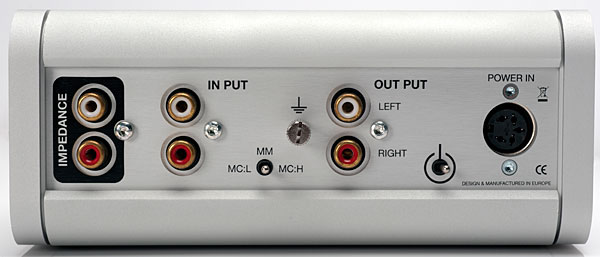 If you're a card-carrying audiophile with a desire to explore the upwardly mobile reaches of high-resolution phonography—ie, sound quality beyond that provided by the phono stages included in most integrated amplifiers—I promise that you will be happy with the sound quality and flexibility of the Profono from Blue Horizon Ideas.
Herb loves . . .
If you're a card-carrying audiophile with a desire to explore the upwardly mobile reaches of high-resolution phonography—ie, sound quality beyond that provided by the phono stages included in most integrated amplifiers—I promise that you will be happy with the sound quality and flexibility of the Profono from Blue Horizon Ideas.
Herb loves . . .
In my experience, even the most expensive systems sound more like clock radios than a full orchestra or the Rolling Stones at Giants Stadium. But! Even small differences in the sound of hi-fi gear can have big effects on our ability to understand and enjoy our recordings. Therefore, it is essential for each of us to spend quality time listening to, pondering about, and self-consciously appreciating recorded music. In order to condition our humanity and our audiographic memory and taste, we must do this mindfully, so that we can become our own connoisseurs of audiophile-quality music playback. The well-designed Schiit Audio Mani and Blue Horizon Ideas Profono phono preamplifiers should be thought of as superior-quality, high-value tools capable of guiding us toward a deeper understanding of our black discs. Mr. Stacey
Just as I was finally hunkering down to write about the Schiit Audio Mani and the Blue Horizon Ideas Profono, I got a strange blast-from-the-past phone call from an "unknown" number. It was the mysterious, long-lost Mr. Stacey, of the Smoky Basement Club. She'd just finished building a new tubed phono preamp and wanted to come over and listen to it with me—right now. I explained that I was a shut-in and never got out of my pajamas: She paid no attention. An hour later, Mr. Stacey and her three "design collaborators" were unplugging everything in my system and installing her two-box prototype. I sat by, silent, tired, and annoyed.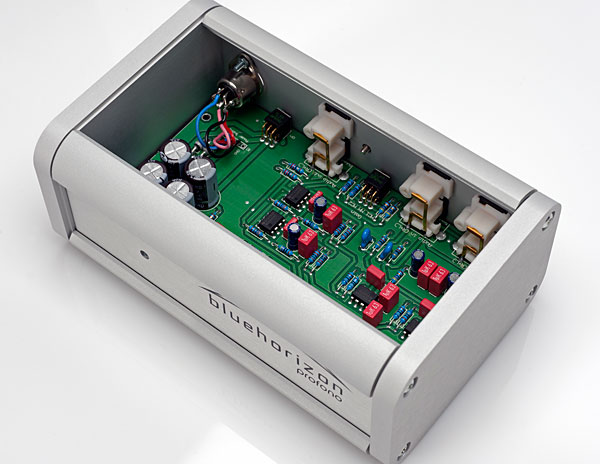 As I chatted away on Facebook, Mr. Stacey lowered my Pioneer PLX-1000's tonearm, with Ortofon 2M Black cartridge, onto the lead-in groove of the first album they saw: Tommy Makem and the Clancy Brothers' A Spontaneous Performance Recording! (Columbia CS 8448), made in 1961 at Columbia's vast 30th Street Studios. My room filled up with the sound of Makem and the Clancys performing the famous and jiggy "Tim Finnegan's Wake" in front of 200 of their shouting, foot-stomping friends.
Moments later, I was choked up and speechless. What the hay? How could this be? This live recording seemed way more live than I had heard any record sound. Ever. I felt as if I could measure the 14" between the mike and Pete Seeger's banjo. All the weird, cloudy, jittery "cartridge noises" I'd become completely used to had vanished. I could smell Makem's breath. I remembered Liam Clancy's words: "Ireland was Ireland when England was a pup, / and Ireland will be Ireland when England's time is up." I sat in complete awe of the spellbinding sound quality. No question: This was the best, most revealing, most sonically complete, most rich, most staggeringly tactile, nothing-left-out-but-the-cartridge-noises LP reproduction I had ever experienced anywhere, anytime, at any price.
My best description of how good this LP sounded: If I removed that budget Pioneer tonearm and modest Ortofon cartridge and replaced them with an old toothbrush hanging on a string, it would still be the best gramophone reproduction this irate shut-in had ever experienced. And everyone in the room agreed.
We played at least a dozen records on my Thorens TD 124 with the Abis SA1.2 arm and Zu DL-103, and every one made me think: I guess it doesn't matter which cartridge, tonearm, turntable, amp, or speakers you have; all you need is a killer phono stage. Is that possible? I used to think the 'table, arm, and cartridge—maybe even the stylus profile—were the heart, breath, and soul of any great stereo system. But suddenly I'm wondering, Maybe it's the phono stage . . . ?
I asked Mr. Stacey if her preamp was for sale.
"Not yet."
"How much do you think it will cost?"
"It is a silver-wired, transformer-coupled, ultra-high-transconductance tube design with passive resistor-inductor (no capacitors) RIAA and 14 totally separate power supplies. It would have to be at least $40,000!" In fact, Mr. Stacey's preamp was an all-out mash-up variation on and evolution of the split-passive RIAA strategy Mike Moffat invented, and of the iron-nickel-core transformer-plus-inductor approach favored by Sakuma-san—influences Mr. Stacey would be the first to acknowledge.
Mr. Stacey and her collaborators left me audio drunk and staggering, wires hanging everywhere. When my system was back in order, I played the Clancy Brothers LP again, first via the Schiit Mani. It actually sounded quieter and more Dionysian than the Stacey stage—but also smaller, less vivid, and a lot less weighty and corporeal. All the way through, I kept thinking, This Schiit costs 0.0032% the projected price of the Stacey, and dammit, the Mani sounds completely righteous in its own eminently musical way.Through the Mani, the air in that 30th Street Studio was obviously darker and thicker than through the profoundly transparent Stacey—but its volume was not reduced. After my new symbol of the Best at Any Cost had left the room, the Mani still pleased me: It sounded open and well organized, and left me free to focus on the music.
The Blue Horizon Ideas Profono played righteously, too—but in an even more Apollonian way than the Stacey or the Mani. (The Mani was more like the Stacey in its femininity and charming delicacy.) The Profono was especially wonderful at distinguishing among the voices of the Clancy Brothers' 200 friends as they joined in every sing-along.
Folks, I swear to you right now: In today's world of high-end audio, the distance between the far-out absolute best and the pretty damn good at a reasonable price is not as big as you might think. And I tell this story not simply to show you how excellent and satisfying these two inexpensive phono stages are, but to give you a sly peek into some of the most secret carryings-on in that smoky, floating world of Gramophone Dreams.
As I chatted away on Facebook, Mr. Stacey lowered my Pioneer PLX-1000's tonearm, with Ortofon 2M Black cartridge, onto the lead-in groove of the first album they saw: Tommy Makem and the Clancy Brothers' A Spontaneous Performance Recording! (Columbia CS 8448), made in 1961 at Columbia's vast 30th Street Studios. My room filled up with the sound of Makem and the Clancys performing the famous and jiggy "Tim Finnegan's Wake" in front of 200 of their shouting, foot-stomping friends.
Moments later, I was choked up and speechless. What the hay? How could this be? This live recording seemed way more live than I had heard any record sound. Ever. I felt as if I could measure the 14" between the mike and Pete Seeger's banjo. All the weird, cloudy, jittery "cartridge noises" I'd become completely used to had vanished. I could smell Makem's breath. I remembered Liam Clancy's words: "Ireland was Ireland when England was a pup, / and Ireland will be Ireland when England's time is up." I sat in complete awe of the spellbinding sound quality. No question: This was the best, most revealing, most sonically complete, most rich, most staggeringly tactile, nothing-left-out-but-the-cartridge-noises LP reproduction I had ever experienced anywhere, anytime, at any price.
My best description of how good this LP sounded: If I removed that budget Pioneer tonearm and modest Ortofon cartridge and replaced them with an old toothbrush hanging on a string, it would still be the best gramophone reproduction this irate shut-in had ever experienced. And everyone in the room agreed.
We played at least a dozen records on my Thorens TD 124 with the Abis SA1.2 arm and Zu DL-103, and every one made me think: I guess it doesn't matter which cartridge, tonearm, turntable, amp, or speakers you have; all you need is a killer phono stage. Is that possible? I used to think the 'table, arm, and cartridge—maybe even the stylus profile—were the heart, breath, and soul of any great stereo system. But suddenly I'm wondering, Maybe it's the phono stage . . . ?
I asked Mr. Stacey if her preamp was for sale.
"Not yet."
"How much do you think it will cost?"
"It is a silver-wired, transformer-coupled, ultra-high-transconductance tube design with passive resistor-inductor (no capacitors) RIAA and 14 totally separate power supplies. It would have to be at least $40,000!" In fact, Mr. Stacey's preamp was an all-out mash-up variation on and evolution of the split-passive RIAA strategy Mike Moffat invented, and of the iron-nickel-core transformer-plus-inductor approach favored by Sakuma-san—influences Mr. Stacey would be the first to acknowledge.
Mr. Stacey and her collaborators left me audio drunk and staggering, wires hanging everywhere. When my system was back in order, I played the Clancy Brothers LP again, first via the Schiit Mani. It actually sounded quieter and more Dionysian than the Stacey stage—but also smaller, less vivid, and a lot less weighty and corporeal. All the way through, I kept thinking, This Schiit costs 0.0032% the projected price of the Stacey, and dammit, the Mani sounds completely righteous in its own eminently musical way.Through the Mani, the air in that 30th Street Studio was obviously darker and thicker than through the profoundly transparent Stacey—but its volume was not reduced. After my new symbol of the Best at Any Cost had left the room, the Mani still pleased me: It sounded open and well organized, and left me free to focus on the music.
The Blue Horizon Ideas Profono played righteously, too—but in an even more Apollonian way than the Stacey or the Mani. (The Mani was more like the Stacey in its femininity and charming delicacy.) The Profono was especially wonderful at distinguishing among the voices of the Clancy Brothers' 200 friends as they joined in every sing-along.
Folks, I swear to you right now: In today's world of high-end audio, the distance between the far-out absolute best and the pretty damn good at a reasonable price is not as big as you might think. And I tell this story not simply to show you how excellent and satisfying these two inexpensive phono stages are, but to give you a sly peek into some of the most secret carryings-on in that smoky, floating world of Gramophone Dreams.
If you're a card-carrying audiophile with a desire to explore the upwardly mobile reaches of high-resolution phonography—ie, sound quality beyond that provided by the phono stages included in most integrated amplifiers—I promise that you will be happy with the sound quality and flexibility of the Profono from Blue Horizon Ideas.
In my experience, even the most expensive systems sound more like clock radios than a full orchestra or the Rolling Stones at Giants Stadium. But! Even small differences in the sound of hi-fi gear can have big effects on our ability to understand and enjoy our recordings. Therefore, it is essential for each of us to spend quality time listening to, pondering about, and self-consciously appreciating recorded music. In order to condition our humanity and our audiographic memory and taste, we must do this mindfully, so that we can become our own connoisseurs of audiophile-quality music playback. The well-designed Schiit Audio Mani and Blue Horizon Ideas Profono phono preamplifiers should be thought of as superior-quality, high-value tools capable of guiding us toward a deeper understanding of our black discs. Mr. Stacey
Just as I was finally hunkering down to write about the Schiit Audio Mani and the Blue Horizon Ideas Profono, I got a strange blast-from-the-past phone call from an "unknown" number. It was the mysterious, long-lost Mr. Stacey, of the Smoky Basement Club. She'd just finished building a new tubed phono preamp and wanted to come over and listen to it with me—right now. I explained that I was a shut-in and never got out of my pajamas: She paid no attention. An hour later, Mr. Stacey and her three "design collaborators" were unplugging everything in my system and installing her two-box prototype. I sat by, silent, tired, and annoyed.
As I chatted away on Facebook, Mr. Stacey lowered my Pioneer PLX-1000's tonearm, with Ortofon 2M Black cartridge, onto the lead-in groove of the first album they saw: Tommy Makem and the Clancy Brothers' A Spontaneous Performance Recording! (Columbia CS 8448), made in 1961 at Columbia's vast 30th Street Studios. My room filled up with the sound of Makem and the Clancys performing the famous and jiggy "Tim Finnegan's Wake" in front of 200 of their shouting, foot-stomping friends.