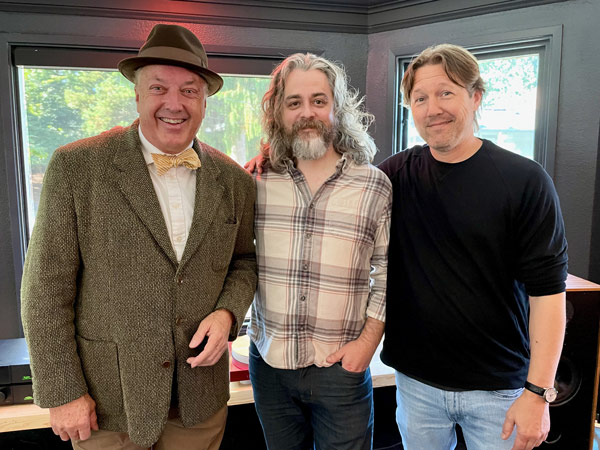
Jake Snider of Gig Harbor Audio and band Minus the Bear stands between Philip O'Hanlon of On A Higher Note (left) and Gig Harbor co-owner Erik Owen (right).
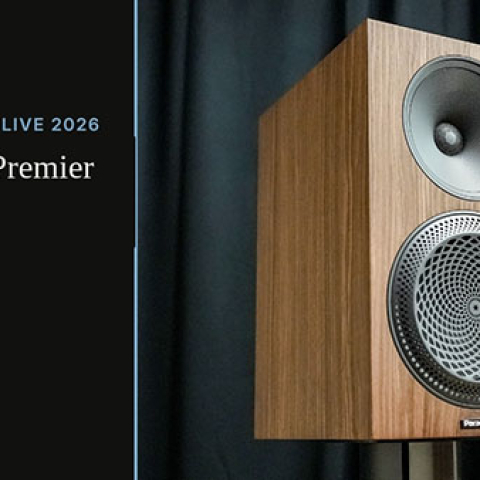
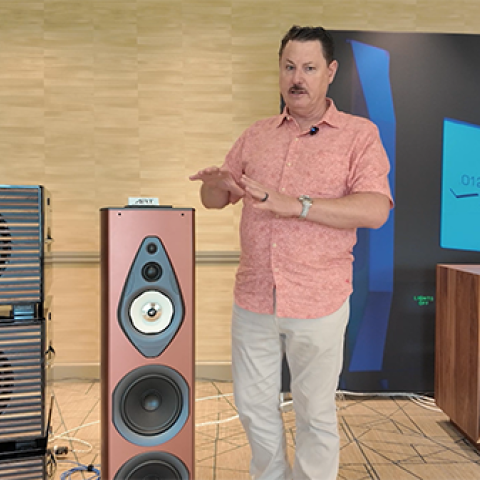
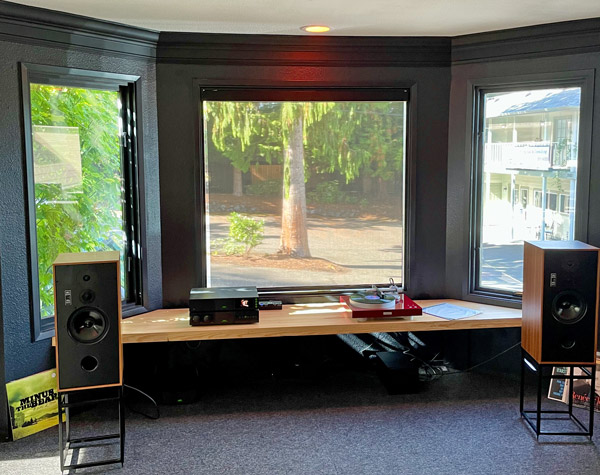
After two years of COVID-enforced isolation, the ever-dapper Philip O'Hanlon, founder and president of On A Higher Note distribution, flew to the PNW (footnote 1) to present, on October 2, the US premiere of the Graham Audio Limited Anniversary Edition LS8/1 loudspeaker. At $9700/pair with stands, the Graham Anniversary Edition LS8/1 looked right at home in the tastefully appointed, main floor showroom of three-floor Gig Harbor Audio, a dealership located a major swim or easy drive from the Seattle-Tacoma metropolitan area.
During a break from music playback, O'Hanlon managed to compact over five decades of BBC loudspeaker history into five minutes. The Graham Anniversary Edition LS8/1 is the latest offspring of Derek Hughes, whose father Spencer Hughes was part of the BBC team that designed the fabled BBC-favored monitor, the LS5/5. (Dudley Harwood, who later founded Harbeth loudspeakers, also contributed to the design.) According to O'Hanlon, current BBC engineers consider the LS5/5 the "ultimate" BBC monitor and used it for decades to calibrate their microphones. But as much as people loved the sound of the original LS5/5 with its unique slotted woofers with Bextrene cones, those cones could play neither very loud nor very deep. The speaker's appeal lay in what O'Hanlon called its "utterly stunning midrange magic."
 Which brings us to the new Graham LS8/1, designed by Derek Hughes. The Graham LS8/1 resembles daddy Spencer Hughes's fabled two-tweeter BC1 (footnote 2). Compared to the original, two-tweeter BC1, which extended up to 16kHz, the Graham LS8/1's new "super-tweeter" extends up to 20kHz. At the other end of the frequency spectrum, the Graham LS8/1's woofer descends to 45Hz ±3dB. O'Hanlon says that the speaker's in-room bass remains audible down to 32Hz.
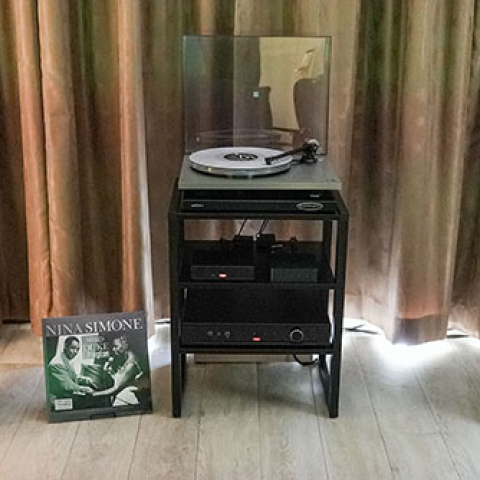
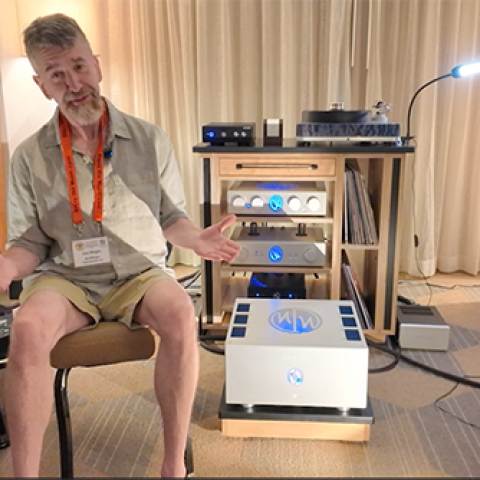
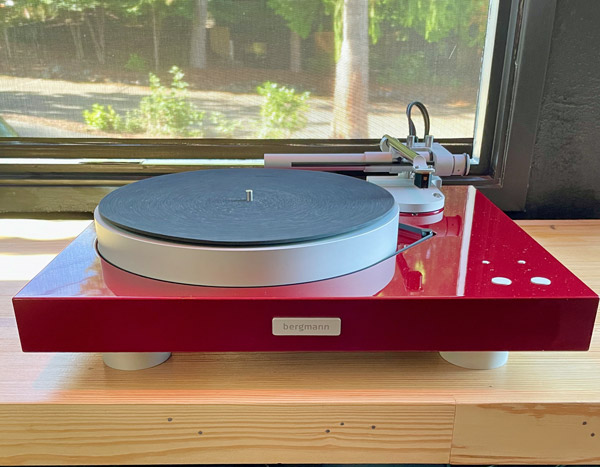 O'Hanlon took advantage of LS8/1's unveiling to also present the belated US launch of the Bergmann Modi air-bearing turntable ($8990, above; footnote 3). In Gig Harbor, it debuted with its optional Thor air-bearing linear tracking tonearm and a larger air pump ($17,000 total), equipped with a Hana ML cartridge ($1200).
The turntable's air-bearing platter requires a pump, which turns off after two minutes of non-use. I've heard noisy pump-driven turntables, but I heard no sound from the pump used by the Modi and Thor. During the demo, O'Hanlon said the Thor allows for on-the-fly adjustment of VTA.
O'Hanlon took advantage of LS8/1's unveiling to also present the belated US launch of the Bergmann Modi air-bearing turntable ($8990, above; footnote 3). In Gig Harbor, it debuted with its optional Thor air-bearing linear tracking tonearm and a larger air pump ($17,000 total), equipped with a Hana ML cartridge ($1200).
The turntable's air-bearing platter requires a pump, which turns off after two minutes of non-use. I've heard noisy pump-driven turntables, but I heard no sound from the pump used by the Modi and Thor. During the demo, O'Hanlon said the Thor allows for on-the-fly adjustment of VTA.
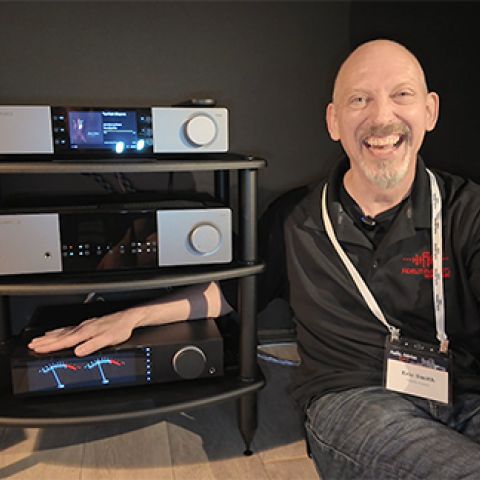
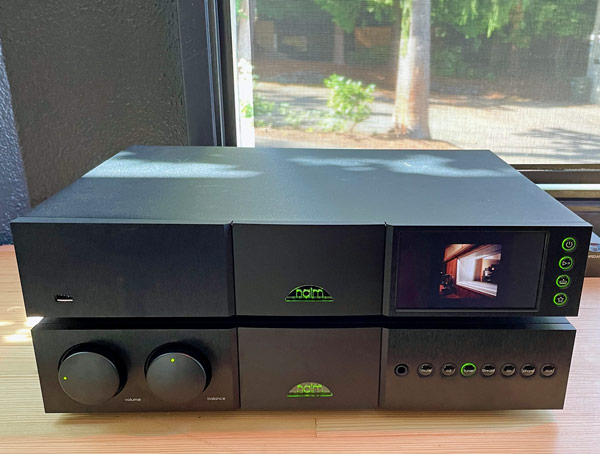 Other essential parts of the system included Naim Audio's SuperNait 3 integrated amplifier ($4990), pictured above with the Naim Audio HiCap power supply ($2490), a Chord Electronics Huei phono stage ($1499), and Gig Harbor Audio's GHA custom 8' Dueland/Switchcraft speaker cables ($499/pair).
Sound Part One
Other essential parts of the system included Naim Audio's SuperNait 3 integrated amplifier ($4990), pictured above with the Naim Audio HiCap power supply ($2490), a Chord Electronics Huei phono stage ($1499), and Gig Harbor Audio's GHA custom 8' Dueland/Switchcraft speaker cables ($499/pair).
Sound Part OneSeated in the sweet spot before a system backed by lightly covered glass windows, I initially thought the sound quite fine, with clearly defined, precisely placed images and modest bass. What puzzled me was the absence of a distinct midrange. Listening solely to vinyl, I thoroughly enjoyed cuts from Clare Teal's single-miked, direct-to-disc A Tribute to Ella Fitzgerald and Dominique Fils-Aimé's Nameless. A special treat was a rare 12" single of Michael Jackson's Quincy Jones-produced "Thriller." (Vincent Price was a hoot.) But even though everything set my foot tapping—a sure sign of musical impact—the only time I began to hear something special in the midrange was when I stood behind the couch, well above tweeter height. By the time I departed for a 20-minute tour of Gig Harbor Audio's new, far more spacious three-level set-up (pictured at the bottom of the page), I had come to the tentative conclusion that the main floor's windows had defeated the Graham LS8/1's midrange "magic." Wrong. Sound Part Two
When I returned to the demo, the sound had changed so dramatically that I asked what had happened. O'Hanlon explained that because Gig Harbor Audio didn't possess the Bergmann's requisite DIN/RCA phono cable, he had initially made do with a cheapie cable that any self-respecting Radio Shack salesman would have left hidden in the stockroom. During my tour, O'Hanlon's Shunyata Alpha DIN/RCA arrived by FedEx. Once it was installed, the sound fundamentally changed.
Footnote 1: Pacific Northwest for the uninitiated. Footnote 2: In designing the BC1, Spencer Hughes drew on the knowledge gained from designing the original LS5/5. Footnote 3: For its debut, the Modi sported a bespoke candy apple red plinth which, as with any special color, costs an additional $3000. The not so basic Modi comes with a black plinth. All versions include silver metal trim. Footnote 4: Yes, we do have sunny days in the PNW.