Sidebar 2: Measurements
Because it's a powered design, measurements of the Genelec Studio Monitor 1031A's impedance and sensitivity are irrelevant. The Genelec's cabinet was quite lively in the bass-reflex tuning region, with a single resonant mode also evident in the midrange (fig.1). The latter might add a hint of "slowness" to the satellite's bass quality, though predicting the subjective effect of the midrange mode is harder; it might be high enough in frequency and low enough in level to be more benign than expected.
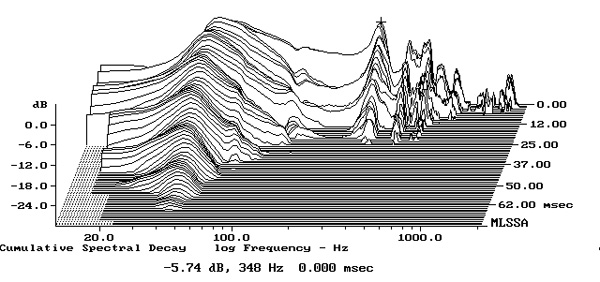
 In the time domain, the Studio Monitor 1031A's impulse response (not shown) was typical of a design with a high-order crossover and was overlaid with ultrasonic (hence inaudible) ringing from the tweeter's "oil-can" resonance. The step response (fig.7) reveals that the tweeter is connected in positive polarity, the midrange in inverted polarity, and that the speaker is nowhere near time-coherent, though that probably is subjectively inconsequential. The associated waterfall plot (fig.8) is superbly clean, implying a high degree of treble clarity.—John Atkinson
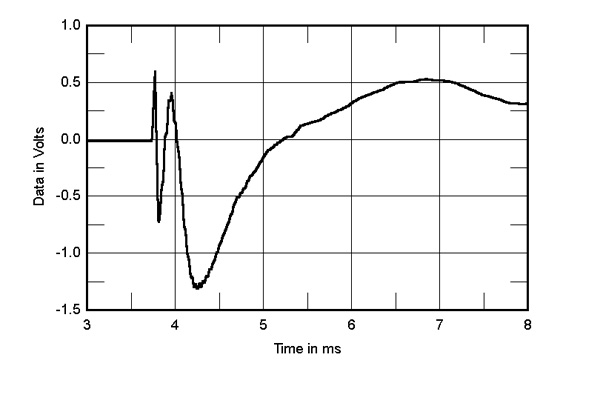
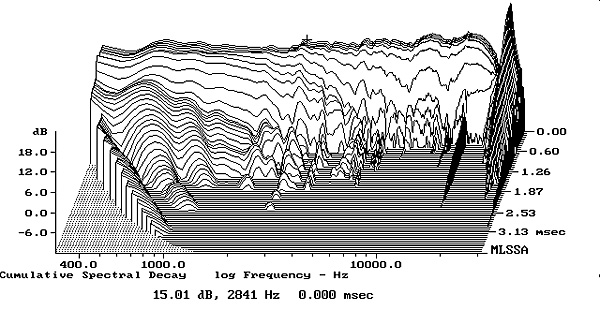
Fig.1 Genelec 1031A, cumulative spectral-decay plot of accelerometer output fastened to bass-cabinet side wall. (Measurement bandwidth, 2kHz.)
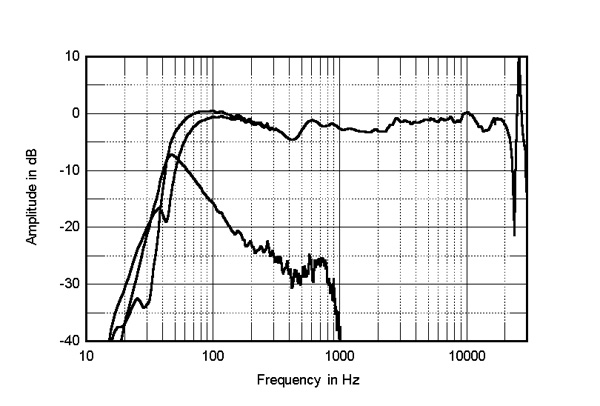
Fig.2 shows the 1031A's frequency response, averaged across a 30° lateral window on the tweeter axis and spliced to the nearfield responses of the woofer and port, together with the complex sum of these two individual outputs. The speaker offers a basically flat balance on-axis, with a slight lack of presence-region energy, as JGH surmised. Alternatively, the 3–12kHz could be regarded as being slightly boosted, particularly as the midrange itself is a little recessed. (How a measured response such as this will be perceived depends on whether the listener locks on to peaks and hears the valleys as lacks of energy, or vice versa.)
Fig.2 Genelec 1031A, anechoic response on tweeter axis at 50", averaged across 30° horizontal window and corrected for microphone response, with the nearfield woofer response plotted below 300Hz.
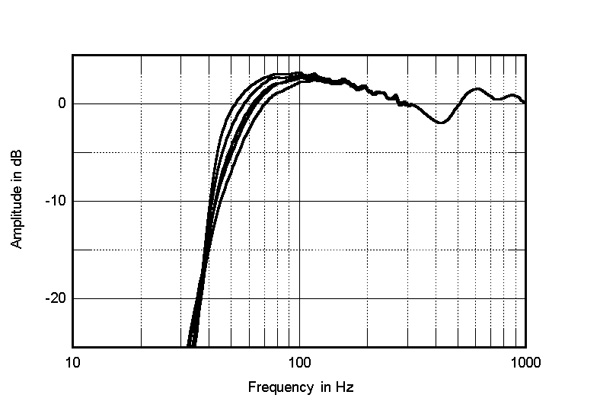
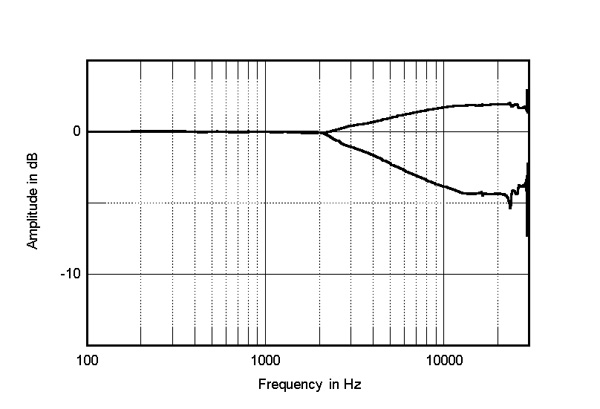
With its rolloff control set to zero, the Genelec mini extends to around 45Hz in the bass, –6dB, with a very steep rolloff below the port tuning frequency of 43Hz. The effect of the bass-rolloff switch is shown in fig.3; basically, by both reducing the extension and increasing the damping of the reflex alignment, this switch makes it possible to optimize the speaker's low-frequency performance for a variety of situations. The effects of the treble control when set to its maximum and minimum positions and compared with the on-axis response are shown in fig.4. As specified, the control applies a boost of 2dB or a cut of up to –4dB at 10kHz. As Gordon found, if the Genelec HF response is too hot for your tastes, this control can compensate exactly for that character.
Fig.3 Genelec 1031A, effect of bass-rolloff control set to 0 and –8, and to all settings in between.
Fig.4 Genelec 1031A, effect of treble control set to +2 and –4 (5dB/vertical div.).
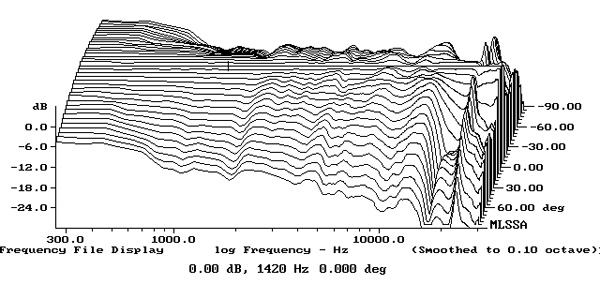
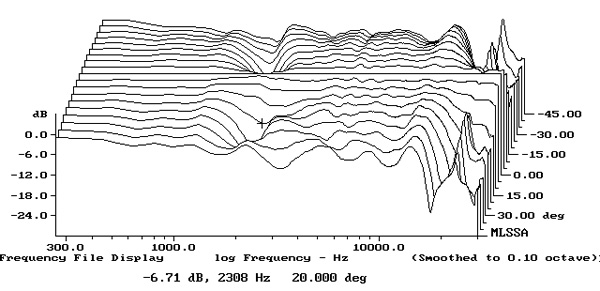
Other than a very slight beaming at the top of the woofer's passband, the 1031A's lateral dispersion (fig.5) is well controlled, the speaker's output falling evenly to its sides except above 16kHz, where it doesn't matter. The overall dispersion is somewhat narrower in the treble than is usually the case with a 1" tweeter, which can make the speaker sound mellow in large or overdamped rooms. In the vertical plane (fig.6), significant suckouts develop 5° above and 15° below the tweeter axis. The listener needs to sit with his ears on or just below the tweeter axis to perceive the flat response of which this speaker is capable. Even so, in a farfield situation, it's possible that this vertical behavior will result in a lack of in-room presence-region energy that will be perceived as a somewhat uninvolving character—or "dark," as Gordon said.
Fig.5 Genelec 1031A, lateral response family at 50", normalized to response on tweeter axis, from back to front: differences in response 90°–5° off-axis, reference response, differences in response 5°–90° off-axis.
Fig.6 Genelec 1031A, vertical response family at 50", from back to front: differences in response 45°–5° above HF axis, reference response, differences in response 5°–45° below HF axis.
Fig.7 Genelec 1031A, step response on tweeter axis at 50" (5ms time window, 30kHz bandwidth).
Fig.8 Genelec 1031A, cumulative spectral-decay plot at 50" (0.15ms risetime).