Sidebar 3: Measurements
I measured one of the X Diamond Mk II loudspeakers, serial number 65793A, in RvB's listening room, driving it with his Krell FPB-200c amplifier. I used DRA Labs' MLSSA system with a calibrated DPA 4006 microphone to examine the speaker's behavior in the farfield and an Earthworks QTC-40 mike for the nearfield responses. It wasn't possible to raise the 190lb loudspeaker off the floor for the measurements, so the first reflection from the ground occurs earlier than is usually the case with my testing. I therefore measured the response and dispersion with the microphone at 1m rather than my usual 50". The speaker sits on casters, so I could move one of the speakers away from the wall behind it so that it fired along his listening room's diagonal; the goal was to push the reflections from the room boundaries as far back in time as possible. However, it wasn't possible to measure the off-axis response more than 60° to each side of the tweeter axis.
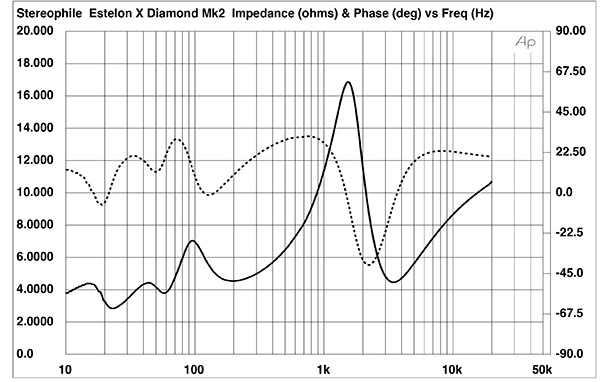
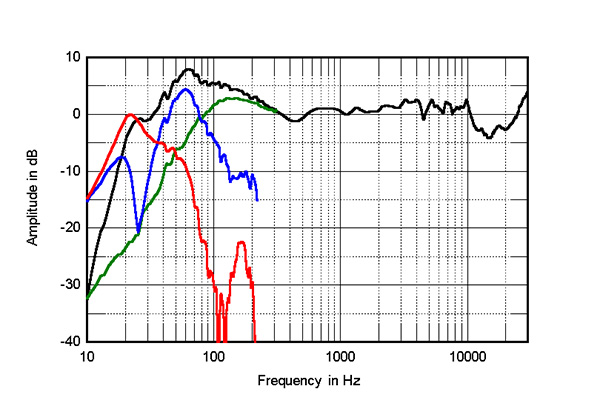
The saddle centered between 20Hz and 30Hz in the impedance magnitude trace implies that the tuning frequency of the port on the Estelon's rear panel lies in this region. The woofer's nearfield response (blue trace below 210Hz in fig.3) had the expected reflex tuning notch at 25Hz, though the port's nearfield response (fig.3, red trace) peaks slightly lower in frequency. While there is a peak at 180Hz in the port's output, this is very low in level. The woofer crosses over to the midrange unit (fig.3, green trace) close to the specified 75Hz.
Footnote 1: EPDR is the resistive load that gives rise to the same peak dissipation in an amplifier's output devices as the loudspeaker. See "Audio Power Amplifiers for Loudspeaker Loads," JAES, Vol.42 No.9, September 1994, and stereophile.com/reference/707heavy/index.html. Footnote 2: This means that the loudspeaker is firing into hemispherical space rather than a full sphere, which boosts the low frequencies. See this discussion. Footnote 3: See fig.2 here.
Fig.1 Estelon X Diamond MkII, electrical impedance (solid) and phase (dashed) (2 ohms/vertical div.).
Estelon specifies the X Diamond Mk II's voltage sensitivity as 88dB/2.83V/1m; my estimate was 3dB higher than that of my Rogers LS3/5a that I always measure at the same time as the speaker under test, at 85.5dB(B)/2.83V/1m. I used Dayton Audio's DATS V2 system to measure the impedance magnitude and phase. The Estelon's nominal impedance is specified as 6 ohms, with a minimum value of 3.8 ohms at 55Hz. The impedance magnitude (fig.1, solid trace) was higher than 4 ohms over most of the audioband; while the impedance did drop to 3.8 ohms at 55Hz, there was another minimum value of 2.84 ohms at 23Hz. In addition, the electrical phase angle (fig.1, dotted trace) is high in several frequency regions; as a result, the effective resistance, or EPDR (footnote 1), drops below 2 ohms from 23Hz to 35Hz, from 58Hz to 72Hz, and below 3 ohms from 210Hz to 610Hz. The minimum EPDR values are 1.85 ohms at 65Hz and 2.5 ohms between 322Hz and 372Hz. The X Diamond Mk II is a current-hungry load for the partnering amplifier.
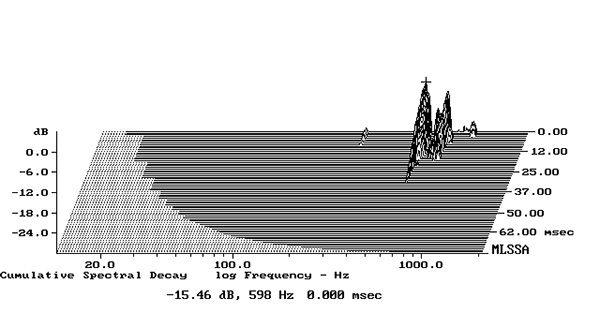
Fig.2 Estelon X Diamond MkII, cumulative spectral-decay plot calculated from output of accelerometer fastened to the baffle 6" above the woofer (MLS driving voltage to speaker, 7.55V; measurement bandwidth, 2kHz).
The enclosure was very quiet when I rapped its panels with my knuckles. Using a plastic-tape accelerometer, the only resonant modes that I found lay at 598Hz and 781Hz (fig.2). As well as the high frequencies of these modes, their low levels and high Q (Quality Factor) will work against them having audible consequences.
Fig.3 Estelon X Diamond MkII, anechoic response on tweeter axis at 1m, averaged across 30° horizontal window and corrected for microphone response, with the nearfield responses of the midrange unit (green), woofer (blue), port (red), and their complex sum (black), respectively plotted below 300Hz, 210Hz, 210Hz, and 300Hz.
The peak between 40Hz and 200Hz in the complex sum of the nearfield responses of the midrange unit, woofer, and port (fig.3, black trace below 300Hz) is due to the nearfield measurement technique, which assumes the baffle extends to infinity in both planes (footnote 2). The Estelon's low-frequency alignment is actually maximally flat, which, with the low tuning frequency of the port, means that this loudspeaker will offer in-room low-frequency extension to 20Hz.
The Estelon's farfield response, averaged across a 30° horizontal window centered on the tweeter axis, is shown as the black trace above 300Hz in fig.3. The response is relatively even through the midrange and treble, though there is a slight excess of energy in the mid-treble region and a lack of energy in the top audio octave. The response starts to rise again above 25kHz; I have encountered this behavior before with speakers that use an Accuton diamond-dome tweeter. With a pistonic tweeter like this that has a high-Q ultrasonic dome resonance, there is a lack of energy at frequencies just below that resonance (footnote 3).
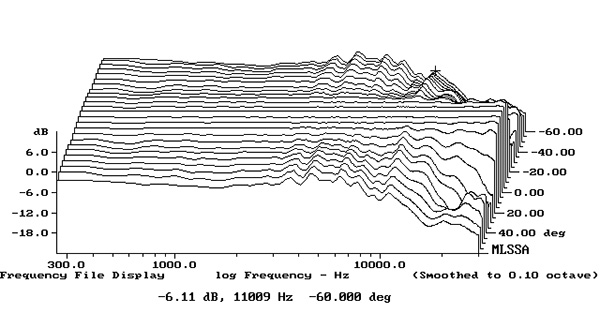
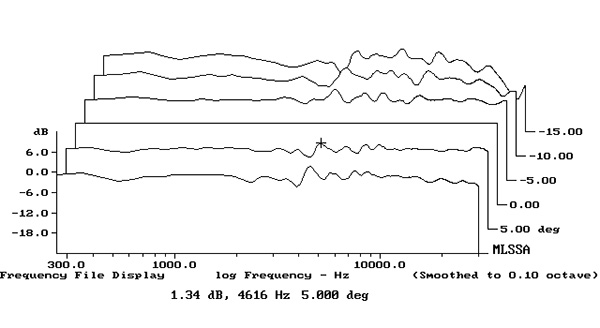
Fig.4 Estelon X Diamond MkII, lateral response family at 1m, normalized to response on tweeter axis, from back to front: differences in response 60–5° off axis, reference response, differences in response 5–60° off axis.
Fig.5 Estelon X Diamond MkII, vertical response family at 1m, normalized to response on tweeter axis, from back to front: differences in response 15–5° above axis, reference response, differences in response 5–10° below axis.
The Estelon's horizontal radiation pattern, normalized to the response on the tweeter axis, which therefore appears as a straight line, is shown in fig.4. The contour lines below 10kHz in this graph up to 30° are even to the speaker's sides, though there is a slight excess of energy at the bottom of the tweeter's passband at off-axis angles greater than that. As usual, the radiation pattern narrows in the top octave. Fig.5 shows the X Diamond Mk II's dispersion in the vertical plane, again normalized to the response on the tweeter axis. The response doesn't change significantly up to 10° above and below the tweeter axis. This is useful, as the tweeter is 40" from the floor, which is a few inches higher than what Stereophile has found to be the typical ear height of a seated listener.
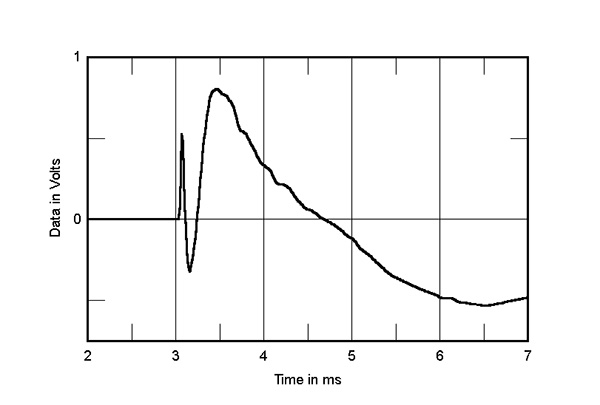
Fig.6 Estelon X Diamond MkII, step response on tweeter axis at 1m (5ms time window, 30kHz bandwidth).
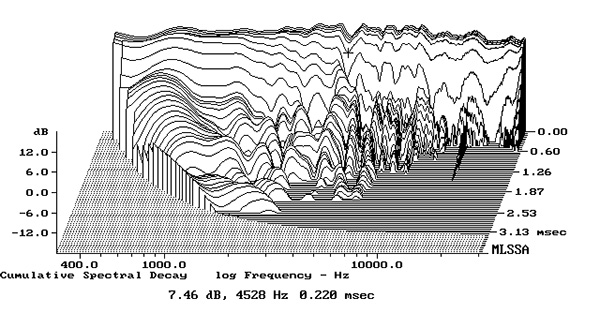
Fig.7 Estelon X Diamond MkII, cumulative spectral-decay plot on tweeter axis at 1m (0.15ms risetime).
In the time domain, the Estelon's step response on the tweeter axis (fig.6) shows that the tweeter and midrange unit are connected in positive acoustic polarity, the woofer in inverted polarity. The tweeter's output arrives first at the microphone, with the decay of its step smoothly blending with the start of the midrange unit's step. Similarly, the negative-going decay of the midrange unit's step blends with the start of the woofer's step. This all implies an optimal crossover topology. Other than a small ridge of delayed energy at 4.5kHz and some low-level hash in the mid-treble region, the X Diamond Mk II's cumulative spectral-decay, or waterfall, plot (fig.7) is clean.
Overall, the Estelon X Diamond Mk II's measured performance is very good, similar in most ways to that of the smaller XB Diamond Mk II that Jim Austin reviewed in November 2022.—John Atkinson
Footnote 1: EPDR is the resistive load that gives rise to the same peak dissipation in an amplifier's output devices as the loudspeaker. See "Audio Power Amplifiers for Loudspeaker Loads," JAES, Vol.42 No.9, September 1994, and stereophile.com/reference/707heavy/index.html. Footnote 2: This means that the loudspeaker is firing into hemispherical space rather than a full sphere, which boosts the low frequencies. See this discussion. Footnote 3: See fig.2 here.