Sidebar 3: Measurements
Nick Doshi, accompanied by Jessie Bentley of Virginia dealer Command Performance AV, picked up the Doshi Evolution Stereo amplifier from Ken Micallef's Greenwich Village apartment and delivered it to me in Brooklyn. They carefully installed the eight numbered Electro-Harmonix 6CA7-EH output tubes, then Nick briefed me on his design philosophy and how to operate the various buttons and switches. As I did with the similar-looking Evolution Monoblock amplifier that Jason Victor Serinus reviewed in May 2021, I left the amplifier powered up for 45 minutes before I started examining the Evolution Stereo's performance on the test bench with my Audio Precision SYS2722 system.
Before doing so, I muted the amplifier and checked the bias current for each of the four paralleled pairs of output tubes using the front-panel display and the four trim pots on the top panel. The manual says that the optimal bias should be "between 190 and 220" on the display. However, after he installed the tubes, Nick Doshi had told me that I should set the bias to "182." I emailed him for clarification, and he confirmed that I should set the bias to "182, as this limits dissipation to 18–19W per EH tube." The trim pots for adjusting bias are very sensitive, so it took me several attempts to achieve the optimal settings. However, even with the trim pot for the left channel's V2 pair at its minimum, the indicated bias was "198" rather than "182." Perhaps one of the tubes was aging faster than the others. Because these were the tubes with which KM had auditioned the amplifier, I continued with the testing.
The Evolution Stereo has both balanced and single-ended inputs, labeled "Buffered" and "DIR.SE," respectively. Doshi recommends using the single-ended inputs, so I performed a full set of measurements with those inputs, repeating some tests with the buffered balanced input. I measured a voltage gain of 31.1dB into 8 ohms with both inputs. Both preserved absolute polarity (ie, were noninverting). The XLR jack is wired with pin 2 hot, the industry standard. The input impedance is specified as 20k ohms balanced and 47k ohms unbalanced. I measured 32k ohms at 20Hz and 1kHz for the single-ended inputs, dropping inconsequentially to 29.6k ohms at 20kHz. The balanced input impedance was 38k ohms from 20Hz to 20kHz, ie, 19k ohms per phase.
After I finished the testing with KM's tube complement, I replaced the two V2 tubes with new Electro-Harmonix 6CA7-EH tubes I found in the amplifier's packaging. After a 45-minute warmup, I adjusted the bias to "182" for these tubes and repeated the THD+N vs frequency test into 8 ohms. The left channel now offered lower distortion than the right channel, confirming that one or both of the V2 tubes that KM had used for his auditioning must have been past their best.
The Doshi Evolution Stereo's measured behavior is dominated by the circuit's limited use of negative feedback. Even with the better-performing right channel, which I assume is due to that channel's tubes being in better shape than the left channel's, this amplifier is best suited to driving loudspeakers with impedances higher than 4 ohms.—John Atkinson
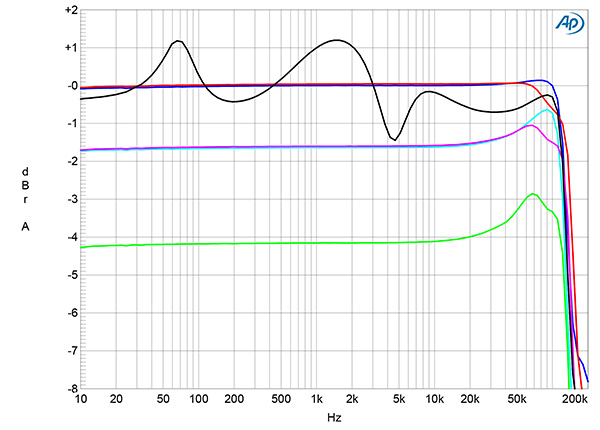
Fig.1 Doshi Evolution Stereo, frequency response at 2.83V into: simulated loudspeaker load (gray), 8 ohms (left channel blue, right red), 4 ohms (left cyan, right magenta), and 2 ohms (green) (1dB/vertical div.).
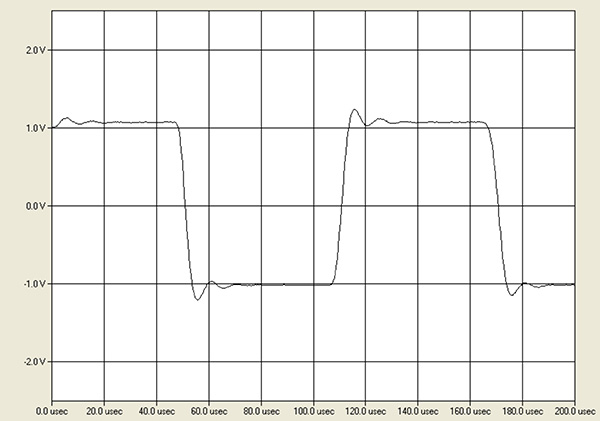
Fig.2 Doshi Evolution Stereo, small-signal, 10kHz squarewave into 8 ohms.
The output impedance was 2.1 ohms at all audio frequencies. As a result, the modulation of the Doshi's frequency response driving our standard simulated loudspeaker was meaningful, at ±1.2dB (fig.1, gray trace). The small-signal bandwidth extended at full level down to 10Hz and up to 100kHz into 8 ohms in the left channel (blue trace) and up to 70kHz in the right channel (red trace). A small peak centered on 60kHz developed into lower impedances. This was absent in the balanced input's response, which started to roll off above 40kHz, reaching –3dB at 120kHz. The 1kHz squarewave (not shown) was superbly square, but the damped ultrasonic peak in the frequency response traces correlates with damped ringing on the tops and bottoms of a 10kHz squarewave (fig.2).
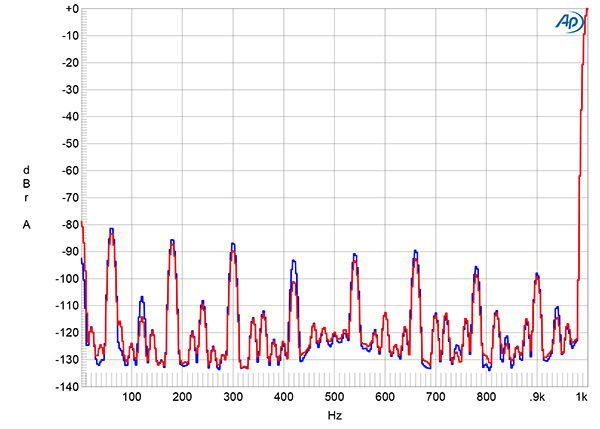
Fig.3 Doshi Evolution Stereo, spectrum of 1kHz sinewave, DC–1kHz, at 1W into 8 ohms with ground l connected (left channel blue, right red) (linear frequency scale).
Channel separation was excellent, at >90dB in both directions below 4kHz and still 80dB at the top of the audioband. The unweighted, wideband signal/noise ratio, taken with the single-ended inputs shorted to ground, was 73.1dB ref. 1W into 8 ohms (average of both channels, which were very similar). This ratio was not affected by the rear-panel ground-lift switch but improved by 1dB when I restricted the measurement to the audioband and by 11dB with an A-weighting filter in circuit. Spectral analysis of the low-frequency noisefloor with the amplifier's rear-panel ground switch set to Ground (fig.3) revealed a low level of random noise but higher levels of AC-supply–related harmonics at 60Hz and its odd-order harmonics. These remained at the same levels with the ground lifted. They are probably due to magnetic interference from the power transformer.
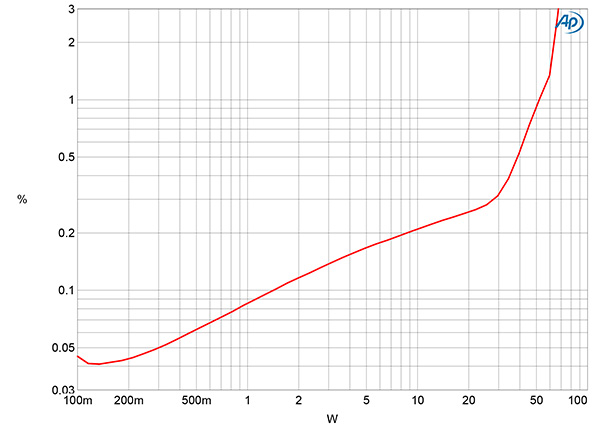
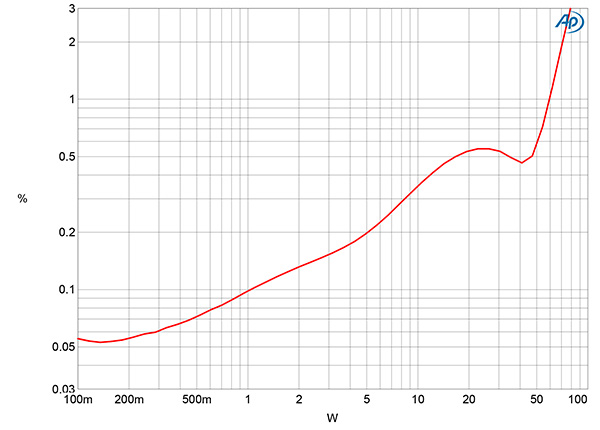
Fig.4 Doshi Evolution Stereo, right channel, distortion (%) vs 1kHz continuous output power into 8 ohms.
Fig.5 Doshi Evolution Stereo, right channel, distortion (%) vs 1kHz continuous output power into 4 ohms.
The Evolution Stereo's maximum power is specified as 65W into 5 ohms (16.1dBW ref. 1W into 8 ohms). With clipping defined as when the THD+noise in the output reaches 1%, I measured 52W into 8 ohms (17.2dBW, fig.4) and 59W into 4 ohms (14.7dBW, fig.5; I do not have a 5 ohm dummy load). Relaxing the clipping criterion to 3% THD+N increased the maximum powers to 69W into 8 ohms (18.4dBW) and 80W into 4 ohms (16dBW). Tested with a 20kHz signal, the amplifier's output into 8 ohms was 29.5W (14.7dBW) at 1% THD+N and 69W (18.4dBW) at 3% THD+N. The maximum output power measured the same in both channels.
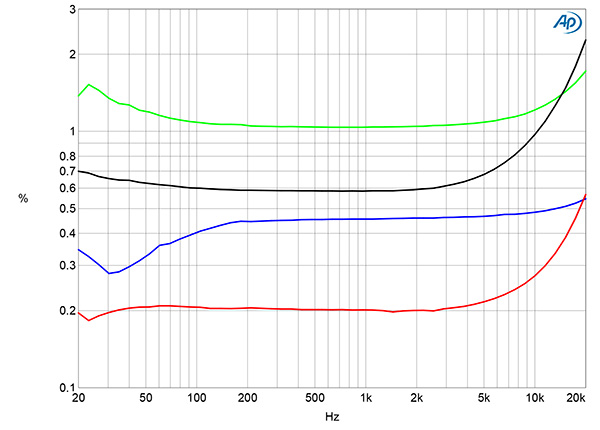
Fig.6 Doshi Evolution Stereo, THD+N (%) vs frequency at 8V into: 8 ohms (left channel blue, right red), 4 ohms (left green, right gray).
Nick Doshi told me that he decided to use just 5dB of global negative feedback when designing the Evolution Stereo's circuit, which is why the distortion rises with increasing power in figs.4 and 5. These graphs were taken with the right channel, because, as you can see from fig.6, which shows how the Doshi amplifier's THD+N percentage varied with frequency at 8V (equivalent to 8W into 8 ohms and 16W into 4 ohms), the distortion was higher in the left channel (blue and green traces) than it was in the right channel (red, gray traces). This may well be a result of the higher bias setting for the left channel's V2 tubes, which I noted earlier. While the distortion rises in the top octave, it does not do so at low frequencies, showing that the output transformer's core is not becoming saturated.
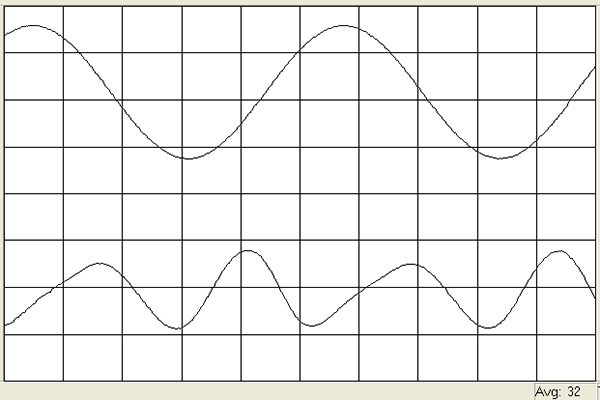
Fig.7 Doshi Evolution Stereo, right channel, 1kHz waveform at 8W into 8 ohms, 0.2% THD+N (top); distortion and noise waveform with fundamental notched out (bottom, not to scale).
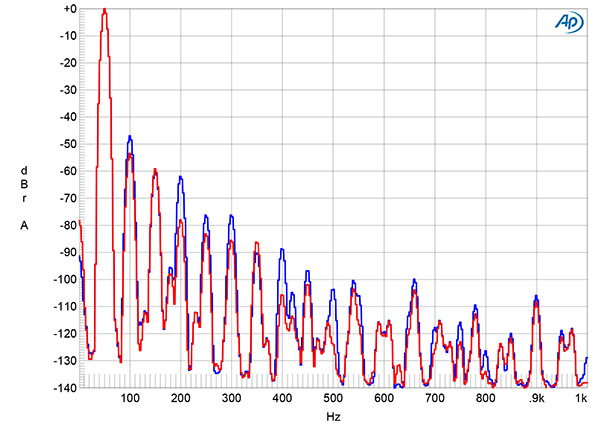
Fig.8 Doshi Evolution Stereo, spectrum of 50Hz sinewave, DC–1kHz, at 15W into 8 ohms (left channel blue, right red) (linear frequency scale).
With so little negative feedback, it's not surprising that the distortion is still relatively high in level; Nick Doshi told me that it would be around 0.3% at moderate powers. Fortunately, the Evolution Stereo's distortion signature into 8 ohms was predominantly the subjectively innocuous second harmonic (fig.7), lying at close to –50dB (0.3%), with the third harmonic around 10dB lower in level (fig.8) and the fourth harmonic at the same level in the left channel (blue trace).
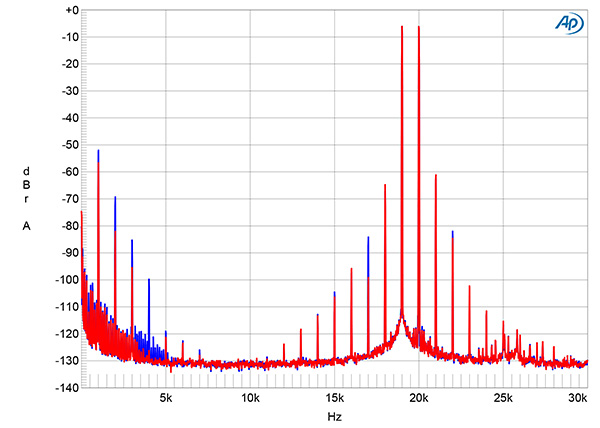
Fig.9 Doshi Evolution Stereo, HF intermodulation spectrum, DC–30kHz, 19+20kHz at 15W peak into 8 ohms (left channel blue, right red) (linear frequency scale).
With an equal mix of 19 and 20kHz tones and the signal peaking at 15W into 8 ohms (fig.9), the difference product at 1kHz lay at –53dB in the left channel (0.2%, blue trace) and –56dB in the right channel (0.15%, red trace). The higher-order products all lay below –60dB (0.1%), however. The levels of the harmonics and intermodulation products were all 10dB higher with the amplifier driving 4 ohms.