After everything settled in, I used the Bridge app to play the first movement of Lou Harrison's Concerto for Violin with Percussion Orchestra, with soloist Tim Fain and Angel Gil-Ordóñez conducting the Post-Classical Ensemble (24/48 WAV, Naxos 8.559825/HDtracks). The Bridge-Vivaldi combo painted the solo violin and percussion with far more believable body and substance than I'd heard before, at home or at audio shows. Textures of drums, gongs, and chimes were far more realistic and transparent, with copious air around percussion. I was astounded by the percussion's lifelike visceral impact.
My impressions remained consistent, regardless of source material. "Electrified II," from Yello's Toy (24/48 WAV, Polydor 4782160/HDtracks), sounded larger and more all-enveloping. In soprano Elisabeth Schwarzkopf's recording of Richard Strauss's lied "Muttertändelei" with George Szell conducting (24/96 WAV, Warner/HDTracks 509990873182), I could hear the subtlest changes in the quality of her voice as she traversed the scales, as well as tiny splices in the original analog tape. Beyond the added detail, I found myself lost in the beauty of her voice. Moving on to DSD64—the Vivaldi v.1.2 wasn't equipped to handle DSD128—I noted the huge orchestral expanse of Iván Fischer and the Budapest Festival Orchestra's recording of Mahler's Symphony 5 (DSD64, Channel Classics 34213/NativeDSD).
It was only when I switched AES/EBU cables from the Network Bridge to the Paganini transport and began playing discs that I realized: as detailed and lifelike as the sound was, files through the Vivaldi v.1.2 had a bit of dryness that I didn't hear from files played through the Rossini DAC. That I'd never heard this dryness at audio shows confirmed that it's only in my own, ultrafamiliar system, carefully assembled and tuned in my purpose-designed music room, that I can clearly hear such differences.
On a good old-fashioned CD of the early 21st century, the sound of the piano on Murray Perahia's disc of works by Handel and Scarlatti (CD, Sony Classical 62785) was delicious: The Vivaldi v.1.2 conveyed a perfect balance of his piano's percussive and sustained sounds. The ability to distinguish among different textures, and to hear the smallest changes in dynamics and expressive fingering, seemed supreme.
Network Bridge with Vivaldi v.2.02
Can great get greater? I asked myself that as I inserted the Vivaldi v.2.02 upgrade disc into the Paganini transport and followed the easy directions. An hour later, I had my answer. The colors of Antonio Lysy's cello on his At the Broad: Music from Argentina (CD, Yarlung YAR27517) were even more vividly saturated than through the Vivaldi v.1.2. I felt as if I'd somehow been moved closer to the instrument, and could hear its full sound before its highs and richness were truncated by distance. I was so impressed by the degree of color saturation that, to fully bask in the sound, I turned the lights out.
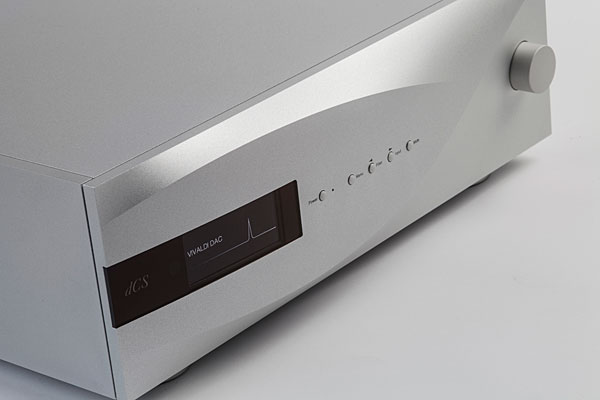 Returning to file playback through the Network Bridge, I inserted the USB stick that contained a file of Terry Riley's In C, performed by the Ragazze Quartet and Slagwerk den Haag (DSD128, Channel Classics 37816/Native DSD). Selecting the Vivaldi v.2.02's new DSD filter, F5, yielded the best sound from DSD I've ever heard. "The three-dimensionality is sensational," I noted. "The dryness of v.1.2 has been replaced by an iridescent clarity to timbres and textures. The transparency is astounding; every clang and bang sounds real."
By the end of In C, my friend Béla, sitting next to me, was ecstatic. "One minute I felt I was inside the music; the next minute, I felt the music was inside me!" he exclaimed. "I could feel it vibrating in all my different organs. My entire body is throbbing."
Béla was describing his response to hearing an ultra-hi-rez recording of game-changing minimalist music whose repetitive patterns came to Riley in the early 1960s as he rode a bus, stoned, to a piano gig at the hungry i, a San Francisco nightclub. No chemical enhancement figured into our listening experience, nor was any necessary; the high comes with any well-executed performance of Riley's masterpiece. That Béla was able to relive Riley's high without knowing the story behind In C speaks volumes of the communicative power of the Network Bridge/Vivaldi v.2.02 combo.
For vocal music, I chose baritone Matthias Goerne and pianist Markus Hinterhäuser's recording of "Meine Rose," from Schumann's song cycle Myrthen (24/96WAV, Harmonia Mundi HMM 902243/HDtracks). In addition to more detail in the voice and a fuller, richer, more lifelike piano, Goerne's voice seemed more palpable than through the excellent Rossini. Sounds and notes were a portal to the spirit.
Comparison: Software and Sources
Returning to file playback through the Network Bridge, I inserted the USB stick that contained a file of Terry Riley's In C, performed by the Ragazze Quartet and Slagwerk den Haag (DSD128, Channel Classics 37816/Native DSD). Selecting the Vivaldi v.2.02's new DSD filter, F5, yielded the best sound from DSD I've ever heard. "The three-dimensionality is sensational," I noted. "The dryness of v.1.2 has been replaced by an iridescent clarity to timbres and textures. The transparency is astounding; every clang and bang sounds real."
By the end of In C, my friend Béla, sitting next to me, was ecstatic. "One minute I felt I was inside the music; the next minute, I felt the music was inside me!" he exclaimed. "I could feel it vibrating in all my different organs. My entire body is throbbing."
Béla was describing his response to hearing an ultra-hi-rez recording of game-changing minimalist music whose repetitive patterns came to Riley in the early 1960s as he rode a bus, stoned, to a piano gig at the hungry i, a San Francisco nightclub. No chemical enhancement figured into our listening experience, nor was any necessary; the high comes with any well-executed performance of Riley's masterpiece. That Béla was able to relive Riley's high without knowing the story behind In C speaks volumes of the communicative power of the Network Bridge/Vivaldi v.2.02 combo.
For vocal music, I chose baritone Matthias Goerne and pianist Markus Hinterhäuser's recording of "Meine Rose," from Schumann's song cycle Myrthen (24/96WAV, Harmonia Mundi HMM 902243/HDtracks). In addition to more detail in the voice and a fuller, richer, more lifelike piano, Goerne's voice seemed more palpable than through the excellent Rossini. Sounds and notes were a portal to the spirit.
Comparison: Software and Sources
After many more tracks had confirmed that the Vivaldi DAC's v.2.02 upgrade and the Network Bridge delivered the most colorful, believable, involving sound I'd ever heard from my system, it was time to investigate playback options. First, I compared the sound of files from USB sticks played through the Bridge using its app to the sound of the same files loaded into my NUC running Roon and controlled by the Roon app. The NUC fed the Network Bridge via a double run of Ethernet cables: NUC to router to Bridge. Up first was Hanover Square North, from a recent recording of Charles Ives's Second Orchestral Set, with Ludovic Morlot conducting the Seattle Symphony Orchestra (24/96 WAV, Seattle Symphony Media SSM1015/HDtracks). Highs were less sharp and more softly delineated with Roon, colors a mite muted, and transparency a bit diminished. Using Roon's Search function, however, was a snap, and accessing cover art and other information inaccessible with the Bridge app were bonuses.
Next I compared two different playback methods for the first movement of Franz Schmidt's Symphony 2, in the recording by Semyon Bychkov and the Vienna Philharmonic (24/48 WAV, Sony Classical 88985355522/Primephonic). The first was with an external HD connected, via a Nordost Valhalla 2 USB link, first to the Bridge (Bridge app) and then to the NUC (Roon app). Both sounded beautiful, but the Bridge software again delivered clearer sound, with sharper highs, more saturated colors, and maximal liquidity and transparency. Roon's sound was smoother, with more apparent emphasis of the midrange and bass. This conclusion held even when I changed the Ethernet cables used with the NUC from Wireworld Platinum Starlight to AudioQuest Diamond.
Locating the file using Network Bridge software required time-consuming scrolling through the HD's contents to discover if it was listed under the composer (Schmidt) or the conductor (Bychkov). Had I not previously retitled the parent folder to make identification easy, I'd have been lost. But with Roon, I just typed "Schmidt" into Search, and two choices appeared: my own 24/192 files and Tidal's 16/44.1 stream. Swami Serinus predicts: The more files you've got, the more you'll use Roon.
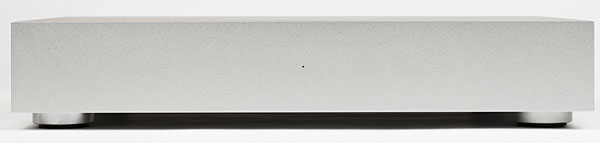 I then compared sources, USB stick vs external HD, for the Network Bridge and Vivaldi v.2.02 by playing soprano Carolyn Sampson's performance of "Sich üben im Lieben," from J.S. Bach's Wedding Cantata, BWV 202, with Petra Müllejans conducting the Freiburg Baroque Orchestra (24/96 WAV, Harmonia Mundi 902252/HDtracks). Although a USB stick obviates the need of a USB cable, and would seem the superior source if you can remember what's on the stick—a big "if" that frequently found Swami Serinus floundering—Nordost's Valhalla 2 USB link is so excellent that the sources were barely distinguishable.
As to which playback software sounded "better," it remained a case of the Bridge app's ultratransparent liquidity vs the Roon app's softer-edged smoothness. Might this have had something to do with the sound of the NUC vs a Mac mini or other computer dedicated solely to file playback? I don't know.
Lest you think I ignored DSD, I compared two native DSD64 tracks, from both SACDs and files. Playing the Trauermarsch from the Fischer/Budapest recording of Mahler's Symphony 5 (SACD/CD/DSD64, Channel Classics 34213), and Antonio Bertali's Ciaconna for Violin, Keyboard and Chitarrone, from violinist Rachel Podger's Perla Barocca: Early Italian Masterpieces (SACD/CD/DSD64, Channel Classics 36014), I felt that the SACD brought out contrasting lines in ways the files did not. SACD also delivered greater depth, and perhaps sounded more neutral. While the sources definitely sounded different, calling one "better" than the other will be a matter of personal preference.
Given that this test involved a discontinued transport, it may not seem relevant to audiophiles who don't use a Vivaldi, Paganini, or other SACD/CD transport. If dCS ever releases a Rossini SACD/CD transport, this comparison will be worth repeating.
Network Bridge with Mytek HiFi Manhattan II DAC
I then compared sources, USB stick vs external HD, for the Network Bridge and Vivaldi v.2.02 by playing soprano Carolyn Sampson's performance of "Sich üben im Lieben," from J.S. Bach's Wedding Cantata, BWV 202, with Petra Müllejans conducting the Freiburg Baroque Orchestra (24/96 WAV, Harmonia Mundi 902252/HDtracks). Although a USB stick obviates the need of a USB cable, and would seem the superior source if you can remember what's on the stick—a big "if" that frequently found Swami Serinus floundering—Nordost's Valhalla 2 USB link is so excellent that the sources were barely distinguishable.
As to which playback software sounded "better," it remained a case of the Bridge app's ultratransparent liquidity vs the Roon app's softer-edged smoothness. Might this have had something to do with the sound of the NUC vs a Mac mini or other computer dedicated solely to file playback? I don't know.
Lest you think I ignored DSD, I compared two native DSD64 tracks, from both SACDs and files. Playing the Trauermarsch from the Fischer/Budapest recording of Mahler's Symphony 5 (SACD/CD/DSD64, Channel Classics 34213), and Antonio Bertali's Ciaconna for Violin, Keyboard and Chitarrone, from violinist Rachel Podger's Perla Barocca: Early Italian Masterpieces (SACD/CD/DSD64, Channel Classics 36014), I felt that the SACD brought out contrasting lines in ways the files did not. SACD also delivered greater depth, and perhaps sounded more neutral. While the sources definitely sounded different, calling one "better" than the other will be a matter of personal preference.
Given that this test involved a discontinued transport, it may not seem relevant to audiophiles who don't use a Vivaldi, Paganini, or other SACD/CD transport. If dCS ever releases a Rossini SACD/CD transport, this comparison will be worth repeating.
Network Bridge with Mytek HiFi Manhattan II DAC
In Michael Lavorgna's review of the Network Bridge for our sister publication AudioStream.com, he paired it with his totaldac d1-six D/A processor rather than the far more expensive Vivaldi DAC. Michael concluded that "the Bridge-endowed system and the music it played sounded more refined. More real. . . . [M]usic is presented as if emanating from its source without obstruction. . . . Nuance is reproduced music's life blood and dCS gets it. And the Bridge gets this as fully as any other similar-functioning-device I've heard in my system. . . . [It] brought out the best my totaldac has to offer." To repeat Michael's experiment with a non-dCS DAC, I turned to Mytek HiFi's Manhattan II. Mytek's Brooklyn ($2000) and Manhattan II ($6000) DACs each sport one AES input and two S/PDIF synchronous inputs. These inputs pass along signals of resolutions only up to 24/192, up to DSD64 via DoP, and MQA. By contrast, each DAC's USB 2 Class 2 input permits playback of up to 32/384 PCM, DSD256, and MQA. After connecting the AES input of the Manhattan II to one of the Network Bridge's AES outputs, into the Bridge went a USB 3.0 stick containing Michael Tilson Thomas and the San Francisco Symphony's download-only release of Berg's Three Pieces for Orchestra (24/192 WAV, SFS Media/HDtracks). This music is ultra-demanding in its full-range instrumentation and dynamics. While it's not the cheeriest music; it felt fitting for the quasi-apocalyptic destruction Hurricane Irma was then visiting on the Caribbean and Florida.
After evaluating the sound through the Network Bridge, I copied the Berg files to my MacBook Pro's SSD and connected the computer to the Manhattan II using the Nordost Valhalla 2 USB link. Using Audirvana Plus app—it was already installed and set up on that computer, which Roon and the latest Amarra playback software were not—the sound was more muffled, less colorful. The loss of detail was anything but subtle. Despite impressive bass, computer playback paled next to the Network Bridge.
By the time you read this, Mytek will have issued an optional Roon-Ready Network Card ($995) for the Manhattan II. Installed, the card enables an Ethernet connection to a home network, NUC, or other home drive, with remote control via tablet or smartphone. The card also offers streaming from Tidal, Spotify, Apple Music, Internet radio, and other services, and a USB port for direct playback of files from a USB stick or external drive.
In other words, the Manhattan II's new Network Card will give it the same functions provided by the Network Bridge, as well as playback of higher-resolution files than the Network Bridge can pass through a single AES cable. What the card doesn't offer are the noise-isolation and other features that make the dCS Network Bridge unique. Evaluating Mytek's Roon-Ready Network Card, and comparing its sound to the Network Bridge feeding music to the Manhattan II, seems worth a Follow-Up.
Conclusions
I've paired so many different components, and explored so many different ways to use the dCS Network Bridge, that I'm probably ready to launch an audiophile edition of match.com. But so painstaking a methodology was necessary to conclusively establish whether the Network Bridge could optimize the sounds of files and streams played through the dCS Vivaldi and other DACs, and present music in the best possible light. The answer is incontrovertible. The $4250 dCS Network Bridge and app comprise an invaluable—I'd say indispensable—asset for owners of a Vivaldi and or older dCS DAC. And even with DACs from companies other than dCS, the Network Bridge delivered sound that was demonstrably superior to conventional computer-audio playback via USB. As with dCS's major upgrade of the Vivaldi DAC's software to v.2.02: Class A all the way.
Can great get greater? I asked myself that as I inserted the Vivaldi v.2.02 upgrade disc into the Paganini transport and followed the easy directions. An hour later, I had my answer. The colors of Antonio Lysy's cello on his At the Broad: Music from Argentina (CD, Yarlung YAR27517) were even more vividly saturated than through the Vivaldi v.1.2. I felt as if I'd somehow been moved closer to the instrument, and could hear its full sound before its highs and richness were truncated by distance. I was so impressed by the degree of color saturation that, to fully bask in the sound, I turned the lights out.
Returning to file playback through the Network Bridge, I inserted the USB stick that contained a file of Terry Riley's In C, performed by the Ragazze Quartet and Slagwerk den Haag (DSD128, Channel Classics 37816/Native DSD). Selecting the Vivaldi v.2.02's new DSD filter, F5, yielded the best sound from DSD I've ever heard. "The three-dimensionality is sensational," I noted. "The dryness of v.1.2 has been replaced by an iridescent clarity to timbres and textures. The transparency is astounding; every clang and bang sounds real."
By the end of In C, my friend Béla, sitting next to me, was ecstatic. "One minute I felt I was inside the music; the next minute, I felt the music was inside me!" he exclaimed. "I could feel it vibrating in all my different organs. My entire body is throbbing."
Béla was describing his response to hearing an ultra-hi-rez recording of game-changing minimalist music whose repetitive patterns came to Riley in the early 1960s as he rode a bus, stoned, to a piano gig at the hungry i, a San Francisco nightclub. No chemical enhancement figured into our listening experience, nor was any necessary; the high comes with any well-executed performance of Riley's masterpiece. That Béla was able to relive Riley's high without knowing the story behind In C speaks volumes of the communicative power of the Network Bridge/Vivaldi v.2.02 combo.
After many more tracks had confirmed that the Vivaldi DAC's v.2.02 upgrade and the Network Bridge delivered the most colorful, believable, involving sound I'd ever heard from my system, it was time to investigate playback options. First, I compared the sound of files from USB sticks played through the Bridge using its app to the sound of the same files loaded into my NUC running Roon and controlled by the Roon app. The NUC fed the Network Bridge via a double run of Ethernet cables: NUC to router to Bridge. Up first was Hanover Square North, from a recent recording of Charles Ives's Second Orchestral Set, with Ludovic Morlot conducting the Seattle Symphony Orchestra (24/96 WAV, Seattle Symphony Media SSM1015/HDtracks). Highs were less sharp and more softly delineated with Roon, colors a mite muted, and transparency a bit diminished. Using Roon's Search function, however, was a snap, and accessing cover art and other information inaccessible with the Bridge app were bonuses.
I then compared sources, USB stick vs external HD, for the Network Bridge and Vivaldi v.2.02 by playing soprano Carolyn Sampson's performance of "Sich üben im Lieben," from J.S. Bach's Wedding Cantata, BWV 202, with Petra Müllejans conducting the Freiburg Baroque Orchestra (24/96 WAV, Harmonia Mundi 902252/HDtracks). Although a USB stick obviates the need of a USB cable, and would seem the superior source if you can remember what's on the stick—a big "if" that frequently found Swami Serinus floundering—Nordost's Valhalla 2 USB link is so excellent that the sources were barely distinguishable.
In Michael Lavorgna's review of the Network Bridge for our sister publication AudioStream.com, he paired it with his totaldac d1-six D/A processor rather than the far more expensive Vivaldi DAC. Michael concluded that "the Bridge-endowed system and the music it played sounded more refined. More real. . . . [M]usic is presented as if emanating from its source without obstruction. . . . Nuance is reproduced music's life blood and dCS gets it. And the Bridge gets this as fully as any other similar-functioning-device I've heard in my system. . . . [It] brought out the best my totaldac has to offer." To repeat Michael's experiment with a non-dCS DAC, I turned to Mytek HiFi's Manhattan II. Mytek's Brooklyn ($2000) and Manhattan II ($6000) DACs each sport one AES input and two S/PDIF synchronous inputs. These inputs pass along signals of resolutions only up to 24/192, up to DSD64 via DoP, and MQA. By contrast, each DAC's USB 2 Class 2 input permits playback of up to 32/384 PCM, DSD256, and MQA. After connecting the AES input of the Manhattan II to one of the Network Bridge's AES outputs, into the Bridge went a USB 3.0 stick containing Michael Tilson Thomas and the San Francisco Symphony's download-only release of Berg's Three Pieces for Orchestra (24/192 WAV, SFS Media/HDtracks). This music is ultra-demanding in its full-range instrumentation and dynamics. While it's not the cheeriest music; it felt fitting for the quasi-apocalyptic destruction Hurricane Irma was then visiting on the Caribbean and Florida.
I've paired so many different components, and explored so many different ways to use the dCS Network Bridge, that I'm probably ready to launch an audiophile edition of match.com. But so painstaking a methodology was necessary to conclusively establish whether the Network Bridge could optimize the sounds of files and streams played through the dCS Vivaldi and other DACs, and present music in the best possible light. The answer is incontrovertible. The $4250 dCS Network Bridge and app comprise an invaluable—I'd say indispensable—asset for owners of a Vivaldi and or older dCS DAC. And even with DACs from companies other than dCS, the Network Bridge delivered sound that was demonstrably superior to conventional computer-audio playback via USB. As with dCS's major upgrade of the Vivaldi DAC's software to v.2.02: Class A all the way.