Sidebar 3: Measurements
As Jim Austin primarily auditioned the CH Precision L1 using its direct-coupled balanced inputs and outputs with the gain adjust set to "0dB," the input impedance set to High, and with the preamplifier powered by the auxiliary X1 supply, I performed a complete set of measurements in that condition. (The manual says not to stack the L1 and X1; the supplied umbilical cable was long enough for me to place the X1 on the floor, well away from the L1.) I then repeated some of the tests using the unbalanced inputs and outputs, then performed the balanced input's Calibration procedure and repeated more tests. I powered down the L1 and X1, and after waiting for an hour to let the power supplies discharge fully, I tested the L1 without the X1. I mainly used my Audio Precision SYS2722 system, repeating some tests with the magazine's higher-performance APx555.
The L1's volume control operated in accurate 0.5dB steps. The maximum gain was 18.08dB for the balanced and unbalanced inputs to the balanced outputs. The maximum gain from the unbalanced input to both the balanced and unbalanced outputs was 12.04dB. The preamplifier preserved absolute polarity (ie, was noninverting) with the balanced inputs and outputs. (Its XLR jacks are wired with pin 2 hot, the AES convention.) However, the unbalanced outputs inverted polarity with both input types. (I checked with the Menu that these inputs' "Phase Polarity" was set to noninverting.)
The L1's input impedance set to High is specified as 94k ohms, balanced, and 47k ohms, unbalanced. I measured 94k ohms at 20Hz and 1kHz and 60k ohms at 20kHz for the balanced inputs. The unbalanced input impedance was 42k ohms at low and middle frequencies and a still-high 21k ohms at the top of the audioband. Setting the input impedance to Low gave 594 ohms, balanced, and 301 ohms, unbalanced, both values consistent from 20Hz to 20kHz and close to the specified values. The balanced output impedance was close to the specified 60 ohms, at 54 ohms; the unbalanced output impedance was 72 ohms, RCA jacks, and 48 ohms, BNC jacks.
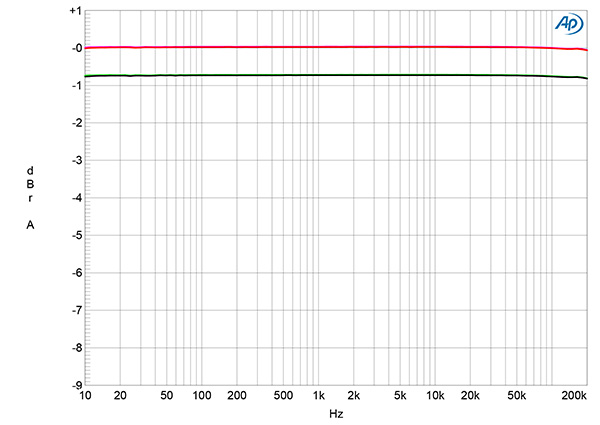
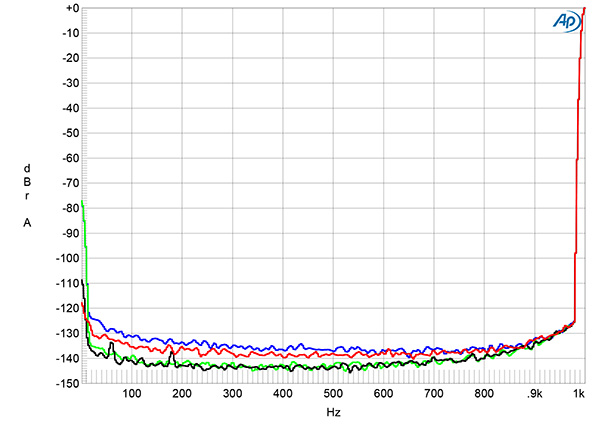
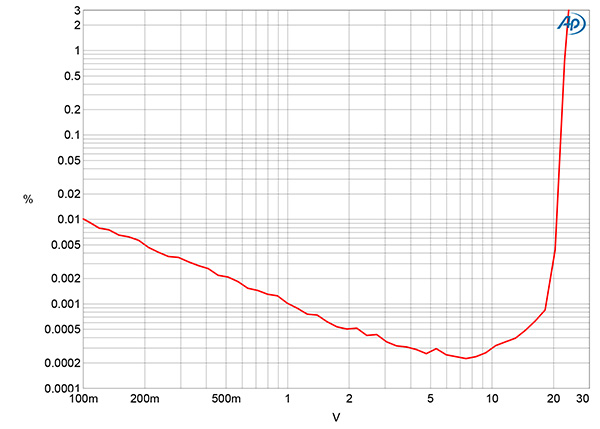
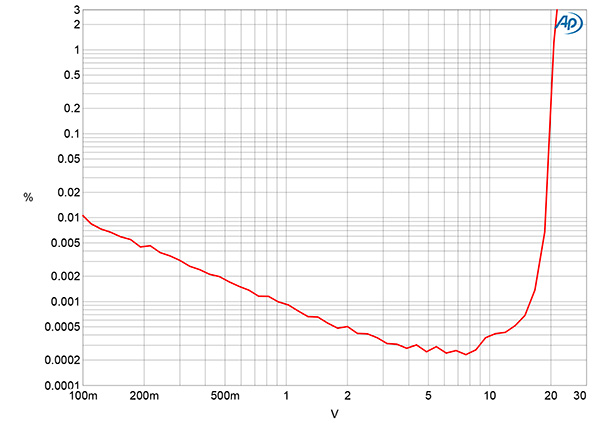
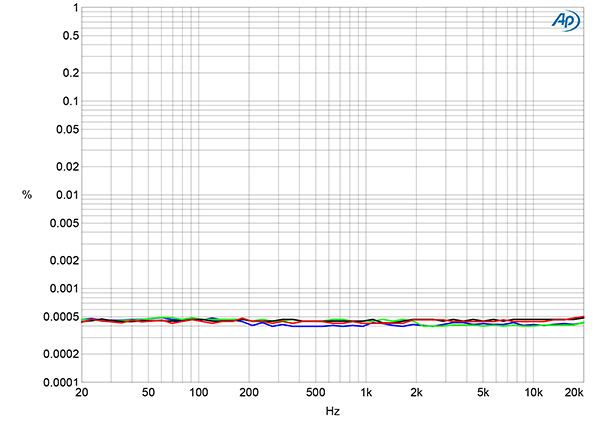
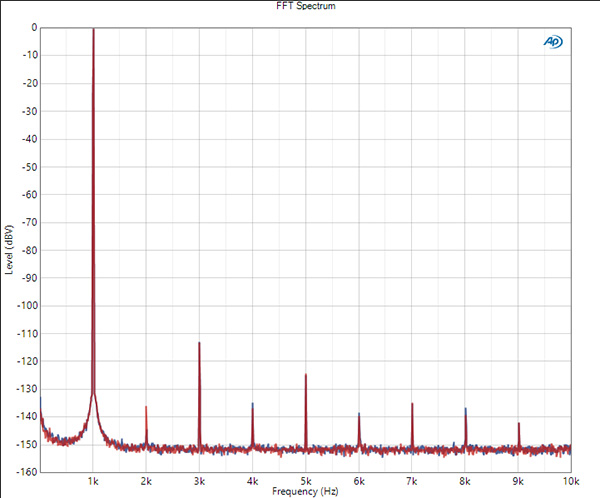
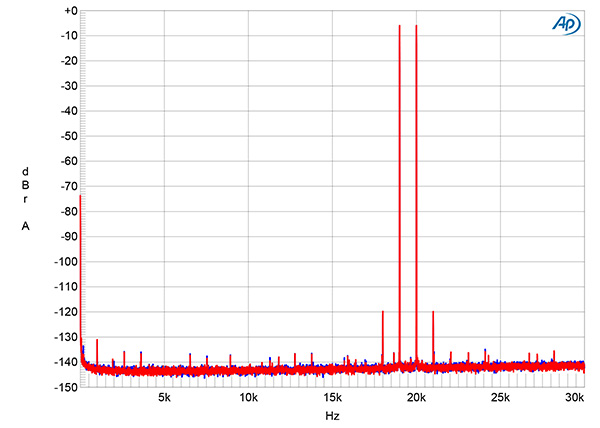
Fig.1 CH Precision L1, balanced frequency response with volume control set to "+18.0dB" at 2V into: 100k ohms (left channel blue, right red), 600 ohms (left green, right gray) (0.5dB/vertical div.).
The preamplifier's balanced frequency response was flat from 10Hz to 200kHz into both 100k ohms (fig.1, blue and red traces) and 600 ohms (green and gray traces). Fig.1 was taken with the L1's volume control at its maximum setting of "+18.0dB." Both the frequency response and the superb channel matching were preserved at lower settings of the control and with the unbalanced inputs and outputs. The CH Precision preamp's channel separation was superbly high, at 140dB in both directions below 1kHz, decreasing only slightly, to 130dB, at the top of the audioband (not shown).
Fig.2 CH Precision L1/X1, balanced spectrum of 1kHz sinewave, DC–1kHz, at 5V into 100k ohms with volume control set to "+18.0dB" (left channel blue, right red) and to "0.0dB" (left green, right gray) (linear frequency scale).
From balanced inputs to balanced outputs, the L1/X1 combination offered extremely low noise, with no power-supply–related spuriae in its output (fig.2). The blue and red traces in this graph were taken with the volume control set to the maximum. Repeating the spectral analysis with the control set to unity gain and increasing the level of the input signal by 18dB so that the output level remained the same reduced the level of the lower-frequency noise components by up to 10dB (gray, green traces). The wideband, unweighted signal/noise ratio, measured with the balanced input shorted to ground but the volume control set to its maximum, was a very high 88dB ref. 2V output (average of both channels, which were very similar). Restricting the measurement bandwidth to the audioband increased the S/N ratio to a superb 102.5dB, while switching an A-weighting filter into circuit further improved this ratio, to 105.3dB. Neither the level of the noisefloor nor the S/N ratios changed when I repeated these analyses without the X1 connected or after I performed the balanced input Calibration.
Fig.3 CH Precision L1/X1, balanced distortion (%) vs 1kHz output voltage into 100k ohms.
Fig.4 CH Precision L1/X1, balanced distortion (%) vs 1kHz output voltage into 600 ohms.
CH Precision specifies the maximum output level as 16V, balanced, and 8V, unbalanced. Figs.3 & 4 respectively plot the percentage of THD+noise in the L1's balanced output against the output voltage into 100k ohms and 600 ohms, with the X1 connected. With clipping defined as when the THD+N reaches 1%, the balanced output clipped at 23V into 100k ohms and 20.5V into 600 ohms. As expected, the L1's unbalanced output clipped at half these voltages. These clipping voltages were the same when I repeated the tests without the X1.
Fig.5 CH Precision L1/X1, balanced distortion (%) vs frequency at 5V into: 100k ohms (left channel blue, right red), 600 ohms (left green, right gray).
The downward slope below 5V of the traces in figs.3 & 4 indicates that the actual distortion lies below the noisefloor. To be sure that the reading was not dominated by noise, I measured how the L1's distortion changed with frequency at 5V. The THD+N percentage was extremely low throughout the audioband into both 100k ohm and 600 ohm loads (fig.5), and, commendably, there was no increase in the top audio octaves.
Fig.6 CH Precision L1/X1, balanced spectrum of 1kHz sinewave, DC–10kHz, at 10V into 100k ohms (left channel blue, right red; linear frequency scale).
Fig.7 CH Precision L1/X1, balanced HF intermodulation spectrum, DC–30kHz, 19+20kHz at 5V into 100k ohms (left channel blue, right red; linear frequency scale).
At 5V into 100k ohms, the third harmonic was the highest in level (not shown) but at –117dB (0.00014%) was negligible. When I raised the output level by 10dB, to 10V, the third harmonic rose to a still negligible –93dB (0.006%; fig.6). The level of this harmonic only rose by 1dB into the current-hungry 600 ohm load! Tested for intermodulation distortion with an equal mix of 19 and 20kHz tones at a peak voltage of 5V into 600 ohms, the second-order difference product at 1kHz lay at –130dB (0.00003%) and the levels of the higher-order products were only 10dB higher (fig.7). And as with the previous measurements, these results didn't change after I disconnected the X1 supply.
The CH Precision L1's measurements are superb, some of the best I have encountered, equaling and in some areas even bettering the measured performance of preamplifiers from Benchmark, MBL, Pass Labs, and Topping.—John Atkinson