Sidebar 3: Measurements
The Burmester 216 can be operated as a conventional two-channel amplifier or, by bridging the two output stages using the supplied adapter cable, as a monoblock. I performed a complete set of measurements in both modes on one of the review samples (serial number 9216060) with my Audio Precision SYS2722 system. I preconditioned the 216 by following the CEA's recommendation of running it in stereo mode at one-eighth the specified power into 8 ohms for 30 minutes. At the end of that time, the temperature of the top panel was 96.4°F (35.8°C) and that of the side panels 110.2°F (43.4°C).
The diagram on the amplifier's rear panel indicates that the balanced inputs are wired with pin 2 negative, the opposite of the AES standard. Consequently, the Burmester inverted absolute polarity in both stereo and mono modes. The 216's input impedance was a low 2800 ohms from 20Hz to 20kHz. The voltage gain in stereo mode at 1kHz was 31.7dB, which is equivalent to a sensitivity of 735mV input for full power. The gain in mono mode increased by just under the expected 6dB, to 37.5dB.
The Burmester 216 offers very low distortion and noise and won't be fazed by having to drive low impedances.—John Atkinson
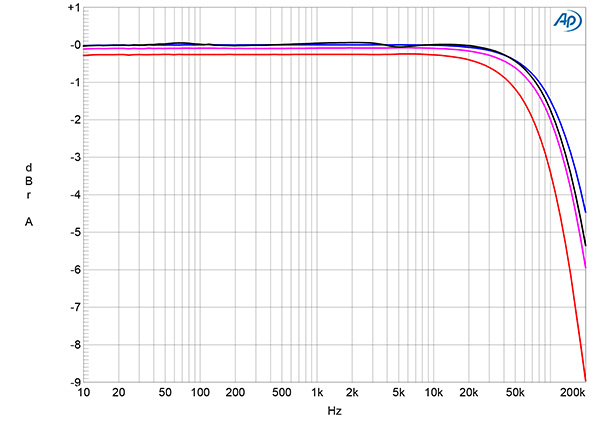
Fig.1 Burmester 216, mono mode, frequency response at 2.83V into: simulated loudspeaker load (gray), 8 ohms (blue), 4 ohms (magenta), and 2 ohms (red) (1dB/vertical div.).
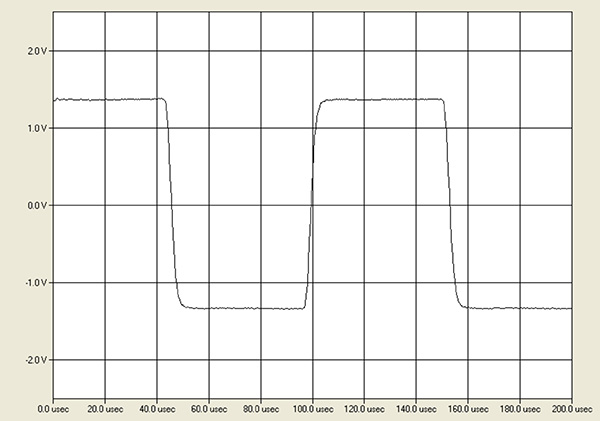
Fig.2 Burmester 216, mono and stereo modes, small-signal 10kHz squarewave into 8 ohms.
The output impedance in stereo mode, including the series impedance of 6' of spaced-pair cable, was 0.08 ohms at 20Hz and 1kHz, 0.1 ohms at 20kHz. The mono mode impedances were similarly low. As a result, the variation in the frequency response with our standard simulated loudspeaker (fig.1, gray trace) was minimal. The response into resistive loads was flat in the audioband, not reaching –3dB until 150kHz into 8 ohms (blue) and 130kHz into 4 ohms (magenta). In mono mode, the ultrasonic response into 2 ohms (red) rolls off a little earlier than it did into higher impedances and in stereo mode, the –3dB point lying at 91kHz. With its wide small-signal bandwidth, the Burmester's reproduction of a 10kHz squarewave into 8 ohms featured very short risetimes in both modes (fig.2), with no overshoot or ringing.
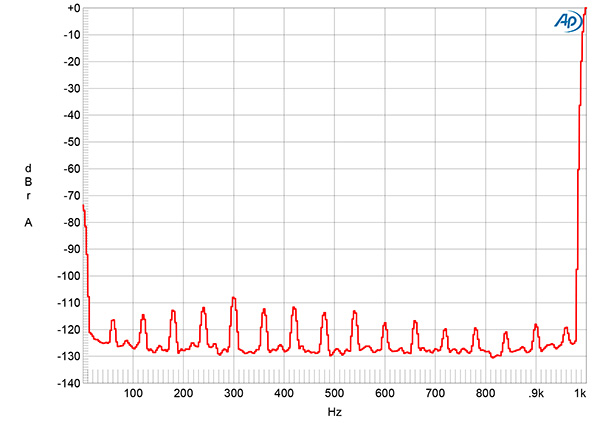
Fig.3 Burmester 216, mono mode, spectrum of 1kHz sinewave, DC–1kHz, at 1Wpc into 8 ohms (linear frequency scale).
Channel separation in stereo mode (not shown) was >80dB in both directions below 1kHz and still 70dB at the top of the audioband. In stereo mode, the unweighted, wideband signal/noise ratio (ref. 1W into 8 ohms), taken with the input shorted to ground, was a superb 85.4dB in the left channel, 82.9dB in the right. These ratios respectively improved to 95.2dB and 93dB when the measurement bandwidth was restricted to the audioband, and to 98dB and 95.5dB when A-weighted. The ratios were equally superb in mono mode. Spectral analysis of the low-frequency noisefloor while the Burmester drove a 1kHz tone at 1Wpc into 8 ohms in mono mode revealed that while power supply–related spuriae at 60Hz and its harmonics were present, these all lay at or below –110dB (fig.3).
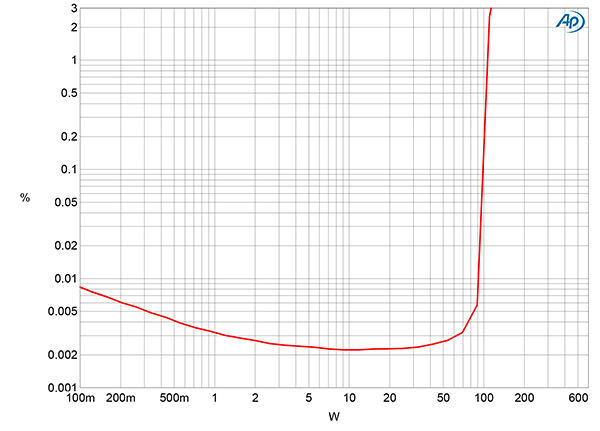
Fig.4 Burmester 216, stereo mode, distortion (%) vs 1kHz continuous output power into 8 ohms.
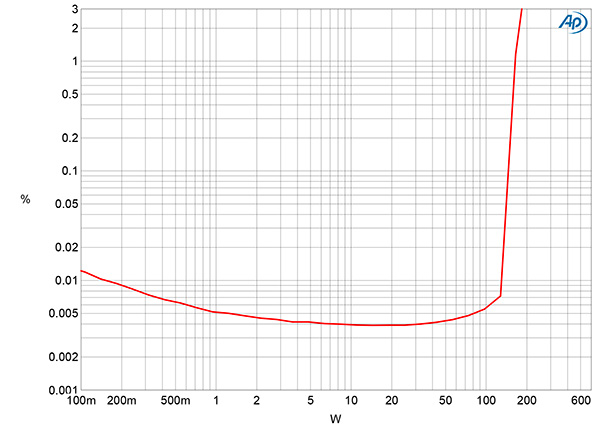
Fig.5 Burmester 216, stereo mode, distortion (%) vs 1kHz continuous output power into 4 ohms.
Burmester specifies the 216's maximum power in stereo mode as 100Wpc into 8 ohms (20dBW), 165Wpc into 4 ohms (19.17dBW), and 245Wpc into 2 ohms (17.9dBW). With our usual definition of clipping, which is when the THD+noise reaches 1%, the 216 met its specified power with both channels driven into both 8 ohms (fig.4) and 4 ohms (not shown). I didn't examine the clipping power into 2 ohms, as Jim Austin hadn't finished his auditioning and this sample had to be returned to him. (Amplifiers sometimes break when driving their maximum power into 2 ohms, which is why I usually leave this test to last.)
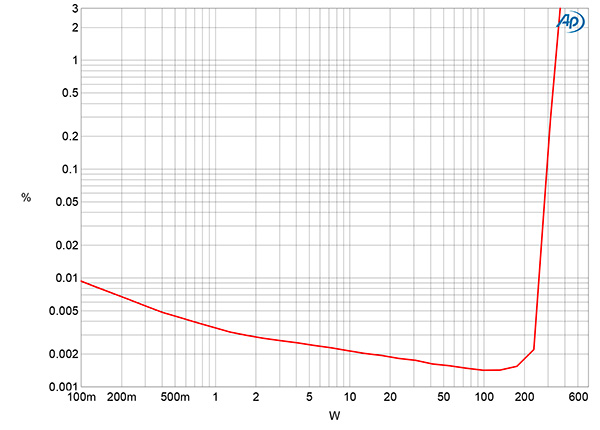
Fig.6 Burmester 216, mono mode, distortion (%) vs 1kHz continuous output power into 8 ohms.
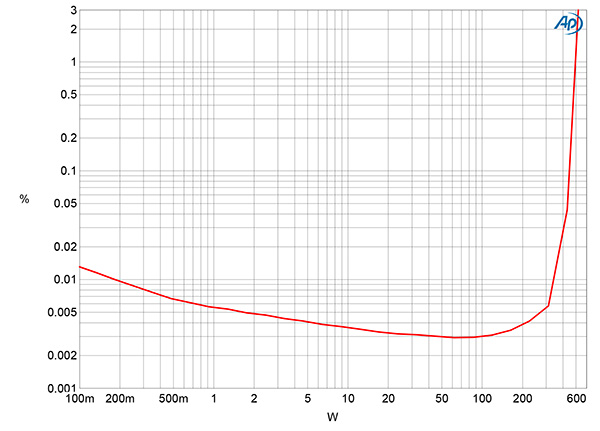
Fig.7 Burmester 216, mono mode, distortion (%) vs 1kHz continuous output power into 4 ohms.
In mono mode, the Burmester clipped at 330Wpc into 8 ohms (25.19dBW, fig.5) and 500Wpc into 4 ohms (24dBW, fig.6).
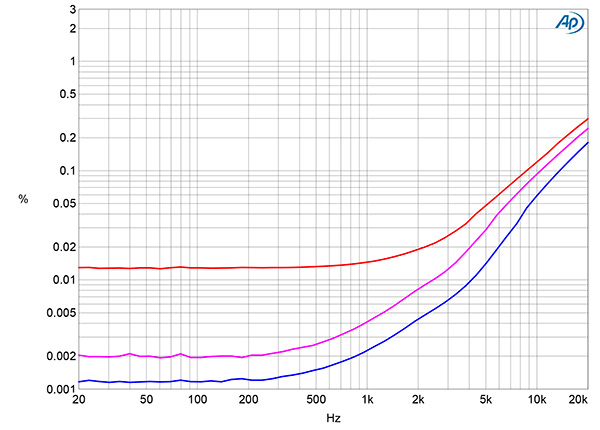
Fig.8 Burmester 216, mono mode, THD+N (%) vs frequency at 20V into: 8 ohms (blue), 4 ohms (magenta), and 2 ohms (gray).
Even at high powers, the distortion below waveform clipping in figs.4–6 was very low. I examined how the percentage of THD+N varied with frequency at 20V, which is equivalent to 50W into 8 ohms, 100W into 4 ohms, and 200W into 2 ohms in both stereo (not shown) and mono (fig.7) modes. The THD+N percentage was higher into 2 ohms (red trace) than it was into the higher impedances (blue and magenta traces), but was still low. The increase in THD+N in the top audio octaves will be due to the usual limitation in open-loop bandwidth reducing the amount of corrective negative feedback available.
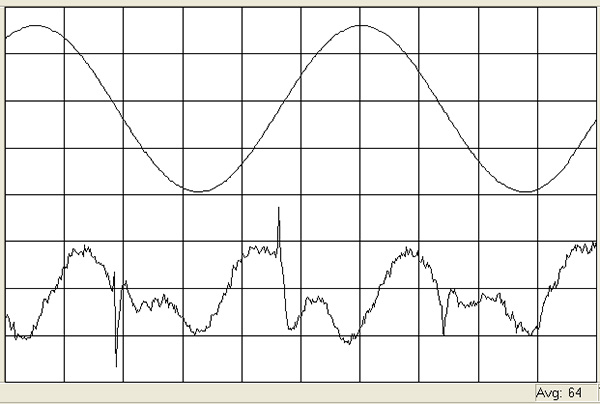
Fig.9 Burmester 216, stereo mode, 1kHz waveform at 50W into 8 ohms, 0.00127% THD+N (top); distortion and noise waveform with fundamental notched out (bottom, not to scale).
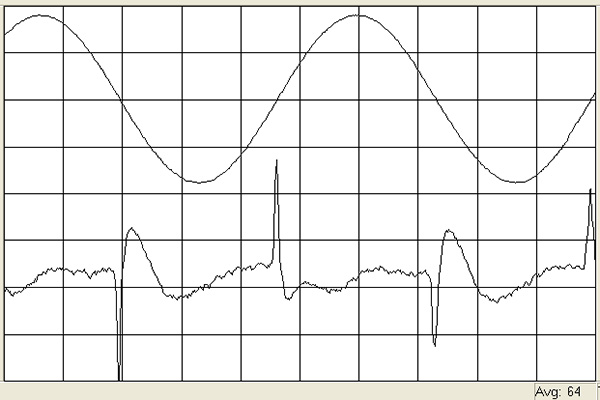
Fig.10 Burmester 216, mono mode, 1kHz waveform at 50W into 8 ohms, 0.00194% THD+N (top); distortion and noise waveform with fundamental notched out (bottom, not to scale).
The distortion waveform in stereo mode was predominantly the second harmonic (fig.8—I had to average 64 captures to reduce the level of the random noise to the point where the waveform of the distortion became clear.). However, spikes occur at the sinewave crossover points, and these were more fully developed at the same power in mono mode (fig.9).
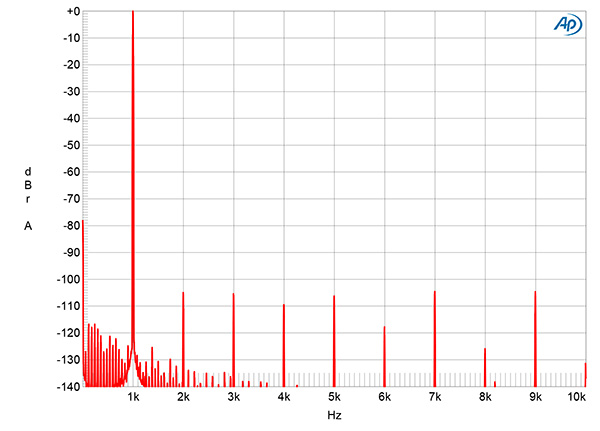
Fig.11 Burmester 216, stereo mode, spectrum of 1kHz sinewave, DC–10kHz, at 50W into 8 ohms (linear frequency scale).
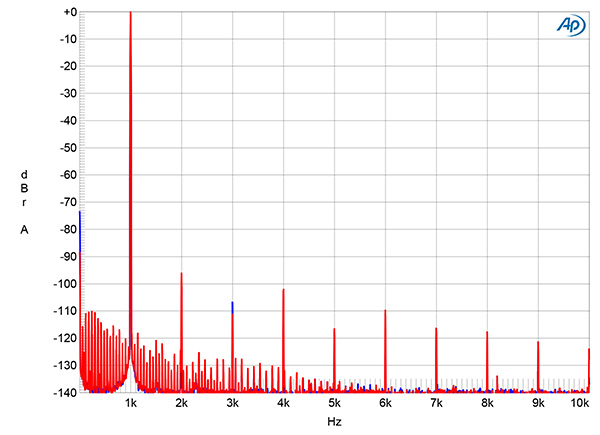
Fig.12 Burmester 216, mono mode, spectrum of 1kHz sinewave, DC–10kHz, at 50Wpc into 8 ohms (left channel blue, right red; linear frequency scale).
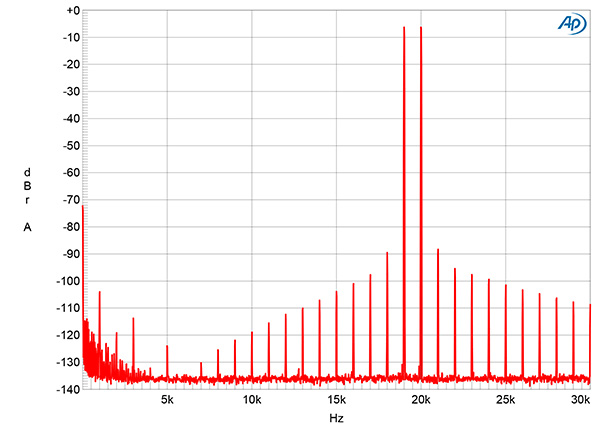
Fig.13 Burmester 216, mono mode, HF intermodulation spectrum, DC–30kHz, 19+20kHz at 40W peak into 4 ohms (linear frequency scale).
These spikes correlate with the presence of higher-order harmonics, which can be seen in spectra taken in both stereo (fig.10) and mono (fig.11) modes. Even so, the levels of the fifth and higher harmonics were extremely low, at close to –110dB (0.0003%). Intermodulation distortion was also very low, the 1kHz difference product resulting from an equal mix of 19 and 20kHz tones at 40W peak into 4 ohms lying at –104dB (0.0006%, fig.12). The rise in distortion in the top octaves seen in fig.7 results in higher-order intermodulation making an appearance in this graph, but the highest in level of these still lay at –90dB (0.003%).