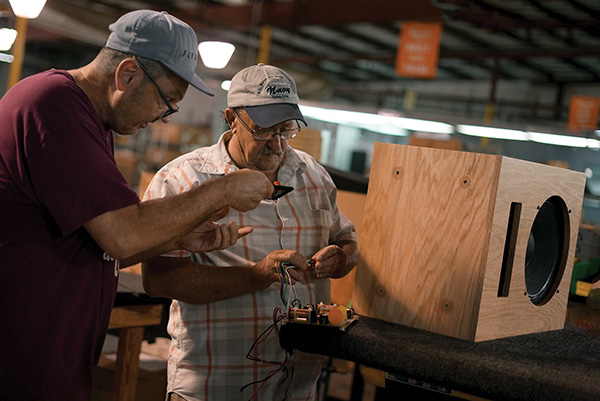
Assembling a Klipsch-Ojas kO-R1.
Which brings us back to public listening spaces. They first became widespread after World War II in Japan, where many could afford neither hi-fi gear nor the imported jazz records they wanted to hear. Most also didn't have enough square footage or privacy to enjoy them at home. These spaces are
becoming popular again, this time beyond Japan, partly for the same reasons. Listening in public, young music connoisseurs can enjoy great records in superb sound among their friends for the price of a drink, sparing themselves the skeptical side-eye of commission-based salespeople. And as Turnbull pointed out during our recent conversation, these days an entrepreneur who might have opened a hi-fi retail store 20 years ago is just as likely to launch a listening bar.
Turnbull makes some people in this business irritable, particularly the self-proclaimed experts who complain loudly and bitterly whenever attention (or revenue) flows to anyone but them. This in itself is telling. Many audiophiles claim they want young listeners to enjoy good sound, but they want them to enjoy it the way
they did. This is a pipe dream. Before writing more think pieces or online laments, audiophiles wondering why young people are staying away from hi-fi retailers are advised to have a long, frank talk with their grandchildren.
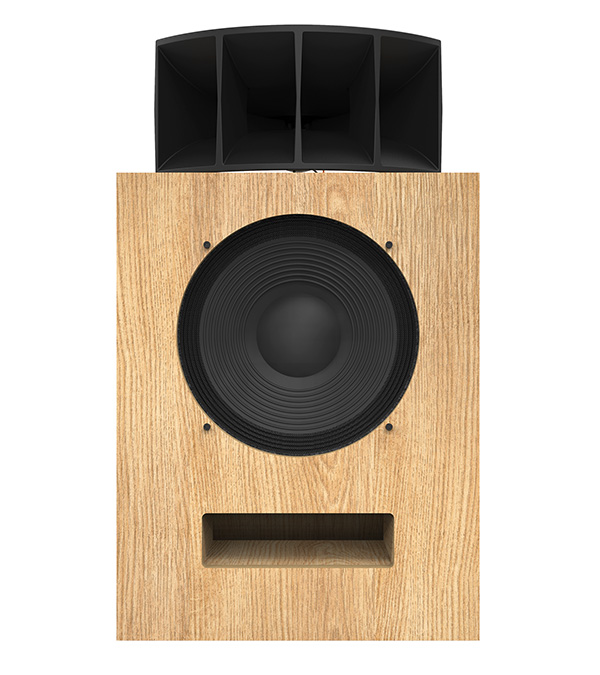 Klipsch-Ojas
After all that, you may be wondering about the Klipsch-Ojas speaker (footnote 1). Dubbed the kO-R1, it is based on the popular Heresy, originally designed by Paul Klipsch in 1957 with the goal of getting big horn performance from a relatively small enclosure. Its biggest early adopters were churches looking for better sound.
The smallest and least expensive member of the Klipsch Heritage series, now in its fourth iteration, the Heresy is known as a rock speaker that can play loud and generate surprising amounts of (upper) bass. Unusually for such a squat box, it's also meant to sit on the floor. The kO-R1 remixes a lot about the formula. When embarking on designing the new speaker, Turnbull wanted to get it off the floor; in the interest of sonic coherence, he changed it from a three-way to a two-way.
What he and Roy Delgado ended up with looks like nothing else in the Klipsch lineup. Its most striking feature is the black metal multicell horn mounted on top of the cabinet. Made from aluminum using sandcasting, a process responsible for its irregular texture, the 1211 horn is produced by Ojas and stamped with the company's name and model number. The cabinet is ported in the front, just below the 12" woofer used in the Heresy IV. There's a five-position treble control on top, and the clear-lacquer finish shows the grain of the birch ply and the butt joints, giving the kO-R1 the look of something Paul Klipsch might have built in his workshop in 1947. Perhaps not surprisingly, Delgado told me that the 1211 bears a striking resemblance to the K-5-J, a horn Klipsch designed in the 1940s and fabricated from wood.
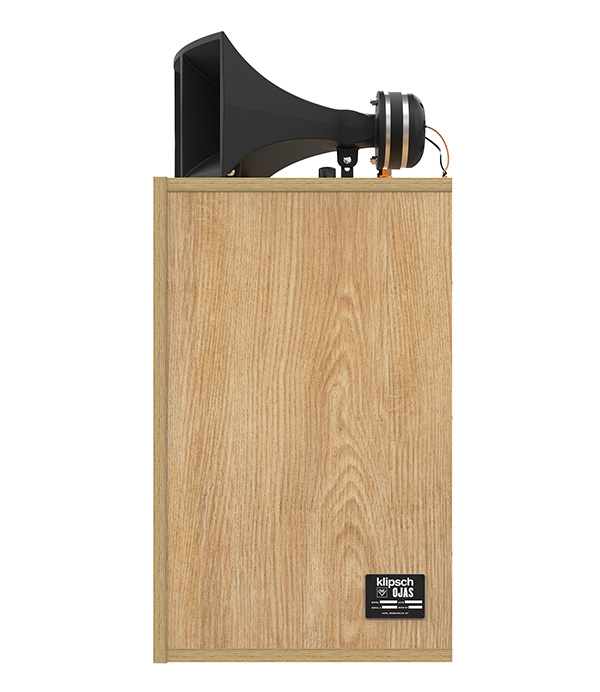
Whether the decidedly midcentury look of the kO-R1 appeals to you is obviously a matter of taste. With its retro-industrial badges and exposed wiring, I found it delightful, a tribute both to Klipsch's history and the long tradition of build-it-yourself amateur designers. Retailing for $8498/pair (stands included) and limited to 100 units, the kO-R1 comes with a little clothbound book, intended, I think, as a document of the collaboration.
I found this piece of marketing fluff a bit difficult to digest. It features 11 photos of Turnbull, including one repurposed from the
GQ shoot where his head is haloed by a woofer like a hi-fi Buddha's; it also describes him as "visionary" and repeatedly compares him to Paul Klipsch. It's no insult to Turnbull to suggest that he bears the same relationship to Paul Klipsch that I do to William Faulkner, and I confess that I suspected him of being a touch grandiose until he told me the book wasn't his doing.
When setting up the kO-R1s on their dedicated stands, I pulled them several feet farther into my loft than the
Klipsch La Scalas I usually listen to, thinking that the smaller speaker would benefit from a more nearfield position. I needn't have worried. With the speakers driven by the
Manley Mahis set to Ultralinear mode, what surprised and impressed me most was how effortlessly they filled my very large living space. Compared to its much larger stablemate, the kO-R1 gave up far less in terms of dynamic expression than I expected.

Listening to "Dead Man's Tetris," from 2014's
You're Dead! by Flying Lotus (Qobuz stream), I was floored by how much jump and crunch these standmount speakers squeezed from the mostly electronic soundscape and was startled when Snoop Dogg's multitracked voice appeared between the speakers. I'm not sure why, but Calvin Cordozar Broadus Jr.'s once-in-a-century voice has the same effect on my brain as perfectly grilled cheeseburgers or 21-year-old Scotch have on other people's insides, so I played the track twice more.
Happily, given the kO-R1's price premium over the Heresy IV, the decision to convert it to a two-way seems to have paid off. When I listened to "Mono No Aware" from an LP of Ruth Garbus's
Alive People (Orindal Records ORD-73, non–cotton-candy-pink pressing), the vividness and immediacy of the singer's voice was reach-out-and-touch-it amazing, a testament to what a good compression driver mated to a horn can do. I've never heard this kind of bracing sound from a dome tweeter, no matter how exotic—a reminder that despite their historic origins, horns remain state-of-the-art devices.
"Mono No Aware" is a Japanese expression that means something like "the pity of things," a recognition of life's impermanence and inherent fragility. It's also an apt descriptor of this album, one of the most original I've heard in recent years. The younger sister of Merrill Garbus, who performs under the name tUnE-yArDs, Ruth Garbus uses her trained voice as a deceptively impassive vehicle for her arresting lyrics. "I don't know what life is/don't know what art is for/but I can understand singing the blues," she intones on "Mono No Aware," capturing something about the confusion and exultation of being young in the early 21st century.
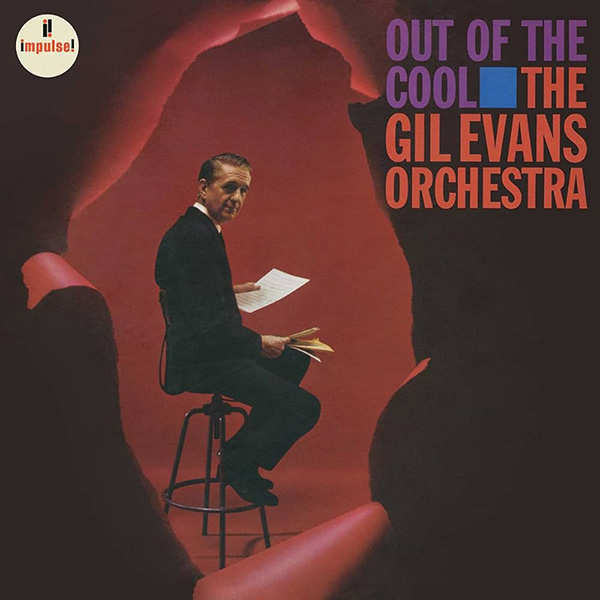
I also played "La Nevada" from an orange-label pressing of the Gil Evans Orchestra's
Out of the Cool (Impulse A-4-S), which features an arrangement as inventive as any Evans recorded with Miles Davis. The LP is also a showcase for the physicality and saturated tone colors that Rudy Van Gelder was able to capture in the early years of his Englewood Cliffs studio. Though the Ojas speaker couldn't match the enormous scale nor the relaxed effortlessness of the much larger and more expensive
La Scala AL5, it reproduced the brass of Jimmy Knepper's trombone and the wood of Ron Carter's bass with just as much texture, color, and physicality.
It's patently unfair to compare the kO-R1 to the La Scala, but the two speakers share more than a pedigree. For one thing, they have a nearly identical frequency response, claimed to be 51Hz–20kHz (±3dB). Of course, measurements tell us only so much. You might imagine that a horn-loaded 15" woofer would sound quite different from a 12" woofer in a ported cabinet, and you'd be right. Whereas the La Scala's bass sounds linear, textured, and highly detailed, with the kO-R1 I heard a slight but distinct upper bass bump, probably around 100Hz, which gave many kinds of music—rock, country, reggae—a fun, propulsive push. But on other fare, particularly acoustic jazz recordings like that Gil Evans LP, I sometimes wished for a more evenhanded and realistic portrayal of the low frequencies. Turnbull told me that this bass accent is intentional, describing his designs as straddling a generational disagreement about how much bass is ideal. "Often, younger listeners criticize my speakers for not having enough bass," he told me, "while older audiophiles say they have too much."
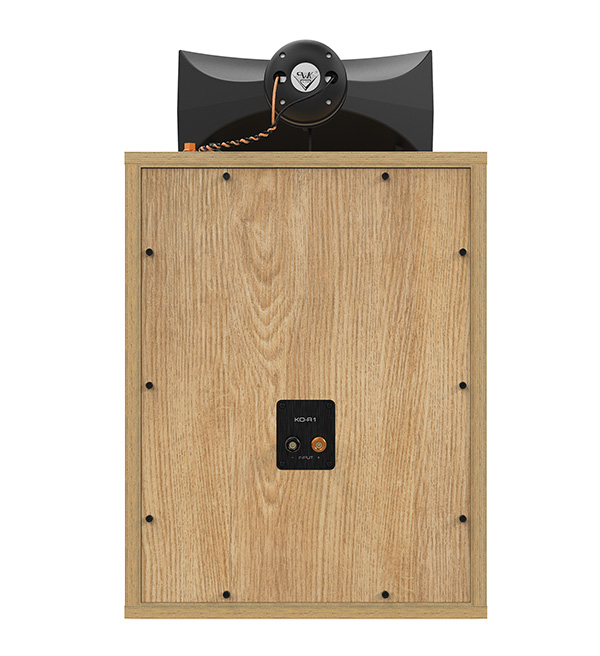
And a last, lovely thing: Rated at 97.5dB, the kO-R1 is audibly less sensitive than the La Scala yet proved better than the larger speaker at making music with low-power single-ended tube amplifiers. Driven by the wonderful Ampsandsound Mogwai SE, a zero-feedback amp outputting 8.2W from a single 6L6GC pentode, the speakers sounded even more pellucid and exciting, with zero audible penalties to bass response or speed. Nice!
As you can probably tell, I thoroughly enjoyed the Klipsch-Ojas kO-R1, a speaker with many talents and a boatload of history and style, suited to all but the largest rooms. Unless you listen to little except chamber music, chances are you'll love it, too.
Footnote 1: Web: ojas.nyc/ &
www.klipsch.com/products/ojas-ko-r1.