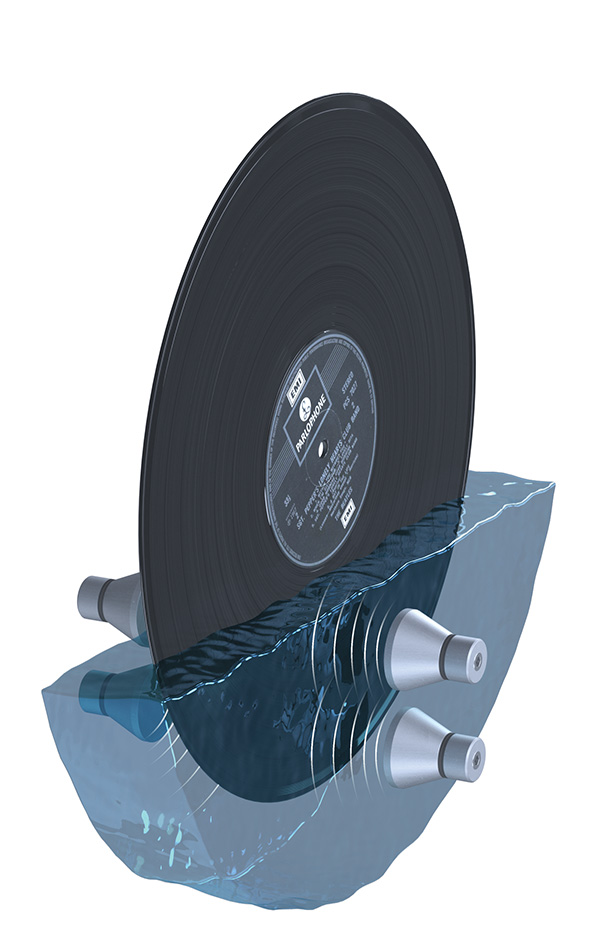
 After running Milton Nascimento's self-titled debut from 1967 (Som Livre 403.6152) through the Degritter, I listened to its most famous track, "Travessia." A poem about the end of a love affair, it established 24-year-old Nascimento as a vital songwriter whose singular tenor and unearthly falsetto would come to be described as "a voz do Deus" (the voice of God). The strings in Luiz Eça's orchestral arrangement can sometimes come across as a bit indistinct and murky, but after the ultrasonic cleaning, they sounded clearer and fuller than I'd heard them. And the chords Nascimento strummed on his acoustic guitar got juicier.
In case you're curious, I did try the Degritter with new records. A wonderful-sounding 45rpm reissue of John Prine's self-titled debut (Analogue Productions AAPA 004-45), released to celebrate the 75th Anniversary of Atlantic Records, came through a cavitation bath with the same brightening I experienced with heavily played disks. It was as though someone had bumped up its contrast and saturation levels in Photoshop.
To see how the Degritter performed with seriously filthy records, I pulled out a copy of Pink Floyd's The Wall that I'd bought while in high school in the mid-1980s. I haven't listened to it in years and never cleaned it, and its grooves were covered with fingerprints and caked with enough Reagan-era gunk to send flurries of loud crackling and popping through the speakers. The Wall was just as gross and crunchy as I remembered.
After running Milton Nascimento's self-titled debut from 1967 (Som Livre 403.6152) through the Degritter, I listened to its most famous track, "Travessia." A poem about the end of a love affair, it established 24-year-old Nascimento as a vital songwriter whose singular tenor and unearthly falsetto would come to be described as "a voz do Deus" (the voice of God). The strings in Luiz Eça's orchestral arrangement can sometimes come across as a bit indistinct and murky, but after the ultrasonic cleaning, they sounded clearer and fuller than I'd heard them. And the chords Nascimento strummed on his acoustic guitar got juicier.
In case you're curious, I did try the Degritter with new records. A wonderful-sounding 45rpm reissue of John Prine's self-titled debut (Analogue Productions AAPA 004-45), released to celebrate the 75th Anniversary of Atlantic Records, came through a cavitation bath with the same brightening I experienced with heavily played disks. It was as though someone had bumped up its contrast and saturation levels in Photoshop.
To see how the Degritter performed with seriously filthy records, I pulled out a copy of Pink Floyd's The Wall that I'd bought while in high school in the mid-1980s. I haven't listened to it in years and never cleaned it, and its grooves were covered with fingerprints and caked with enough Reagan-era gunk to send flurries of loud crackling and popping through the speakers. The Wall was just as gross and crunchy as I remembered.
 So I went back to the trusty VPI and got to scrubbing. After vacuuming, I listened yet again. Now The Wall sounded noticeably less crunchy, and the fingerprints were gone, but it retained the clarity it had gained from the Degritter. All of which suggests that both machines have their uses and aren't totally redundant: For really dirty records, a pass through both machines is ideal. Is that a good enough reason to own two record cleaning machines? Don't look at me.
There's another meaningful difference between these machines that's worth mentioning. The VPI's tank-like durability and longevity is a result not only of solid construction and great aftermarket service but also of the machine's relative simplicity. Besides the motors that control suction and rotate the platter, there's not much inside it that can break. But a fully automatic ultrasonic machine like the Degritter is a far more complex proposition—essentially a computer filled with many moving parts and ... water. So Degritter's customer support, two-year warranty, and post-warranty service costs may be something to explore and consider, especially given the machine's nontrivial price (footnote 2).
So I went back to the trusty VPI and got to scrubbing. After vacuuming, I listened yet again. Now The Wall sounded noticeably less crunchy, and the fingerprints were gone, but it retained the clarity it had gained from the Degritter. All of which suggests that both machines have their uses and aren't totally redundant: For really dirty records, a pass through both machines is ideal. Is that a good enough reason to own two record cleaning machines? Don't look at me.
There's another meaningful difference between these machines that's worth mentioning. The VPI's tank-like durability and longevity is a result not only of solid construction and great aftermarket service but also of the machine's relative simplicity. Besides the motors that control suction and rotate the platter, there's not much inside it that can break. But a fully automatic ultrasonic machine like the Degritter is a far more complex proposition—essentially a computer filled with many moving parts and ... water. So Degritter's customer support, two-year warranty, and post-warranty service costs may be something to explore and consider, especially given the machine's nontrivial price (footnote 2).
 All Blues
There's nothing New Yorkers like more than a secret. Private dinners for 20 that sell out in minutes, speakeasies you enter through a phonebooth, and record stores hidden on the upper floors of residential buildings are the kinds of things that make our hearts convulse a little faster. So when my friend Victor asked if I wanted to go to a new listening space with hardly any online presence and not even a sign, I said when and where. And that is how, on a recent night, we found ourselves looking for an unmarked door on a deserted street in Chinatown. It was Valentine's Day. Yeah, I know. Don't ask. After we found the door and walked in, we were met by a tall, bald, powerfully built man in a devastating gray suit, who offered his hand and said, "Welcome, I'm Cornelius." He asked if we wanted a seat at the bar or in the "listening theater," explaining that in either location we were expected to be quiet. The friendly but decisive way in which Cornelius said this made it clear that putting up with people's noise wasn't his favorite activity. The front page of the menu reiterated this point at greater length.
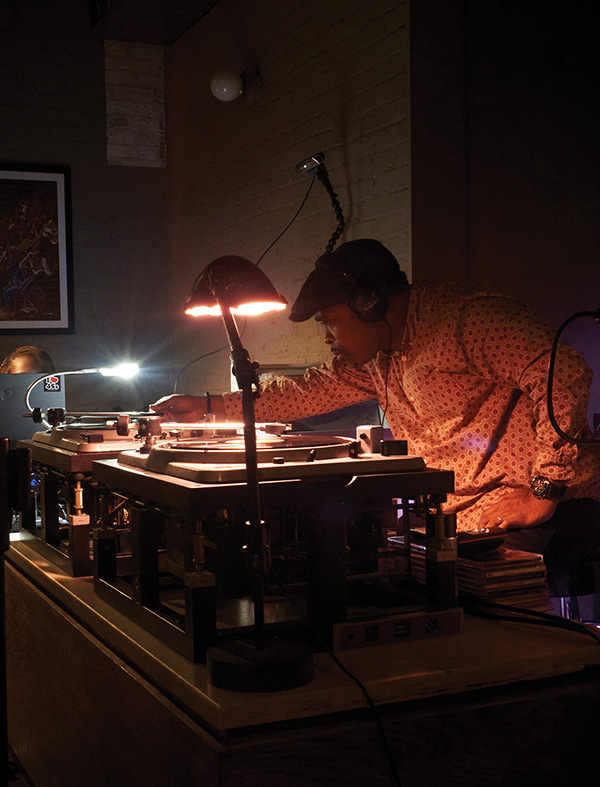 The joint's middle-aged owner, a concert promoter from Tokyo named Yuji Fukushima, worked the booth. He greeted us warmly and explained that All Blues was his "passion project." It turned out that he was also the owner of a Soho clothing store named after another cut from Miles Davis's Kind of Blue LP, Blue in Green. I recalled visiting it months earlier not only because it carried my favorite brand of Japanese socks (footnote 4) but because it was the only clothing shop I'd visited with a sound system built around Leave It to Beaver–era Altec Voice of the Theater speakers, each about the size of a refrigerator.
In an earlier column about new listening spaces in New York, I wrote about the ways these places differed from their Japanese counterparts in an effort to accommodate the musical and social habits of Americans. All Blues proved to be something else—an attempt to transplant a Tokyo-style jazz kissa in its purest guise to the US. The JBL, Marantz, and McIntosh gear from the golden age of American hi-fi could have come straight from a shop in Tokyo's Akihabara district. (In fact, some of it did: Fukushima told me that he'd bought the Paragon in Japan and had it shipped to New York.) The bar and kitchen serve Japanese fare, like the very respectable grilled eel that Victor and I enjoyed alongside whiskey-and-sake cocktails. Most importantly, the hands-on approach to encouraging a respectful noise level reminded me of Tokyo more than New York.
The joint's middle-aged owner, a concert promoter from Tokyo named Yuji Fukushima, worked the booth. He greeted us warmly and explained that All Blues was his "passion project." It turned out that he was also the owner of a Soho clothing store named after another cut from Miles Davis's Kind of Blue LP, Blue in Green. I recalled visiting it months earlier not only because it carried my favorite brand of Japanese socks (footnote 4) but because it was the only clothing shop I'd visited with a sound system built around Leave It to Beaver–era Altec Voice of the Theater speakers, each about the size of a refrigerator.
In an earlier column about new listening spaces in New York, I wrote about the ways these places differed from their Japanese counterparts in an effort to accommodate the musical and social habits of Americans. All Blues proved to be something else—an attempt to transplant a Tokyo-style jazz kissa in its purest guise to the US. The JBL, Marantz, and McIntosh gear from the golden age of American hi-fi could have come straight from a shop in Tokyo's Akihabara district. (In fact, some of it did: Fukushima told me that he'd bought the Paragon in Japan and had it shipped to New York.) The bar and kitchen serve Japanese fare, like the very respectable grilled eel that Victor and I enjoyed alongside whiskey-and-sake cocktails. Most importantly, the hands-on approach to encouraging a respectful noise level reminded me of Tokyo more than New York.
Footnote 2: Recently, a manufacturer of a popular ultrasonic record cleaner has been informing customers that it will no longer service their units, instead offering a discounted "upgrade path" to the current model. Caveat emptor. Footnote 3: All Blues Musiquarium NYC, 87 Walker St., New York, NY 10013. Email: info@allbluesnyc.com. Web: allbluesnyc.com