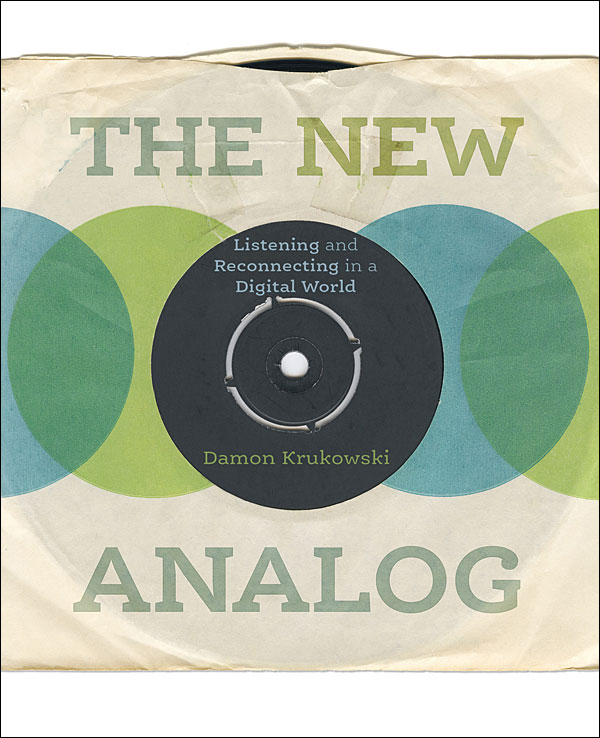
The New Analog: Listening and Reconnecting in a Digital World, by Damon Krukowski. The New Press, 2017. Hardcover, 240 pp., $24.95. Also available as an e-book.
Defining noise is tricky business.
In high-end audio, noise is often defined as the enemy—of music, beauty, truth. Engineers and enthusiasts alike spend significant amounts of time, energy, and money attempting to minimize or control noise so that it has the least possible impact on the source signal: music. In this way—if we are intelligent, careful, and fortunate—we can extract from our stereos cleaner, clearer, more naturally beautiful sound for listening experiences that are enriching, emotionally compelling, and, above all, fun. On the other hand, when noise is allowed to excessively modulate the signal, music can sound relatively abrasive, more mechanical, and, ultimately, less engaging.
In this simplified definition, noise is a problem to be solved, and our efforts to minimize it are noble indeed. Yet in his provocative new book, The New Analog: Listening and Reconnecting in a Digital World, musician and writer Damon Krukowski wonders whether there is a time and place for noise, after all. More to the point, he asserts that "noise is as communicative as signal," often containing contextual information that in fact describes time and place.
Should we reconsider our relationship with noise?
To answer that question, we must settle on a definition of noise. Krukowski himself seems hesitant to do so—at least outright—but he does offer clear distinctions between analog and digital media. He writes with a poet's profundity and focus, a drummer's sense of rhythm: "Analog is not simply old, and digital is not merely new"—a sentiment with which most audiophiles would quickly agree. Like many Stereophile readers, Krukowski is not interested in ranking various forms of media. Still, while his own deep-seated allegiance to analog communication sometimes betrays him—he dislikes Facebook, is skeptical of GPS, longs for the days of extensive liner notes—he makes clear that there is much to be gained from digital communication, the potential to reach far larger audiences with a speed and efficiency previously unknown.
 Krukowski continues: "Analog media always include noise, necessarily—efforts to minimize noise in analog environments adjust its ratio to signal, but never eliminate it. Digital media, on the other hand, are capable of separating signal from noise absolutely."
Is this correct? Many audio engineers would contend that it is impossible to separate signal from noise absolutely—that, in fact, some amount of noise always travels with the signal, especially when working within the digital environment. Some readers will be tempted to stop here, dismissing Krukowski's premise as little more than uncritical nostalgia at best, willful ignorance at worst.
That would be too easy. Reading on, one finds that Krukowski's perspective was formed not in the listening room or test lab, but in the digital recording studio. There, he says, signal is easily defined as any sound musicians and engineers want to communicate, while noise is simply anything that isn't signal. If we extend these definitions beyond the recording studio, we find ourselves in a world where, depending on our interests and goals, signal and noise constantly shift. In a crowded restaurant, we listen intently to the events of our companion's day (the signal), while tuning out the chatter of nearby tables (the noise). Or we decide to eavesdrop on others, thereby reversing signal and noise.
The limits of analog recording necessitate that sometimes unintended sounds—the clink of cocktail glasses, the rumbling of passing trains, and other audiophile delights—remain in a final mix. With digital technology, the savvy engineer can completely erase these unintended sounds, making it as though they never occurred. We are given silence—or a likeness thereof.
But when noise is erased, what else is lost? And what is compromised when we—artists, engineers, and listeners—no longer have the power to define signal and noise? These are the questions at the heart of The New Analog. Krukowski may not have the answers, but he wants to engage in a thoughtful conversation. Decision makers, he suspects, may not have consumers' best interests in mind.
Take, for instance, music streaming services and their troubling deficit of metadata (footnote 1). Noting the Internet's vast amount of easily accessible and affordable music, Krukowski writes, "[S]treaming services are anxious about leaving their users in that moment of indecision; endless choice means they might make no choice, and not use the service at all. So instead of supplying copious information for listeners to research their interests—the metadata of printed media—Spotify and other streaming services have . . . stripped all music of all but the bare minimum tags." (footnote 2)
Thus, to streaming services, metadata is inessential noise that inevitably interferes with the signal (and profitability) of music. I shared this thought with Enno Vandermeer, cofounder of Roon—a music-player application that strives to reconnect listeners to their digital media, in part through the thoughtful use of metadata. Vandermeer responded via e-mail: "Roon aims to provide a digital update of the 'active listening' experience, which in the past would have entailed listening to radio and reading music press for discovery, shopping for records, reading liner notes for lyrics and insights into performers/producers/composers, researching upcoming concerts, and collecting a deeply personal music library that reflected one's tastes. In effect, what Krukowski is lamenting is the disappearance of the active listening culture that supported—and indeed required—rich sources of music-related information to fuel it."
In this light, Krukowski's plea becomes only more urgent. Audiophiles will sympathize with what he calls "thick listening"—perhaps especially because it does more to describe the differences between active listening (as an event unto itself) and casual listening (as a supplement to some other event) than it does to describe the differences between digital and analog media. Ultimately, Krukowski contends that the thoughtful act of sorting through noise promotes successful, meaningful communication. He celebrates noise in all its various forms, urging us—readers, listeners, thinkers, communicators, consumers—to listen with all our senses engaged.
Not a bad idea.—Stephen Mejias
Krukowski continues: "Analog media always include noise, necessarily—efforts to minimize noise in analog environments adjust its ratio to signal, but never eliminate it. Digital media, on the other hand, are capable of separating signal from noise absolutely."
Is this correct? Many audio engineers would contend that it is impossible to separate signal from noise absolutely—that, in fact, some amount of noise always travels with the signal, especially when working within the digital environment. Some readers will be tempted to stop here, dismissing Krukowski's premise as little more than uncritical nostalgia at best, willful ignorance at worst.
That would be too easy. Reading on, one finds that Krukowski's perspective was formed not in the listening room or test lab, but in the digital recording studio. There, he says, signal is easily defined as any sound musicians and engineers want to communicate, while noise is simply anything that isn't signal. If we extend these definitions beyond the recording studio, we find ourselves in a world where, depending on our interests and goals, signal and noise constantly shift. In a crowded restaurant, we listen intently to the events of our companion's day (the signal), while tuning out the chatter of nearby tables (the noise). Or we decide to eavesdrop on others, thereby reversing signal and noise.
The limits of analog recording necessitate that sometimes unintended sounds—the clink of cocktail glasses, the rumbling of passing trains, and other audiophile delights—remain in a final mix. With digital technology, the savvy engineer can completely erase these unintended sounds, making it as though they never occurred. We are given silence—or a likeness thereof.
But when noise is erased, what else is lost? And what is compromised when we—artists, engineers, and listeners—no longer have the power to define signal and noise? These are the questions at the heart of The New Analog. Krukowski may not have the answers, but he wants to engage in a thoughtful conversation. Decision makers, he suspects, may not have consumers' best interests in mind.
Take, for instance, music streaming services and their troubling deficit of metadata (footnote 1). Noting the Internet's vast amount of easily accessible and affordable music, Krukowski writes, "[S]treaming services are anxious about leaving their users in that moment of indecision; endless choice means they might make no choice, and not use the service at all. So instead of supplying copious information for listeners to research their interests—the metadata of printed media—Spotify and other streaming services have . . . stripped all music of all but the bare minimum tags." (footnote 2)
Thus, to streaming services, metadata is inessential noise that inevitably interferes with the signal (and profitability) of music. I shared this thought with Enno Vandermeer, cofounder of Roon—a music-player application that strives to reconnect listeners to their digital media, in part through the thoughtful use of metadata. Vandermeer responded via e-mail: "Roon aims to provide a digital update of the 'active listening' experience, which in the past would have entailed listening to radio and reading music press for discovery, shopping for records, reading liner notes for lyrics and insights into performers/producers/composers, researching upcoming concerts, and collecting a deeply personal music library that reflected one's tastes. In effect, what Krukowski is lamenting is the disappearance of the active listening culture that supported—and indeed required—rich sources of music-related information to fuel it."
In this light, Krukowski's plea becomes only more urgent. Audiophiles will sympathize with what he calls "thick listening"—perhaps especially because it does more to describe the differences between active listening (as an event unto itself) and casual listening (as a supplement to some other event) than it does to describe the differences between digital and analog media. Ultimately, Krukowski contends that the thoughtful act of sorting through noise promotes successful, meaningful communication. He celebrates noise in all its various forms, urging us—readers, listeners, thinkers, communicators, consumers—to listen with all our senses engaged.
Not a bad idea.—Stephen Mejias
Footnote 1: Krukowski's relationship with music-streaming services is especially interesting. In his Pitchfork article "Making Cents," Krukowski revealed that "Tugboat," a single by his band, Galaxie 500, was streamed on Pandora 7800 times in the first quarter of 2012, for which the composer royalties totaled just 21¢. Footnote 2: During a fascinating conversation with Ben Sisario, music columnist for the New York Times, held May 6 at Brooklyn's Rough Trade record store, Sisario politely challenged Krukowski, saying that the entire Internet might be considered today's liner notes. Krukowski conceded the point, with a qualification: "It's not from the artist's expression."
Krukowski continues: "Analog media always include noise, necessarily—efforts to minimize noise in analog environments adjust its ratio to signal, but never eliminate it. Digital media, on the other hand, are capable of separating signal from noise absolutely."
Is this correct? Many audio engineers would contend that it is impossible to separate signal from noise absolutely—that, in fact, some amount of noise always travels with the signal, especially when working within the digital environment. Some readers will be tempted to stop here, dismissing Krukowski's premise as little more than uncritical nostalgia at best, willful ignorance at worst.
Footnote 1: Krukowski's relationship with music-streaming services is especially interesting. In his Pitchfork article "Making Cents," Krukowski revealed that "Tugboat," a single by his band, Galaxie 500, was streamed on Pandora 7800 times in the first quarter of 2012, for which the composer royalties totaled just 21¢. Footnote 2: During a fascinating conversation with Ben Sisario, music columnist for the New York Times, held May 6 at Brooklyn's Rough Trade record store, Sisario politely challenged Krukowski, saying that the entire Internet might be considered today's liner notes. Krukowski conceded the point, with a qualification: "It's not from the artist's expression."