Joe Kubala agreed to send what amounted to an 80-lb tub filled with Elation! cables and a Kubala-Sosna Xpander power distributor. Although in price the Elation!s are far more comparable to Nordost's Valhalla 2s than their Odin 2s, Kubala felt I wouldn't be disappointed.
While awaiting that shipment, I reinstalled my Pass Labs XA200.8s so that I could review recordings without pain. But when the Passes now sounded bad as well, I went into a full panic. Check the connections, check the ground . . . everything checked out except my composure.
Many days later, but before I'd settled down, my reference amps began to sound themselves again. In retrospect, I believe the problem was not that one of my neighbors had started a power-sucking marijuana-growing operation that was dumping obscene levels of noise into the line, but that I'd gummed up the sound by spraying much too much DeOxit contact cleaner on my connectors.
Regardless, I ended up with a tub full of Kubala-Sosna cables in the middle of my music room. Weeks went by before I could summon up sufficient fortitude to carefully replace my entire system's worth of Nordost cables and power treatment products with their Kubala-Sosna equivalents: Elation!s and the Xpander. I used not a single squirt of DeOxit. And, as I finally sat down to listen, and realized that I would also need to hear the Audionets with the Nordosts before I could write the review, the Almighty Atkinson's wise words came back to haunt me . . .
 Listening
As excellent as the Kubala-Sosna Elation!s were with bass, and as admirably smooth as the system sounded overall, I found it darker, less open on top, less rich in the midrange, and not as focused as with the Nordost Odin 2s. So here, I confine my observations to those made after my reference wires were returned to the system. As I listened to Mahler's Symphony 9, with Iván Fischer conducting the Budapest Festival Orchestra (SACD/CD, Channel Classics CCS SA 36115), I noted how tightly the Audionet Maxes depicted bass-drum thwacks. Rapid timpani rolls were correspondingly clearer than with my Pass amps. But I had little sense of hall acoustic and boundaries. Although the violins sounded fairly silky and sweet, they were a little edgier than I'm accustomed to. Overall, the sound was darker and less colorful than with my reference monoblocks.
Even more deep percussion is to be savored in Revueltas's Sensemayá, with Werner Herbers conducting the Ebony Band (SACD/CD, Channel Classics CCS SA 21104). Here, the Maxes excelled more in bass impact than in richness. Ditto with soprano Carolyn Sampson's recital disc Fleurs (SACD/CD, BIS 2102)—Joseph Middleton's piano sounded flatter than usual, Sampson's voice more toned down, less engaging, a bit edgier.
Back to percussion and speed. I find the 24-bit/96kHz download of Ludovic Morlot and the Seattle Symphony's recording of Stravinsky's The Rite of Spring (Seattle Symphony Media 1005) extremely demanding in both departments, as well as extremely colorful. Once again, the Audionets were superb on the low end.
 Mezzo-soprano Jamie Barton may have sounded a bit darker and less brilliant through the Maxes than I'm accustomed to, but I absolutely loved listening to her huge, resplendent voice in the 24/96 download of her All Who Wander, with pianist Brian Zeger (Delos 3494). Ditto for a very different singer, lyric soprano Elly Ameling, whose gifts, on her rendition of Schubert's "Die Sterne" with Dalton Baldwin (The Artistry of Elly Ameling, CD, Philips 473-4512), the Maxes reproduced without that last iota of radiance that the Pass XA200.8s can provide.
A tip of the hat to Jon Iverson for turning me on to Yello—I indulged in two 24/48 download tracks from their album Toy (Polydor). The driving beat of "Lost in Motion" was extremely fast, with lots of layering. Ditto with "Electrified II," whose very wide, studio-enhanced soundstage, sizzling top, and fast, hard-hitting bass made me want to get up and dance. Both tracks sounded so much tighter and more impactful through the Maxes than through the Passes that I don't hesitate to say it: If your preferences lean toward hard rock, driving jazz, or propulsive/explosive music of any genre, Audionet's Max monoblocks are must-hears.
These sentiments were reaffirmed when I revisited Four Four Three: The Music of Terry Riley (DSD128 download, Channel Classics 37816) that I reviewed for Stereophile.com. This collaboration of the Ragazze String Quartet with the percussion quartet Slagwerk Den Haag and Kapok—a genre-redefining trio of horn, guitar, and drum kit—has slam for days, and sounded fabulous: again, darker than I'm used to, but fabulous nonetheless.
"This Seeming Dream," from Zen Widow's Screaming in Daytime (Makes Men Forget) (CD, pfMentum PFMCD 069), was ideal for illustrating the Maxes' many strengths. From bright and eerie sounds to piercing trumpet and knock-down violent percussion, this unhinged jazz from trumpeter Leo Wadada Smith, percussionist Garth Powell, and crew was so compelling that I quickly turned out the lights to better surrender to its grip. Ditto for "Black on White Paper," which sounded even more stark and violent than through the AVM MA8.2 monoblocks. If the Audionet Maxes didn't transmit the most well-lit images on the planet, their darker yet detailed top, combined with their excellence down below, made them ideal for recordings with ear-bleed potential.
Group Think
Mezzo-soprano Jamie Barton may have sounded a bit darker and less brilliant through the Maxes than I'm accustomed to, but I absolutely loved listening to her huge, resplendent voice in the 24/96 download of her All Who Wander, with pianist Brian Zeger (Delos 3494). Ditto for a very different singer, lyric soprano Elly Ameling, whose gifts, on her rendition of Schubert's "Die Sterne" with Dalton Baldwin (The Artistry of Elly Ameling, CD, Philips 473-4512), the Maxes reproduced without that last iota of radiance that the Pass XA200.8s can provide.
A tip of the hat to Jon Iverson for turning me on to Yello—I indulged in two 24/48 download tracks from their album Toy (Polydor). The driving beat of "Lost in Motion" was extremely fast, with lots of layering. Ditto with "Electrified II," whose very wide, studio-enhanced soundstage, sizzling top, and fast, hard-hitting bass made me want to get up and dance. Both tracks sounded so much tighter and more impactful through the Maxes than through the Passes that I don't hesitate to say it: If your preferences lean toward hard rock, driving jazz, or propulsive/explosive music of any genre, Audionet's Max monoblocks are must-hears.
These sentiments were reaffirmed when I revisited Four Four Three: The Music of Terry Riley (DSD128 download, Channel Classics 37816) that I reviewed for Stereophile.com. This collaboration of the Ragazze String Quartet with the percussion quartet Slagwerk Den Haag and Kapok—a genre-redefining trio of horn, guitar, and drum kit—has slam for days, and sounded fabulous: again, darker than I'm used to, but fabulous nonetheless.
"This Seeming Dream," from Zen Widow's Screaming in Daytime (Makes Men Forget) (CD, pfMentum PFMCD 069), was ideal for illustrating the Maxes' many strengths. From bright and eerie sounds to piercing trumpet and knock-down violent percussion, this unhinged jazz from trumpeter Leo Wadada Smith, percussionist Garth Powell, and crew was so compelling that I quickly turned out the lights to better surrender to its grip. Ditto for "Black on White Paper," which sounded even more stark and violent than through the AVM MA8.2 monoblocks. If the Audionet Maxes didn't transmit the most well-lit images on the planet, their darker yet detailed top, combined with their excellence down below, made them ideal for recordings with ear-bleed potential.
Group Think
After I'd finished my solo listening, I invited 20 members of the Pacific Northwest Audio Society to my home, in Port Townsend, Washington, to compare the sounds of the Audionets and Passes in a series of listening sessions. Set-up issues meant that the Maxes were at a disadvantage: They lacked Grand Prix Monaco amp stands, to help with bass, clarity, transparency, and soundstaging; and their Odin 2 power cables were shorter and, due to Nordost's unique mechanical-resonance technology, less revealing than the longer Odin 2s on the Passes. Nonetheless, the Maxes' strengths emerged.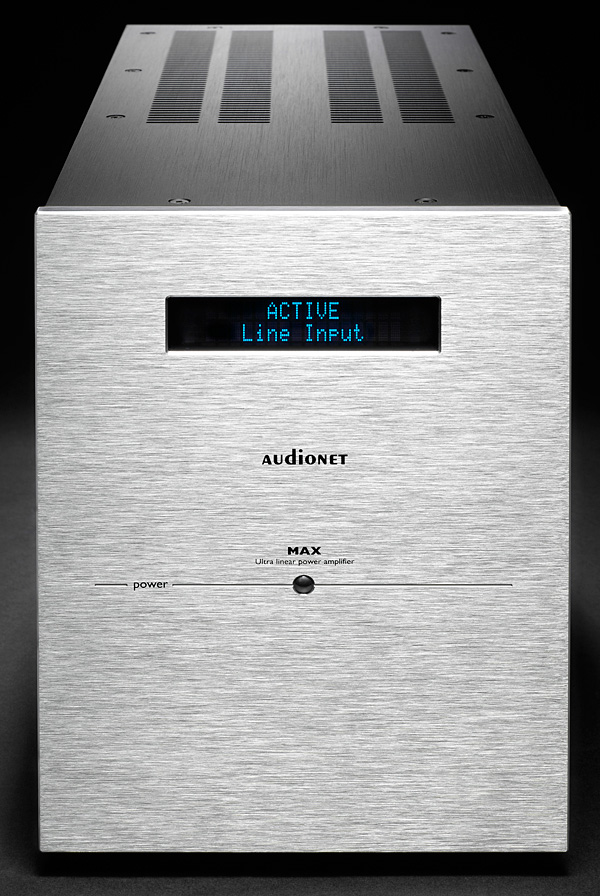 To a person, Group 1, which heard the Pass Labs XA200.8s before the Audionet Maxes, unanimously preferred the Audionets. Group 2, which listened to the amps in the reverse order, overwhelmingly preferred the Passes. As much as this says about the limits of an A/B comparisons based on listening to short passages of music without the opportunity to at least return to A after having heard A and B, it also produced some extremely revealing commentary.
Group 1 (in which there was such unanimity of opinion, they let Society President Rene Jaeger speak for them): "The Audionet was better in transparency, clarity, and ability to delineate instruments; it had tighter, more exact, and better delineated bass. You could actually hear the reflections of the timpani from the back of the hall, and, in the 24/96 tracks from The Rite of Spring, the distinctly different timbral contributions of timpani and bass drum."
Group 2 (these quotes are from various different members): "The Pass was more emotionally engaging. The Audionet was cerebral and cool, and would work in a system that needed a little drying out." "The Pass was more open-sounding, and sounded more like music. The Audionet was more sibilant, with more of an edge on voices, and even the piano." "In terms of overall engagement, I thought I could listen to the Pass longer. There was more heart." "Pass had an ability to differentiate different sounds from different instruments, as opposed to that Phil Spector wall of noise that I thought I was getting from the Audionet."
People had the most difficulty talking about color. And, as I hear it, it is in color, warmth, and an emotionally compelling sense of beauty and grace that the Pass Labs XA200.8 excels. The Audionet Max was unquestionably tighter and more impactful in the low end, at least through the Wilson Alexias, and more defined overall. Its sound was also more connected than the AVM MA8.2's, with less Spartan-like space between aural images.
Summing Up
To a person, Group 1, which heard the Pass Labs XA200.8s before the Audionet Maxes, unanimously preferred the Audionets. Group 2, which listened to the amps in the reverse order, overwhelmingly preferred the Passes. As much as this says about the limits of an A/B comparisons based on listening to short passages of music without the opportunity to at least return to A after having heard A and B, it also produced some extremely revealing commentary.
Group 1 (in which there was such unanimity of opinion, they let Society President Rene Jaeger speak for them): "The Audionet was better in transparency, clarity, and ability to delineate instruments; it had tighter, more exact, and better delineated bass. You could actually hear the reflections of the timpani from the back of the hall, and, in the 24/96 tracks from The Rite of Spring, the distinctly different timbral contributions of timpani and bass drum."
Group 2 (these quotes are from various different members): "The Pass was more emotionally engaging. The Audionet was cerebral and cool, and would work in a system that needed a little drying out." "The Pass was more open-sounding, and sounded more like music. The Audionet was more sibilant, with more of an edge on voices, and even the piano." "In terms of overall engagement, I thought I could listen to the Pass longer. There was more heart." "Pass had an ability to differentiate different sounds from different instruments, as opposed to that Phil Spector wall of noise that I thought I was getting from the Audionet."
People had the most difficulty talking about color. And, as I hear it, it is in color, warmth, and an emotionally compelling sense of beauty and grace that the Pass Labs XA200.8 excels. The Audionet Max was unquestionably tighter and more impactful in the low end, at least through the Wilson Alexias, and more defined overall. Its sound was also more connected than the AVM MA8.2's, with less Spartan-like space between aural images.
Summing Up
Even among monoblocks costing $30,000 to $40,000 per pair, trade-offs are inevitable. The Max may sound a bit dark in some set-ups, but it's not into fuzzy-wuzzies or lily-gilding. Rather, it's a straight-talking, often thrilling-sounding monoblock that puts its money where its mouth is. And it's exceedingly strong in areas that many music lovers consider their top priorities. If that's you, and you've got the bucks, don't hesitate to audition the Audionet Max monoblocks in your system.
ListeningAs excellent as the Kubala-Sosna Elation!s were with bass, and as admirably smooth as the system sounded overall, I found it darker, less open on top, less rich in the midrange, and not as focused as with the Nordost Odin 2s. So here, I confine my observations to those made after my reference wires were returned to the system. As I listened to Mahler's Symphony 9, with Iván Fischer conducting the Budapest Festival Orchestra (SACD/CD, Channel Classics CCS SA 36115), I noted how tightly the Audionet Maxes depicted bass-drum thwacks. Rapid timpani rolls were correspondingly clearer than with my Pass amps. But I had little sense of hall acoustic and boundaries. Although the violins sounded fairly silky and sweet, they were a little edgier than I'm accustomed to. Overall, the sound was darker and less colorful than with my reference monoblocks.
Mezzo-soprano Jamie Barton may have sounded a bit darker and less brilliant through the Maxes than I'm accustomed to, but I absolutely loved listening to her huge, resplendent voice in the 24/96 download of her All Who Wander, with pianist Brian Zeger (Delos 3494). Ditto for a very different singer, lyric soprano Elly Ameling, whose gifts, on her rendition of Schubert's "Die Sterne" with Dalton Baldwin (The Artistry of Elly Ameling, CD, Philips 473-4512), the Maxes reproduced without that last iota of radiance that the Pass XA200.8s can provide.
After I'd finished my solo listening, I invited 20 members of the Pacific Northwest Audio Society to my home, in Port Townsend, Washington, to compare the sounds of the Audionets and Passes in a series of listening sessions. Set-up issues meant that the Maxes were at a disadvantage: They lacked Grand Prix Monaco amp stands, to help with bass, clarity, transparency, and soundstaging; and their Odin 2 power cables were shorter and, due to Nordost's unique mechanical-resonance technology, less revealing than the longer Odin 2s on the Passes. Nonetheless, the Maxes' strengths emerged.
To a person, Group 1, which heard the Pass Labs XA200.8s before the Audionet Maxes, unanimously preferred the Audionets. Group 2, which listened to the amps in the reverse order, overwhelmingly preferred the Passes. As much as this says about the limits of an A/B comparisons based on listening to short passages of music without the opportunity to at least return to A after having heard A and B, it also produced some extremely revealing commentary.
Group 1 (in which there was such unanimity of opinion, they let Society President Rene Jaeger speak for them): "The Audionet was better in transparency, clarity, and ability to delineate instruments; it had tighter, more exact, and better delineated bass. You could actually hear the reflections of the timpani from the back of the hall, and, in the 24/96 tracks from The Rite of Spring, the distinctly different timbral contributions of timpani and bass drum."
Even among monoblocks costing $30,000 to $40,000 per pair, trade-offs are inevitable. The Max may sound a bit dark in some set-ups, but it's not into fuzzy-wuzzies or lily-gilding. Rather, it's a straight-talking, often thrilling-sounding monoblock that puts its money where its mouth is. And it's exceedingly strong in areas that many music lovers consider their top priorities. If that's you, and you've got the bucks, don't hesitate to audition the Audionet Max monoblocks in your system.