My Sennheiser HD650 'phones have a nominal impedance of 220 ohms, which might suggest that they would be a much better match for the AK100. However, the downside of this high load impedance is reduced sensitivity: the AK100 couldn't drive the Sennheisers to anything like a loud enough level. With an impedance that varies between 70 and 95 ohms, the closed-back Sony MDR-7506 should work well with the AK100. Certainly, the AK100 had no problem driving the MDR-7506s to high levels.
Listening
I used the AK100 for six weeks of listening, mostly on the move but also for headphone listening at home. I performed all my initial auditioning using Ray Samuels Audio's Emmeline The Hornet headphone amplifier. This has an output impedance of less than an ohm, thus bypassing the impedance interaction issue. Even so, with the Sony MDR-7506 headphones playing "The Old Wild Men," from 10cc's Sheet Music (256kbps MP3 Amazon download, UK Records), I preferred the sound without the amplifier, the midrange sounding a bit better defined. Conversely, the Dunedin Consort's performance of J.S. Bach's St. Matthew Passion, conducted by John Butt (24/88.2 Studio Master download, Linn CKD 313P), benefited from the Emmeline's extra control of the bass, the direct sound lacking low-frequency authority. With the Ultimate Ears 18 Pro driven direct, the treble of the St. Matthew Passion sounded a little shelved down, with a forward upper midrange, but the low frequencies sounded fuller than I was expecting from the 'phones' impedance curve. Driven by the Ray Samuels amplifier, the Ultimate Ears had a more even balance through the midrange and treble, with a tighter upper bass and more extended lower bass. Even so, I found that, in the long term, I wasn't bothered by the alteration in tonal balance with the in-ear monitors driven directly. It was akin to using tinted glasses—after a while, you're no longer aware of the tint. And it could be corrected with the AK100's built-in equalization, of course.
I was using the AK100-Hornet combination on a transatlantic flight when the battery in the amplifier gave up. (I hadn't recharged it before leaving for the airport.) I continued the journey with first the JH16s, then the Ultimate Ears connected directly to the AK100. There was still low bass present—the pedal lines in Bach's Prelude and Fugue in D, performed by Michael Murray on the organs of the First Congregational Church in Los Angeles (ALAC files, ripped from Telarc CD-80088), were still readily audible, but more so with the UE18 Pros. In "Love and Blessings," from Paul Simon's So Beautiful or So What (24/96 Apple Lossless file, Hear Music/HDtracks), the primary bass instrument in the verses is a deep-toned drum. But a descending bass-guitar line appears in the doo-wop bridge, and even without the Emmeline amplifier, this was well defined through the Ultimate Ears, and appropriately supportive of the melodic line.
By contrast, with the AK100 driving the Sony headphones, even with the theoretically better impedance match, that bass line was a little too lightweight. Contrary to what you can read on the Internet, the balanced-armature in-ear monitors did not have a problem with the AK100's 22 ohm output impedance, other than the modification of their frequency response. With most recordings, the Sonys needed the outboard amplifier to best serve the music, while the Sennheiser HD560s needed it simply to play loud enough.
 Now that's a problem
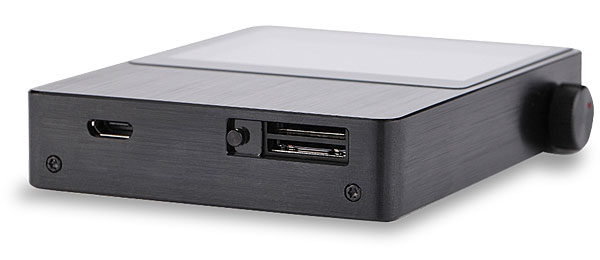
The majority of rock and jazz albums consist of individual songs, so if that's all the music you play, you wouldn't spot the AK100's shortcoming with many classical recordings: it doesn't offer gapless playback! This is not a problem with concertos and symphonies from the classical era, but with a recording like the Dunedin Consort's performance of Bach's St. Matthew Passion, not to mention any through-composed opera, where the track markers are dropped into a continuous stream of music, you end up with half-second silences between tracks where there should be none.
Against the 160GB iPod Classic
My iPod Classic is 2010 vintage and has a measured output impedance of 5 ohms. The first comparisons were with each player connected to the Emmeline headphone amplifier driving the Sony MDR-7506 headphones. Obviously, as the iPod is limited to sample rates of 48kHz and below, all comparisons were performed using files ripped from CD or downloads at 44.1kHz. Playing 10cc's "Old Wild Men," it was no contest. The iPod had a more aggressive mid-treble, the AK100 more refined-sounding highs with more top-octave air. It was a close match when it came to the amount and quality of low frequencies, but overall, the lossy compression seemed to have more of a damaging effect with the file played on the iPod. There was consistently more of a sense of ease with the AK100. There was less space apparent with the iPod when I played "Fit Song," from Cornelius's Sensuous (ALAC files ripped from CD, Warner Japan EVE016). Perhaps more important, both the drum samples and the staccato guitar chords on this track had more texture through the Astell&Kern, sounding less like shaped and processed noise. The iPod wasn't unlistenable, but it tended to emphasize the rattle of the snare wires; the AK100 let me hear a little more of the body of the snare drum's sound.
In the Big Rig
I finished my auditioning using the AK100 as a standalone DAC in my reference system. I used AudioQuest's top-model Angel stereo 3.5mm-to-RCA cables to connect it to the preamp, though it's fair to note that, at $865, this cable is significantly more expensive than the player! But before auditioning the Astell&Kern as a DAC, I used a Monster TosLink 3.5mm optical cable to connect its S/PDIF output to the Arcam FMJ D33 DAC, so I could get a handle on its performance as a data source. It performed very well in this role. Joni Mitchell's "The Jungle Line," from Herbie Hancock's River: The Joni Letters (Apple Lossless 24/96, Verve/HDtracks), fed to the Arcam DAC from the AK100 via TosLink, sounded indistinguishable from the same file fed from my Mac mini to the Arcam via USB. And to my surprise, the AK100 did output 192kHz-sampled data via TosLink. Feeding analog data from the Astell&Kern to the Pass Labs preamp and comparing with the Arcam with levels matched at 1kHz, the high-end DAC offered a better-defined soundstage, with more precise sculpting of the individual objects within the recorded space. The AK100 sounded a little less involving, with a flatter soundstage overall. But considering the price, the AK100 served well in this role, sounding close to the budget-priced Schiit Bifrost reviewed elsewhere in this issue. The Bifrost reproduced more of the overwarm double bass in "Killing the Blues," from Alison Kraus and Robert Plant's Raising Sand (24/96 ALAC file transcoded from FLAC download, Rounder/HDtracks 11661); the AK100 offered better definition of the bass. It also had a little more top-octave air apparent than the soft-sounding Bifrost.
Astell&Kern's AK100 is a true high-end source component.
Summing up
Given that in-ear headphones, especially those that use a single armature, roll off in the top octave, a skeptic might argue that there is little point in a portable player offering the capability of handling files sampled at greater than 48kHz. And when you consider that an old guy like myself, just turned 65 as you read these words, can't hear frequencies above 14kHz, the case against high-resolution portable playback would appear to be closed. Yet my experience of music sampled at 88.2kHz and above through the Astell&Kern AK100 was positive; versions of those files downsampled to 44.1kHz sounded less involving, and grayer overall. Case proven for the higher sample rates and bit depths, as far as I'm concerned. What is incontrovertible is that the AK100 offers listeners on the move a better-performing and -sounding DAC than that used in the iPods. If you can live with the lack of gapless playback, I highly recommend this first offering from Astell&Kern (footnote 1). At $699, it's reasonably priced for what it offers.
Footnote 1: At the High End show in Munich last May, Astell&Kern announced their second product. The AK120's D/A and analog circuits are dual-mono, it supports up to 192GB of memory, and offers gapless playback, all for a significantly higher price than the AK100: $1299. The AK120 will be available in the US in the fourth quarter of 2013. A&K says that a firmware update for the AK100 will add gapless playback.
I used the AK100 for six weeks of listening, mostly on the move but also for headphone listening at home. I performed all my initial auditioning using Ray Samuels Audio's Emmeline The Hornet headphone amplifier. This has an output impedance of less than an ohm, thus bypassing the impedance interaction issue. Even so, with the Sony MDR-7506 headphones playing "The Old Wild Men," from 10cc's Sheet Music (256kbps MP3 Amazon download, UK Records), I preferred the sound without the amplifier, the midrange sounding a bit better defined. Conversely, the Dunedin Consort's performance of J.S. Bach's St. Matthew Passion, conducted by John Butt (24/88.2 Studio Master download, Linn CKD 313P), benefited from the Emmeline's extra control of the bass, the direct sound lacking low-frequency authority. With the Ultimate Ears 18 Pro driven direct, the treble of the St. Matthew Passion sounded a little shelved down, with a forward upper midrange, but the low frequencies sounded fuller than I was expecting from the 'phones' impedance curve. Driven by the Ray Samuels amplifier, the Ultimate Ears had a more even balance through the midrange and treble, with a tighter upper bass and more extended lower bass. Even so, I found that, in the long term, I wasn't bothered by the alteration in tonal balance with the in-ear monitors driven directly. It was akin to using tinted glasses—after a while, you're no longer aware of the tint. And it could be corrected with the AK100's built-in equalization, of course.
Now that's a problemThe majority of rock and jazz albums consist of individual songs, so if that's all the music you play, you wouldn't spot the AK100's shortcoming with many classical recordings: it doesn't offer gapless playback! This is not a problem with concertos and symphonies from the classical era, but with a recording like the Dunedin Consort's performance of Bach's St. Matthew Passion, not to mention any through-composed opera, where the track markers are dropped into a continuous stream of music, you end up with half-second silences between tracks where there should be none.
My iPod Classic is 2010 vintage and has a measured output impedance of 5 ohms. The first comparisons were with each player connected to the Emmeline headphone amplifier driving the Sony MDR-7506 headphones. Obviously, as the iPod is limited to sample rates of 48kHz and below, all comparisons were performed using files ripped from CD or downloads at 44.1kHz. Playing 10cc's "Old Wild Men," it was no contest. The iPod had a more aggressive mid-treble, the AK100 more refined-sounding highs with more top-octave air. It was a close match when it came to the amount and quality of low frequencies, but overall, the lossy compression seemed to have more of a damaging effect with the file played on the iPod. There was consistently more of a sense of ease with the AK100. There was less space apparent with the iPod when I played "Fit Song," from Cornelius's Sensuous (ALAC files ripped from CD, Warner Japan EVE016). Perhaps more important, both the drum samples and the staccato guitar chords on this track had more texture through the Astell&Kern, sounding less like shaped and processed noise. The iPod wasn't unlistenable, but it tended to emphasize the rattle of the snare wires; the AK100 let me hear a little more of the body of the snare drum's sound.
I finished my auditioning using the AK100 as a standalone DAC in my reference system. I used AudioQuest's top-model Angel stereo 3.5mm-to-RCA cables to connect it to the preamp, though it's fair to note that, at $865, this cable is significantly more expensive than the player! But before auditioning the Astell&Kern as a DAC, I used a Monster TosLink 3.5mm optical cable to connect its S/PDIF output to the Arcam FMJ D33 DAC, so I could get a handle on its performance as a data source. It performed very well in this role. Joni Mitchell's "The Jungle Line," from Herbie Hancock's River: The Joni Letters (Apple Lossless 24/96, Verve/HDtracks), fed to the Arcam DAC from the AK100 via TosLink, sounded indistinguishable from the same file fed from my Mac mini to the Arcam via USB. And to my surprise, the AK100 did output 192kHz-sampled data via TosLink. Feeding analog data from the Astell&Kern to the Pass Labs preamp and comparing with the Arcam with levels matched at 1kHz, the high-end DAC offered a better-defined soundstage, with more precise sculpting of the individual objects within the recorded space. The AK100 sounded a little less involving, with a flatter soundstage overall. But considering the price, the AK100 served well in this role, sounding close to the budget-priced Schiit Bifrost reviewed elsewhere in this issue. The Bifrost reproduced more of the overwarm double bass in "Killing the Blues," from Alison Kraus and Robert Plant's Raising Sand (24/96 ALAC file transcoded from FLAC download, Rounder/HDtracks 11661); the AK100 offered better definition of the bass. It also had a little more top-octave air apparent than the soft-sounding Bifrost.
Given that in-ear headphones, especially those that use a single armature, roll off in the top octave, a skeptic might argue that there is little point in a portable player offering the capability of handling files sampled at greater than 48kHz. And when you consider that an old guy like myself, just turned 65 as you read these words, can't hear frequencies above 14kHz, the case against high-resolution portable playback would appear to be closed. Yet my experience of music sampled at 88.2kHz and above through the Astell&Kern AK100 was positive; versions of those files downsampled to 44.1kHz sounded less involving, and grayer overall. Case proven for the higher sample rates and bit depths, as far as I'm concerned. What is incontrovertible is that the AK100 offers listeners on the move a better-performing and -sounding DAC than that used in the iPods. If you can live with the lack of gapless playback, I highly recommend this first offering from Astell&Kern (footnote 1). At $699, it's reasonably priced for what it offers.
Footnote 1: At the High End show in Munich last May, Astell&Kern announced their second product. The AK120's D/A and analog circuits are dual-mono, it supports up to 192GB of memory, and offers gapless playback, all for a significantly higher price than the AK100: $1299. The AK120 will be available in the US in the fourth quarter of 2013. A&K says that a firmware update for the AK100 will add gapless playback.