"It takes a K50 about 2 months to burn in properly," he told me. "It sounds too thin and sharp for the first 200 hours. If you turn it off for any length of time, it will take about 3 days to get back to optimum performance."
Ranking outputs in order of sound quality, Jenkins greatly prefers the K50's I2S, AES3 (aka AES/EBU), and S/PDIF digital outputs to USB. "You really don't want to use USB," he said. "I could bore you with why the sound quality of USB has been negatively impacted by the evolution of the USB standard, but I won't." What did not bore me was the prospect of comparing the various servers, players, and outputs. Evaluating outputs proved challenging because my reference dCS Rossini doesn't accept I2S, software bugs prevented me from easily switching between outputs (at first), the K50 occasionally reported the wrong file resolution, and on single AES3 and S/PDIF, dCS counsels not to exceed 24/192 PCM or DSD64. Only USB allowed me to play the highest-resolution files in my test arsenal. Given the need to evaluate several sources, outputs, and combinations of players and servers on a unit that would continue to settle in during the review period (footnote 4), I had my work cut out for me.
Jenkins told me that while I could access the 8 or 9TB contents of my NAS with either Roon or Squeeze, the K50 sounds best playing from an SSD. Customers can slide up to three SSDs into the back of the unit, totaling up to 24TB. My review sample included a 1TB slide-in SSD; I had loads of fun watching Mark Cole transfer files to it from half a world away.
Setup
Jenkins gave the okay to using a nonlimiting power conditioner such as my AudioQuest Niagara 7000 and Niagara 5000, as long as I avoided putting server and DAC on different isolation transformers, which might cause an earth potential difference and damage the DAC. I was careful. On the 7000, the K50 joined the Rossini DAC, Clock, and Transport on a single transformer block; both the D'Agostino Momentum HD preamp and the LPS powering my EtherREGEN went on the other, and the D'Agostino Progression monoblocks occupied two high-current outlets. The Marks also approved the use of equipment supports, so Nordost SortKones were called into play.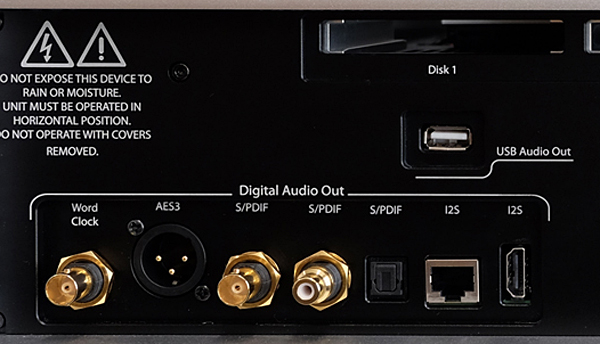 I listened to files on my NAS (accessed via Ethernet), the same files on the slide-in SSD, and streams from Tidal and Qobuz sourced, again, through Ethernet. Outputs included AES3, USB, and (very briefly) Ethernet. Noting that single AES3 cannot reliably transmit files >24/192 PCM or DSD higher than DSD64, I stuck with files that could be played with every combination and permutation available for testing (footnote 5).
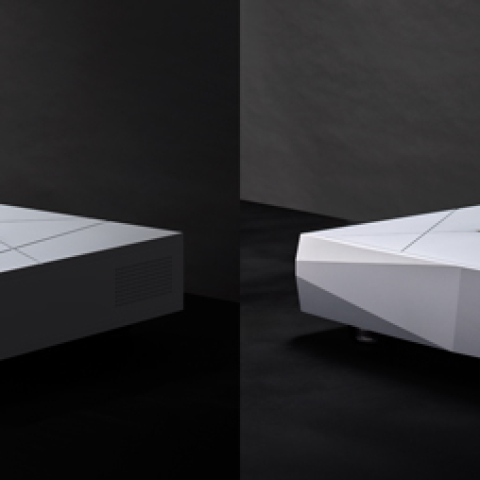
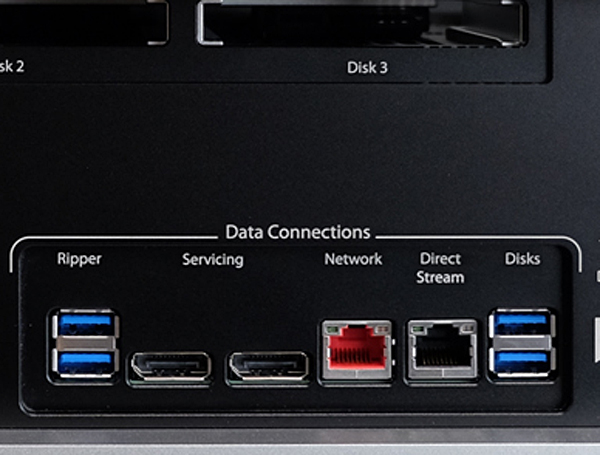
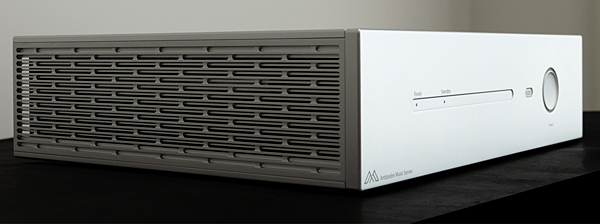
I won't bore you with a description of the unit's front and rear panels; anyone who is interested in buying a music server can access antipodes.audio for far more information than this review can hold. It suffices to say that the learning curve was steep and the time limited; the bugs and quirks of beta software, combined with the lack of a manual (which will probably be remedied by publication time), were a challenge. But in the end ...
I listened to files on my NAS (accessed via Ethernet), the same files on the slide-in SSD, and streams from Tidal and Qobuz sourced, again, through Ethernet. Outputs included AES3, USB, and (very briefly) Ethernet. Noting that single AES3 cannot reliably transmit files >24/192 PCM or DSD higher than DSD64, I stuck with files that could be played with every combination and permutation available for testing (footnote 5).
I won't bore you with a description of the unit's front and rear panels; anyone who is interested in buying a music server can access antipodes.audio for far more information than this review can hold. It suffices to say that the learning curve was steep and the time limited; the bugs and quirks of beta software, combined with the lack of a manual (which will probably be remedied by publication time), were a challenge. But in the end ...
 It's all about the music
Well, almost. To arrive at the point where I could simply sit back, close my eyes, let out a sigh, and bask in the blessings of glorious music reproduction, I first had to determine which combination of outputs, server, player, and source delivered the most satisfying sound. To summarize: After comparing the latest builds (footnote 6) of Roon server, Roon player, Squeeze server, and Squeezelite player software on the most recent iteration of the Antipodes K50, the duo of Squeeze server/Squeezelite player, transmitted via single AES3 to the dCS Rossini DAC + Clock, delivered the most transparent, detailed, color-saturated, vivid, midrange-and bass-rich sound of all options available to me. In addition, files stored on the K50's optional SSD sounded a mite better—the extra transparency was noticeable—than the same files sourced from my NAS, Tidal, or Qobuz. Alas, the Squeeze server/Squeezelite player are nowhere near as user-friendly as Roon. The Squeezes require separate searches through personal storage, Tidal, and Qobuz; I never succeeded in finding a search bar for the NAS and slotted-in SSD—which could mean that I'm blind or that we just failed to turn it on. File provenance, metadata, liner notes, commentary, album art, and other features are considerably more accessible and attractively displayed in Roon 1.8. And then there are the strange anomalies, eg, displaying the cover of French soprano Véronique Gens's new album while playing files for Caroline Shaw and So Percussion's recent Nonesuch release Let the Soil Play Its Simple Part when that cover was not in the Shaw folder.
But for sound alone, Squeeze and Squeezelite ruled on the K50. "Your system has never sounded better," proclaimed the husband during a rare visit to the music room to hear the final movement of Mahler's Symphony No.4, as remastered on Classic Kathleen Battle: A Portrait (16/44.1 WAV, Sony), sourced from my NAS and performed by Ms. Battle and the Vienna Philharmonic under Lorin Maazel. Three weeks earlier, he had heard the same music through my reference server.
On this delightful, heartwarming recording, images were larger and had more substance than usual. Bass was more solid and impactful, highs a mite more vivid. Colors were full and inviting, and transparency was excellent. From a recording notable for its wide soundstage, the K50/Squeeze combo projected a different sense of openness than I'm accustomed to, with more of the space between widely spaced instruments filled with the radiant sound of the instruments themselves. This is not a euphemistic way of suggesting that the soundstage was congested: It wasn't. Rather, the weave of the instrumental fabric was tighter. Figuratively speaking, I couldn't hold up the fabric to the sun and perceive as much light penetrating between the threads, because the fabric was so all-of-one-piece. Think 600 thread count sheets vs 200.
Shortly before I started writing this review, I used the Squeeze server and Squeezelite player to access files on the K50's slotted-in SSD of the "How Lovely Is Thy Dwelling Place" chorus from the classic analog stereo recording of Brahms's A German Requiem, performed by the Philharmonia Chorus and Orchestra under Otto Klemperer and remastered to digital by Warner (24/96 WAV). Colors and soundstage were wonderful, the music glorious (footnote 7). Through my reference server, the soundstage was set farther back, with noticeably more air surrounding voices. With the K50, I moved a step closer to the stage (or vice versa), voices sounded bigger, colors were more intense, and a natural reverberation that increases with distance ceded to improved immediacy. This was no mere trade-off: Instead of dwelling upon what I had "lost," I reveled in what I had gained. How lovely is thy dwelling place indeed, especially when you can get closer to the front door.
I also revisited a recording that I reviewed in the September issue, Finnish composer Sebastian Fagerlund's Nomade Water Atlas (24/96 WAV, BIS-2445), performed by cellist Nicolas Altstaedt and the Finnish Radio Symphony Orchestra under Hannu Lintu. Through the K50, the orchestra sounded fuller, warmer in the middle, and more dynamic and coherent than I recalled; it was noticeably more of one piece. Some of my scribbled comments: "Thrilling ... what great stuff ... really exciting ... percussion excellent ... great midrange ... I think the additional color and weightier midrange, albeit subtle, significantly increase the music's impact."
 From the sublime to Yello's "Electrified II" from Toy (24/48 WAV, Polydor 4782160): The K50 delivered some of the most solid electronically generated deep bass ever reproduced by the Wilson Alexia 2 loudspeakers in my room. I marveled at the extra depth and resonance in the voice of Swiss septuagenarian Dieter Meier. Equally revelatory was James Blake's self-produced "There's a Limit to Your Love" from James Blake (16/44.1 WAV, A&M 949999). For the first time ever, I heard the quality and pitch of those ridiculously strong electronic bass blasts shift midstream. How is it possible that I never heard that before? (footnote 8)
The server then set me off on an irony-laced journey, choosing tracks apparently at random, moving from Billie Eilish's "Listen Before I Go" (from When We All Fall Asleep, Where Do We Go?) to Joan Baez's "Babe, I'm Gonna Leave You" from Joan Baez in Concert, Part 1. Then came baritone Charles Panzéra's gorgeous 78-year-old recording of Fauré's "En Sourdine" ("Muted"), followed by Alexander Melnikov and Isabelle Faust's newer and distinctly unmuted first movement of Mozart's Violin Sonata in D Major, K.506.
Blake's "Limit" put a halt to the journey. I was so amused by the bizarre sequence of files in my NAS's single-track section. I didn't care about formats and resolutions. All that I thought about was how gorgeous everything sounded.
I've listened to Panzéra many times; the transition from the warm and gentle voice of the song's opening to the forceful voice of the song's middle section has never impacted me so deeply. If you want to know why Fauré dedicated his last song cycle, L'horizon chimérique (The Imaginary Horizon), to the 25-year-old Panzéra, listen to his artistry through the Antipodes K50.
Short of heavy metal and noise, I threw everything I could at the K50, from the maximally colored music of Henri Dutilleux to the recent remastering of Sgt. Pepper's Lonely Hearts Club Band. Every experience was revelatory.
Which means
From the sublime to Yello's "Electrified II" from Toy (24/48 WAV, Polydor 4782160): The K50 delivered some of the most solid electronically generated deep bass ever reproduced by the Wilson Alexia 2 loudspeakers in my room. I marveled at the extra depth and resonance in the voice of Swiss septuagenarian Dieter Meier. Equally revelatory was James Blake's self-produced "There's a Limit to Your Love" from James Blake (16/44.1 WAV, A&M 949999). For the first time ever, I heard the quality and pitch of those ridiculously strong electronic bass blasts shift midstream. How is it possible that I never heard that before? (footnote 8)
The server then set me off on an irony-laced journey, choosing tracks apparently at random, moving from Billie Eilish's "Listen Before I Go" (from When We All Fall Asleep, Where Do We Go?) to Joan Baez's "Babe, I'm Gonna Leave You" from Joan Baez in Concert, Part 1. Then came baritone Charles Panzéra's gorgeous 78-year-old recording of Fauré's "En Sourdine" ("Muted"), followed by Alexander Melnikov and Isabelle Faust's newer and distinctly unmuted first movement of Mozart's Violin Sonata in D Major, K.506.
Blake's "Limit" put a halt to the journey. I was so amused by the bizarre sequence of files in my NAS's single-track section. I didn't care about formats and resolutions. All that I thought about was how gorgeous everything sounded.
I've listened to Panzéra many times; the transition from the warm and gentle voice of the song's opening to the forceful voice of the song's middle section has never impacted me so deeply. If you want to know why Fauré dedicated his last song cycle, L'horizon chimérique (The Imaginary Horizon), to the 25-year-old Panzéra, listen to his artistry through the Antipodes K50.
Short of heavy metal and noise, I threw everything I could at the K50, from the maximally colored music of Henri Dutilleux to the recent remastering of Sgt. Pepper's Lonely Hearts Club Band. Every experience was revelatory.
Which means
With the optimal server and player software, the best output connections compatible with my DAC, and files sourced from optional user-added solid state drives that can store up to 24TB, the Antipodes K50 music server distinguished itself as the finest-sounding music server ever to grace my system. Image size and weight, color saturation, bass control, and transparency were the best my system has ever delivered. Listening was the most enjoyable and rewarding I've ever experienced at home. That is cause for celebration. As I don my party hat, I can't pretend that the K50's best-sounding software and navigation options are particularly user-friendly. But the sonic rewards they deliver are profound. Our measurements can't reveal why one server sounds better than another; you'll have to take my word for it or listen for yourself. I strongly suggest the latter approach: If a $15,000 music server is within your price range, or you want to hear all that a $15,000 server can deliver, audition the K50. Class A+ all the way.
Footnote 4: For much of the review period, the K50 played files 24/7. Footnote 5: Jenkins wrote, "I should add that I am not a big fan of high-bitrate recordings or DSD. If you have harsh digital sound, then using higher bit rates and/or DSD will reduce that problem. But the trade-off is that you will lose midrange and upper bass presence. This is just a personal view, and nothing to do with any design choices we have made. Bigger bitrate numbers do not mean 'better.' High bitrates require longer filters, which makes the top-end smoother but shifts the problem down further into the audio spectrum. On top of this timing errors are magnified, transmission has to be accurate at even higher frequencies, and asking any computing device to operate at a higher speed means it operates at reduced precision. It is about managing the trade-offs in the best interest of the musical experience, like so many other considerations in audio." Footnote 6: As of July 5, 2021. Footnote 7: I'm partial. I sang the tenor part in my high school chorus. Footnote 8: You don't have to answer that.
Jenkins gave the okay to using a nonlimiting power conditioner such as my AudioQuest Niagara 7000 and Niagara 5000, as long as I avoided putting server and DAC on different isolation transformers, which might cause an earth potential difference and damage the DAC. I was careful. On the 7000, the K50 joined the Rossini DAC, Clock, and Transport on a single transformer block; both the D'Agostino Momentum HD preamp and the LPS powering my EtherREGEN went on the other, and the D'Agostino Progression monoblocks occupied two high-current outlets. The Marks also approved the use of equipment supports, so Nordost SortKones were called into play.
I listened to files on my NAS (accessed via Ethernet), the same files on the slide-in SSD, and streams from Tidal and Qobuz sourced, again, through Ethernet. Outputs included AES3, USB, and (very briefly) Ethernet. Noting that single AES3 cannot reliably transmit files >24/192 PCM or DSD higher than DSD64, I stuck with files that could be played with every combination and permutation available for testing (footnote 5).
I won't bore you with a description of the unit's front and rear panels; anyone who is interested in buying a music server can access antipodes.audio for far more information than this review can hold. It suffices to say that the learning curve was steep and the time limited; the bugs and quirks of beta software, combined with the lack of a manual (which will probably be remedied by publication time), were a challenge. But in the end ...
It's all about the musicWell, almost. To arrive at the point where I could simply sit back, close my eyes, let out a sigh, and bask in the blessings of glorious music reproduction, I first had to determine which combination of outputs, server, player, and source delivered the most satisfying sound. To summarize: After comparing the latest builds (footnote 6) of Roon server, Roon player, Squeeze server, and Squeezelite player software on the most recent iteration of the Antipodes K50, the duo of Squeeze server/Squeezelite player, transmitted via single AES3 to the dCS Rossini DAC + Clock, delivered the most transparent, detailed, color-saturated, vivid, midrange-and bass-rich sound of all options available to me. In addition, files stored on the K50's optional SSD sounded a mite better—the extra transparency was noticeable—than the same files sourced from my NAS, Tidal, or Qobuz. Alas, the Squeeze server/Squeezelite player are nowhere near as user-friendly as Roon. The Squeezes require separate searches through personal storage, Tidal, and Qobuz; I never succeeded in finding a search bar for the NAS and slotted-in SSD—which could mean that I'm blind or that we just failed to turn it on. File provenance, metadata, liner notes, commentary, album art, and other features are considerably more accessible and attractively displayed in Roon 1.8. And then there are the strange anomalies, eg, displaying the cover of French soprano Véronique Gens's new album while playing files for Caroline Shaw and So Percussion's recent Nonesuch release Let the Soil Play Its Simple Part when that cover was not in the Shaw folder.
From the sublime to Yello's "Electrified II" from Toy (24/48 WAV, Polydor 4782160): The K50 delivered some of the most solid electronically generated deep bass ever reproduced by the Wilson Alexia 2 loudspeakers in my room. I marveled at the extra depth and resonance in the voice of Swiss septuagenarian Dieter Meier. Equally revelatory was James Blake's self-produced "There's a Limit to Your Love" from James Blake (16/44.1 WAV, A&M 949999). For the first time ever, I heard the quality and pitch of those ridiculously strong electronic bass blasts shift midstream. How is it possible that I never heard that before? (footnote 8)
The server then set me off on an irony-laced journey, choosing tracks apparently at random, moving from Billie Eilish's "Listen Before I Go" (from When We All Fall Asleep, Where Do We Go?) to Joan Baez's "Babe, I'm Gonna Leave You" from Joan Baez in Concert, Part 1. Then came baritone Charles Panzéra's gorgeous 78-year-old recording of Fauré's "En Sourdine" ("Muted"), followed by Alexander Melnikov and Isabelle Faust's newer and distinctly unmuted first movement of Mozart's Violin Sonata in D Major, K.506.
With the optimal server and player software, the best output connections compatible with my DAC, and files sourced from optional user-added solid state drives that can store up to 24TB, the Antipodes K50 music server distinguished itself as the finest-sounding music server ever to grace my system. Image size and weight, color saturation, bass control, and transparency were the best my system has ever delivered. Listening was the most enjoyable and rewarding I've ever experienced at home. That is cause for celebration. As I don my party hat, I can't pretend that the K50's best-sounding software and navigation options are particularly user-friendly. But the sonic rewards they deliver are profound. Our measurements can't reveal why one server sounds better than another; you'll have to take my word for it or listen for yourself. I strongly suggest the latter approach: If a $15,000 music server is within your price range, or you want to hear all that a $15,000 server can deliver, audition the K50. Class A+ all the way.
Footnote 4: For much of the review period, the K50 played files 24/7. Footnote 5: Jenkins wrote, "I should add that I am not a big fan of high-bitrate recordings or DSD. If you have harsh digital sound, then using higher bit rates and/or DSD will reduce that problem. But the trade-off is that you will lose midrange and upper bass presence. This is just a personal view, and nothing to do with any design choices we have made. Bigger bitrate numbers do not mean 'better.' High bitrates require longer filters, which makes the top-end smoother but shifts the problem down further into the audio spectrum. On top of this timing errors are magnified, transmission has to be accurate at even higher frequencies, and asking any computing device to operate at a higher speed means it operates at reduced precision. It is about managing the trade-offs in the best interest of the musical experience, like so many other considerations in audio." Footnote 6: As of July 5, 2021. Footnote 7: I'm partial. I sang the tenor part in my high school chorus. Footnote 8: You don't have to answer that.