Tube Preamp Reviews

Sort By:  Post Date TitlePublish Date

Audio Research SP-3 preamplifier

We thought Audio Research's previous-model SP-2C (footnote 1) was excellent, but this is even better—the closest thing available, in fact, to the ideal straight wire with gain. Our sample had a minor glitch—there was a slight "plop" if you rotated the tone controls rapidly—but we could find nothing else about it to criticize. Currently, by far the best preamplifier than money can buy. And would you believe it uses tubes (at reduced heater voltage, for extended life and cooler operation)!

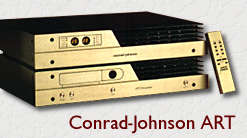
Conrad-Johnson ART Preamplifier

Almost two years ago, Conrad-Johnson's Lew Johnson came to Santa Fe while visiting his western dealers. We were chatting about acquaintances in the industry as I showed him the new house I'd barely moved into when he spread a blueprint across a stack of record boxes and showed me a design for a new product.

Nagra PL-P preamplifier

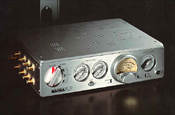
One memorable afternoon during HI-FI '97, Kathleen and my pudgy little self were hustling down the crowded corridors of San Francisco's venerable St. Francis Hotel, trying to make the Nagra press event. The Nagra suite was crowded with buzzing journalists, their anticipation palpable—the new Nagra PL-P preamplifier was about to enjoy its official debut. Suddenly the door to the demo room flew open. The vacuum created by the stampeding hordes nearly sucked the hors d'oeuvres off the table.

Sonic Frontiers Line 2 line preamplifier

In just a few years, Sonic Frontiers has evolved from a parts and kit vendor to a full-line audio manufacturer (footnote 1). Their initial offerings were well received, but their kit origins were apparent in the layout and cosmetics of their products. While SF still offers kits (like their high-value Assemblage DAC-2), the new line of vacuum-tube electronics has world-class construction, design, and packaging. This generation of SF equipment is evidence of their advanced evolution, even though their constructor genome can be detected in the use of audiophile-preferred, as opposed of OEM, components.

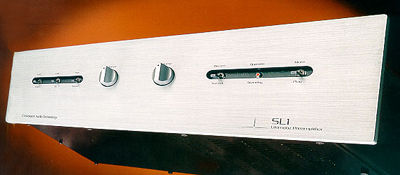
Convergent Audio Technology SL-1 preamplifier

It takes more than passing courage to make another assault on building the world's best tube preamplifier. You face stiff competition from well-established firms like Audio Research, Conrad Johnson, and Counterpoint. Such units can't be made inexpensively, and you face the steadily growing problem of tube supply: it is getting harder and harder to get tubes that are stable, have predictable sound and performance characteristics, and are long-lived. And you have to show audiophiles who have been burned before that you will still be around when they need service.

Balanced Audio Technology VK-5 preamplifier & VK-60/75 power amplifiers

How important is the use of balanced circuit typology in the design of preamplifiers and power amplifiers? Ask the top audio designers (I didn't, but just play along, okay?) and you'll get a wide variety of opinions. Some reject the balanced approach outright, arguing that it represents a needless duplication of circuit components, and that better results can be achieved if the same attention and resources are devoted to perfecting a single-ended circuit. In his provocatively titled article "Balance:">http://www.stereophile.com//features/335/">Balance: Benefit or Bluff?" (Stereophile, November 1994, p.77), Martin Colloms questioned the advantages of balanced designs, suggesting that while the results may be better in certain respects (eg, noise level), the reproduced sound may suffer in other, perhaps more important ways (eg, rhythm and dynamics).

Audio Research SP9 preamplifier

Following the introduction of their very expensive, tube/FET hybrid SP11 preamplifier, there were rumors that Audio Research was working on a hybrid tube/transistor preamplifier targeted to cost less than $2000. The rumors were confirmed when ARC showed a black-and-white photo of the SP9 at the 1987 Winter CES. Obviously, like all magazines, we were impatient to receive a review sample, but the first review of the SP9 actually appeared in the summer '87 issue of Peter Moncrieff's IAR Hotline. Peter's review was almost intemperately enthusiastic, comparing the SP9 positively with early samples of the SP11 and suggesting that its sound quality was considerably better than would be expected from its $1695 asking price. Naturally, we were anticipating good things when our review sample arrived in Santa Fe in late July.

Advertisement
Advertisement
Advertisement