Solid State Power Amp Reviews

Sort By:  Post Date TitlePublish Date

VTL MB 175 Signature monoblock power amplifier

Prejudice is bad—whether it's directed at people, places, or things. You know how it goes: digital is "bright," analog is "warm," solid-state is "brittle and etched," tubes are "smooth and soft" dynamic drivers are "low-resolution," electrostats and planars are "high-resolution" copper wire is "smooth," silver is "bright," etc. While putting everything that crosses your path into one box or another makes life simpler and seemingly more organized, the truth, musical or otherwise, usually gets mutilated in the process. Not that we all don't have preferences—but those are not the same as prejudices.

Pass Labs Aleph 3 power amplifier

Everyone's going crazy for single-ended power amplifiers. What's the big deal? What is it about these relatively low-powered contraptions that could make everybody so nutso? And has Pass Labs' Nelson Pass completely lost his marbles, selling a 30Wpc amplifier for a price that can buy a high-quality 200Wpc amp? Isn't that 200W amp seven times as loud—and seven times as good—as a 30W amp?

Krell Full Power Balanced 600 power amplifier

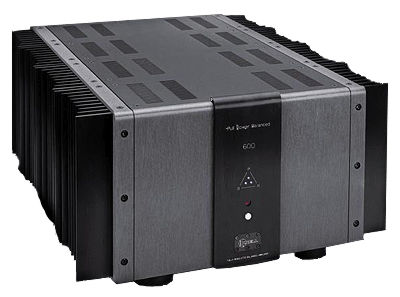
Latest and largest in Krell's current range of power amplifiers, the 600Wpc, $12,500 Full Power Balanced 600 joins the 300Wpc FPB 300 ($9000) and the 200Wpc (originally 150Wpc) FPB 200 ($5900). All are single-box stereo chassis and are specified as "Full Power Balanced"—I think to distinguish the essence of these designs from ordinary stereo amplifiers operated in balanced-bridged mode, usually with impaired performance. The FPB 600's speaker output is balanced; ie, neither "positive" or negative" terminals are connected to ground or the amplifier chassis. (Note that no speaker switches or headphone adaptors, which often have joined channel grounds, may be used, as they will short the outputs.) The output terminals are electrically at 0V, but float above the chassis ground.
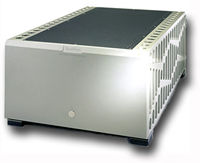

Ayre Acoustics V-3 power amplifier

"Why no review of the Ayre V-3?" queried Stephen Slaughter in July's "Letters" column, echoing several urgent posts to my e-mail address. Word of mouth on this remarkable 100Wpc amplifier was reaching fever pitch. Show reports over the last several years had sounded a consistent note—rooms that demoed with V-3s kept getting mentioned in "Best of Show" overviews. Naturally, this also meant that the pendulum had started its backward swing. "It's not really as good as people are saying," one WCES attendee confided in me. "That's why they won't give it to critics."

YBA 1 Alpha HC power amplifier

The auteur theory of the cinema, first described in the 1950s by François Truffaut, states that a great movie represents the artistic vision of one person, usually the director. Moviemaking may involve collaboration, but it cannot be done successfully by a committee. There has to be a single individual in charge, one whose sensitivity and world view is reflected in the movie. In the same sense that the author of a novel is telling a story through the medium of print, the director of a movie is telling a story through the medium of film.

PS Audio 200C power amplifier

Several issues back, I mentioned a major "new wave" of power amplifiers coming along: the Adcom 555, the New York Audio Labs transistor-tube hybrids, and the latest Krells, for example. They demonstrate that major audible improvements are still possible in something as well-explored as the power amplifier. Not only that, some of these products demonstrate that superior performance can be combined with relatively low price.

Jeff Rowland Design Group Model 2 power amplifier

I remember having a conversation with an audiophile some time ago about the thorny subject of choosing an amplifier. He was convinced, on the basis of an article he had read in Stereo Review, that all amplifiers of a given power rating sound pretty much the same. Although he was sufficiently well off to buy just about anything on the market, he didn't want to waste his money. He chose the amplifier for his system by going through the Audio Annual Directory Issue, calculating the price:watt ratio for each amplifier that was listed, and then bought the amplifier with the lowest price/watt figure that had enough power to drive his speakers. He didn't do any comparative listening and didn't consider buying anything that cost more for the same power, because he knew already that it wouldn't sound any different.

Krell KSA-50S power amplifier

In the fall of 1982, I had just become the Editor of the English magazine Hi-Fi News & Record Review. Hi-fi was in a state of flux. The Compact Disc had just made its debut in Japan, but the British and American launches were six months and a year away, respectively. The Linn orthodoxy prevailed about the role of the source in system performance, but there was no agreement about what was and was not important when it came to enhancing the musical experience. "Objectivists" insisted that amplifiers and even loudspeakers had pretty much reached a design plateau where no further improvement was necessary or even desirable, while "subjectivists" were fragmented. All I was aware of was that my system, based on Celestion SL6 loudspeakers, needed more of an undefinable something.

Quad 405 power amplifier

This is something we don't see too often: an entirely new approach to power amplifier design. As Quad points out in its literature for the 405, class-A operation of transistors provides the lowest distortion, but drastically limits the amount of power an output transistor can deliver without overheating. (Most transistor amps use class-AB output operation, in which each of a pair of power transistors handles part of each signal cycle and shuts down during the other part. Imperfect synchronism between the two halves causes the familiar "crossover distortion," which accounts for most solid-state sound. In class-A operation, each output transistor draws current though the entirety of each signal cycle, eliminating the crossover transition but doubling the amount of time current is drawn, and thus tending to cause the transistor to heat up more.)
Advertisement
Advertisement
Advertisement