Phono Preamp Reviews

Sort By:  Post Date TitlePublish Date

Leema Acoustics Essentials phono preamplifier
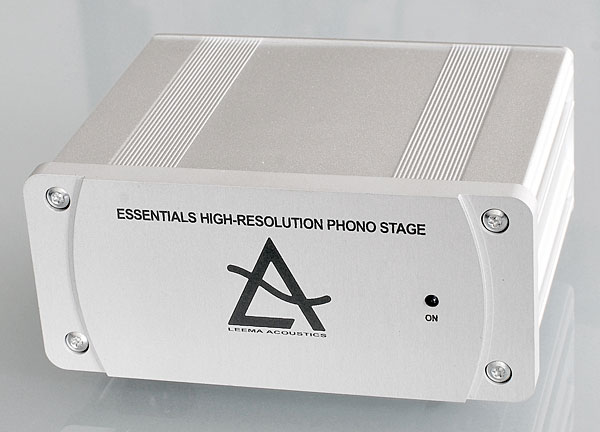
"The way that young people will get into high-end audio is not through streaming: It's through the LP."

When that observation was offered during a recent phone conversation, I wrote it down word for word—not just because I agree with it, but because it was so remarkable: The audio-industry veteran who offered it owns a digital front end worth tens of thousands of dollars, and hasn't owned a turntable for at least a dozen years. Nevertheless, as became clear during the remainder of our conversation, he understands the dynamic that keeps vinyl at the top: a confluence of marketing psychology and genuine sonic goodness.

Sentec EQ11 phono preamplifier

With quiet elegance, the Sentec EQ11 phono stage and equalizer entered my expanding world of gramophone dreams. The EQ11 ($2500) is a modestly sized, tubed phono stage with the industry-standard RIAA phono equalization and five other EQ curves. These additional curves are for records pressed by companies that did not fully or promptly comply with the new, supposedly global industry standard introduced by the Recording Industry Association of America (RIAA) in 1954.

Liberty Audio B2B-1 phono preamplifier

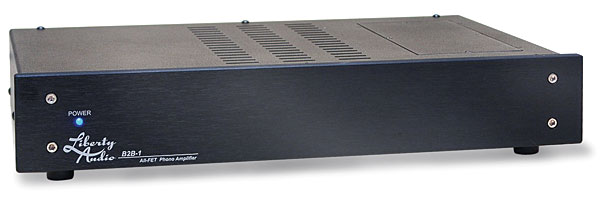
The all-FET, class-A, B2B-1 phono preamplifier ($1749), made in the US by Liberty Audio, is beautifully built inside and out, and comes in a heavy-duty aluminum chassis with a baked-on crackle finish and a 3/8"-thick, black-anodized faceplate. The overall build quality and physical appearance suggest something that costs more than $3000, which is probably what it would cost were it sold through retailers and not factory direct. It comes with a two-week return policy.

Precision Transducer Engineering MMMC Phono Preamplifier

The phono preamplifiers reviewed this month are both affordable ($400–$1960) and highly accomplished, and the most expensive of them offers versatility that's unprecedented in my experience. Three of them are designed to be used only with moving-magnet, moving-iron, and high-output moving-coil cartridges, so I installed Shure's V15VxMR cartridge in VPI's Classic 3 turntable and listened in MM mode to all of them, beginning with the least expensive.

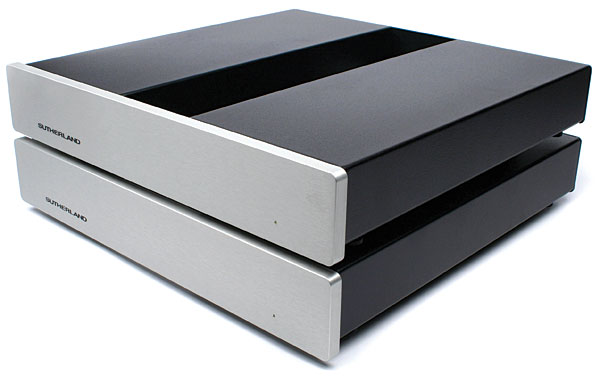
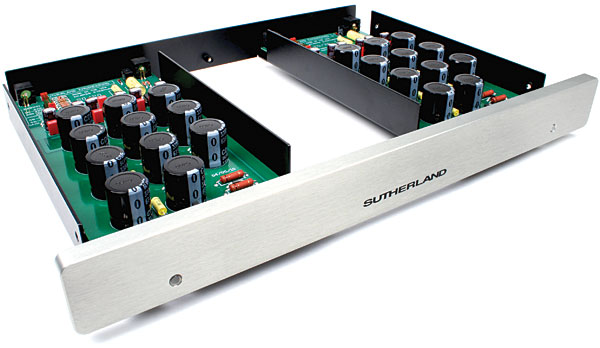
Sutherland Engineering Phono Block monoblock phono preamplifier

Saying that Sutherland Engineering builds a nice line of phono stages is like saying that the Porsche 911 Carrera is a nice line of sports car. The Sutherlands all share common design philosophies, features, and sonic attributes—but just as ramping up from Porsche's classic Carrera Coupe ($78,000) to the GT3 ($115,000) or the Turbo S Cabriolet ($172,000) increases the level of performance and distills the Porsche experience down to its essence, ascending the Sutherland line from the PH3D ($1000) to the 20/20 ($2200) to the Hubble ($3800) buys more of what Ron Sutherland is all about.

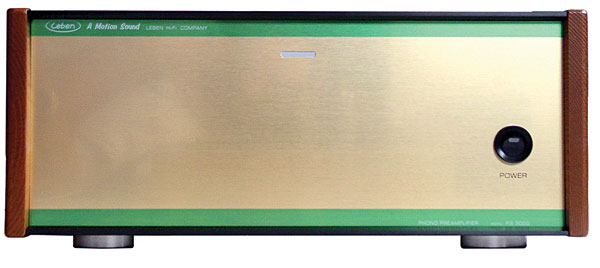
Leben RS-30EQ phono preamplifier

The Leben RS-30EQ phono preamplifier ($2695) incorporates a pair of common dual-triode tubes (12AT7) for phono gain, but breaks with tradition by using a CR-type equalization circuit rather than the more common negative-feedback type. Total gain is specified as 23.5dB, which is sufficient for moving-magnet pickups; an external transformer is recommended for use with moving-coil types. A silicon full-wave rectifier supplies heater voltage, while the rail is supplied by a 6X5GT rectifier tube.

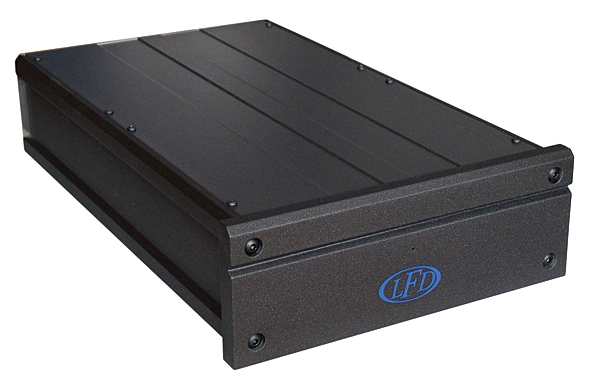
LFD Phonostage LE phono preamplifier

Far be it from me to surrender these column inches to the whims of a manufacturer.

That said, there's ample reason to break with tradition and offer the thoughts of an obscure English company called LFD, whose products may already have tripped your surveillance wires. In their "Charter to Product Commitment and Traditional Values"—which can be read in its entirety on Frohmusik's website and is signed by Bews and Hawksford (see below)—the people of LFD suggest, in so many words, that they will not manufacture goods outside of their native England; that their design work is guided by listening as much as by engineering theory; that they believe some component parts sound better than others of identical numeric value, depending on their specific role in an audio circuit; that their philosophy of circuit design is decidedly minimalist; and that they advocate the enjoyment of music on vinyl LP. That the principals of LFD have thus far avoided being burned alive as heretics is a source of wonder.

Sutherland Engineering 20/20 phono preamplifier

Why no batteries?

It seemed a simple and obvious question, but I couldn't get an answer out of Ron Sutherland. Why did his new 20/20 phono preamp use an AC power supply instead of batteries? I asked directly, I asked repeatedly, I tried framing the question in different ways, all to no avail. Did the AC supply make it sound better? Was it less expensive to build? Were potential customers turned off by having to replace batteries once every year or two?

Advertisement
Advertisement
Advertisement