J. Gordon Holt

Sort By:  Post Date TitlePublish Date

Is Music in Danger?

When I attended the Audio Engineering Society convention in October 1987 (my first time in over eight years; full report in this issue), I was impressed by the incredible technology now available to composers of music. I was also dismayed, however, by the extent to which so-called purist audio, as well as "acoustical" music, have been consigned to oblivion by the pro audio community. It was clear, both from the exhibits and the many conversations on which I eavesdropped, that audio professionals are no longer concerned about fidelity, in the sense of trying to reproduce sounds accurately. A "real" sound has become to them merely raw material of no value except as something to be processed, manipulated, folded, bent, and spindled to produce any sonic effect except the original one. About a third of the products displayed at the 83rd AES convention were tools for doing that.
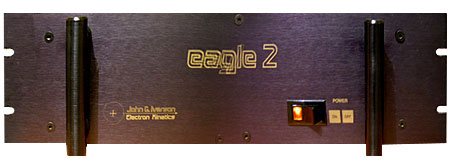
Electron Kinetics Eagle 2 power amplifier

When I first heard the Eagle 2 at the 1985 Winter CES I knew this amplifier was a winner. I was eager for a chance to get my hands on it, but I also knew that J. Gordon Holt was champing at the bit to do the same. So it came as both a surprise and a delight when ye Gracious Editor gave me first crack at the Eagle 2. I wasn't disappointed; the little Eagle more than lived up to expectations. It's not the best power amplifier I've ever heard, but it's damn good. It is, in fact, better than its big brother, the Eagle 7A, in significant ways; in view of the 2's reasonable price, that's saying a lot.

Universal Components

A reader who asked to remain anonymous wrote to tell us the results of some tests he saw conducted on one of our top-rated loudspeaker systems. Frequency-response checks showed that the system had virtually no deep bass, a midbass peak, a midrange slump, and a high-end rise. Further checks had shown gross distortion at input levels of over about 6W, and a definitely limited (although adequate for Row-M listening) maximum output-level capability. Said reader then went on to ask how we could possibly consider such a speaker to be one of the best available.

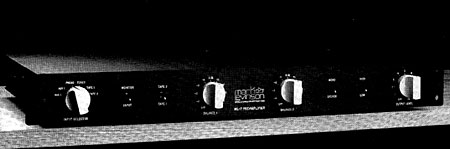
Mark Levinson ML-7A preamplifier

Before launching into Stereophile's first-ever report on a Mark Levinson product, an important point needs to be clarified. Although Mark Levinson products were originally made by Mark Levinson, they are no longer. Au contraire, Mark Levinson products are now being made by Madrigal, Ltd., which bought Mark Levinson Audio Systems' assets and trademark two years ago. Mark Levinson's products, as distinguished from Mark Levinson products, are now being manufactured by a company called Cello. But the subject of this report, the Mark Levinson ML-7A preamplifier, is a product of Madrigal, Ltd., not of Cello. Now that I've made that all perfectly clear, we may proceed.

A Question of Reliability

A letter in the April 1988 issue (Vol.11 No.4) from reader Harold Goldman, MD, decried the seemingly appalling failure rate of high-end products, citing a $10,000/pair power amplifier, an $11,000 turntable, and a $1500 CD player which had all been reported in recent issues as having failed during or shortly after testing by Stereophile. And Dr. Goldman's list was far from complete. We have also experienced during the past couple of years the failure, or inoperation upon delivery, of two $2500 solid-state power amplifiers, a $1700 subwoofer, a $5000 hybrid amplifier, two pairs of $1200 loudspeakers, several pairs of under-$1000 loudspeakers, and many CD players costing over $1000 each, mainly those based on Philips transports.

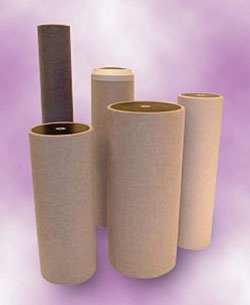
Acoustic Sciences Corp. Tube Traps

In my rather jaded report">http://www.stereophile.com/asweseeit/the_1986_winter_ces/">report from the 1986 Winter CES (Vol.9 No.2), I remarked that there was nothing really new in the field of high-end audio. Well, I was wrong. I overlooked the Acoustic Sciences Corporation Tube Traps, a patented new acoustic device designed by Arthur Noxon (president of ASC). The Traps represent the first practical and effective solution to a perennial audiophile problem: standing waves in the listening room.

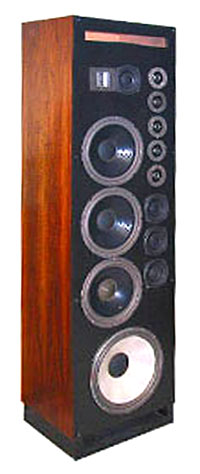
VMPS SuperTower IIa/R loudspeaker

One of the nicest features of the High End is its diversity. Regardless of whatever trend is fashionable, there will always be manufacturers to buck it, and sell alternative concepts and sounds. VMPS is just such a case. With few exceptions, the recent trend in speaker systems has been toward small-to-medium-sized "monitors" with good imaging and high resolution, but limited bass and dynamics (footnote 1). The VMPS SuperTowers provide the former, but buck the trend by adding reproduction of the deepest bass and outstanding full-range dynamics.

Advertisement
Advertisement
Advertisement