
J. Gordon Holt

Sort By:  Post Date TitlePublish Date

Canned Music

Everyone knows music is a good thing. More than merely good, it appears to meet some kind of human need, because every race in every land has a musical tradition going back to before recorded or recounted history. Some of their music may not seem like music to our unsophisticated ears, but as soon as someone discovered that two sticks of different sizes produced different pitches when struck on a venerated ancestor's skull, he advanced beyond mere rhythm to what must be considered music. (Two sticks would, presumably, play binary music: the first precursor of digital sound.) In fact, were there no music at all today, humankind would probably find it necessary to invent it on the spot, along with a mythology relating how it was created on the eighth day, after ingrown toenails.
Eye Anchors: LaserVision Discs

Until recently, I have considered LaserVision video discs as a rather dubious medium for serious music reproduction. The only review I had read about it by a critical listener (Harry Pearson in The Absolute Sound) was I singularly unenthusiastic, and since I had not heard one myself, I was inclined to take his word for it.

Seeing Red

Although inclined to mood swings bordering on the manic-depressive, I am generally a very patient, tolerant person, willing to accept and overlook the foibles of those less perfect than myself. But even my incredible equanimity has its limits, beyond which the milk of my human kindness curdles, becoming as lumpy as last month's yogurt.

The Second Sense

When it comes to video, most audiophiles are insufferable snobs. These normally reasonable people, who are among the first to admit that great sound in a motion picture theater makes a great film much more enjoyable, nonetheless. scoff at the very idea of augmenting their own sound with images, or of trying to create the kind of audio-visual experience in their home that they routinely enjoy at the cinema. Doing that involves video, which they equate with TV, which they equate with LCD (footnote 1) dross. This is unfortunate, because visuals can enhance good sound, and good sound can do wonders for non-TV video programs like Hollywood motion pictures.

Grabbing the Crystal by the Ball

Every once in a while, and particularly around the first of the year, news writers (of which I am one) get the urge to play oracle, laying our credibilities on the line by attempting to divine what the coming year will bring. Since I am writing this at the end of January, the chances of my miscalling my shots have already been reduced by a factor of 0.083. But there are still 11 months to go, and some possibility that a prediction or two may be wrong. Nonetheless, I shall intrepidly grab the bull by the horns, the crystal by the ball, and the opportunity of the moment to take an educated guess at what the rest of 1988 holds for audio.

The Colossus of Audio

About 2200 years ago, a Greek writer named Antipater of Sidon compiled a list of the seven wonders of the world, which included a 100'-high statue of the Sun god Helios, erected next to the harbor of Rhodes on the Aegean sea. A of S called it the Colossus of Rhodes, for an obvious reason. Now there's a new Colossus, the derivation of whose name is a little less obvious, but which could justifiably be included in any contemporary listing of the seven wonders of the audio world.

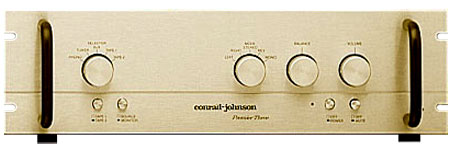
Conrad-Johnson Premier 3 preamplifier

It says something for the state of technology that, after a quarter of a century, there still is no authoritative explanation for why so many high-end audiophiles prefer tubes. Tubes not only refuse to die, they seem to be Coming back. The number of US and British firms making high-end tube equipment is growing steadily, and an increasing number of comparatively low-priced units are becoming available. There is a large market in renovated or used tube equipment—I must confess to owning a converted McIntosh MR-71 tuner—and there are even some indications that tube manufacturers are improving their reliability, although getting good tubes remains a problem.

Components, Unite!

Ever since Stereophile took up the cudgels for subjectivity, and had the temerity to insist that even the best products have certain colorations, we have stressed compatibility in choosing components. By compatibility we do not mean merely matching impedances and signal levels, but mating components whose sonic peculiarities tended to offset one another.

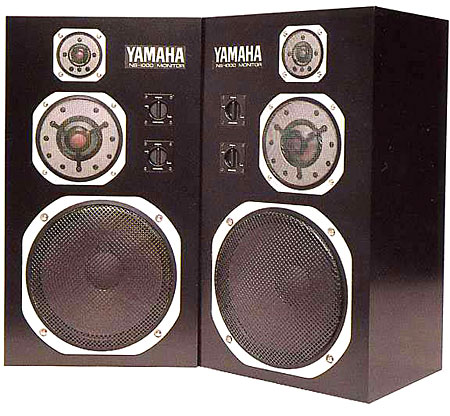
Yamaha NS-1000 Loudspeaker

Every engineer has known for years that, while beryllium has excellent physical qualities for use as a speaker radiator—light weight, rigidity, and a remarkable degree of internal damping—it is not usable as such because it cannot be stamped out like most other materials. It will not stretch, and any attempt to shape it simply causes it to split.
Advertisement
Advertisement
Advertisement