Floor Loudspeaker Reviews

Sort By:  Post Date TitlePublish Date

Waveform Research Mach 17 loudspeaker

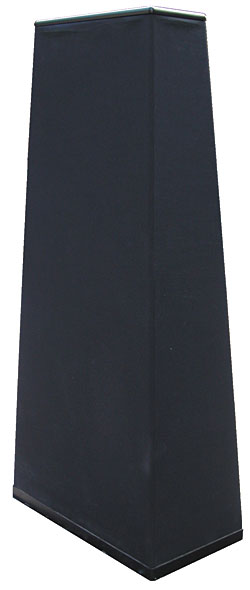
I first heard the Canadian-made Waveform Research Mach 17 loudspeaker system in New York City at HI-FI '96, Stereophile's Home Theater & Specialty Audio Show. Another Ontario native, Chris">http://www.stereophile.com/interviews/996russell">Chris Russell of Bryston Ltd., had raved to me about their sound. His recommendation sent me outside my assigned reporting area and down to the sixth floor of the Waldorf=Astoria, to dimly lit room 602—full of ASC">http://www.stereophile.com/roomtreatments/215">ASC Tube Traps, amplifiers, cables, and the twin truncated pyramids of the Mach 17s.
Revel Concerta F12 loudspeaker

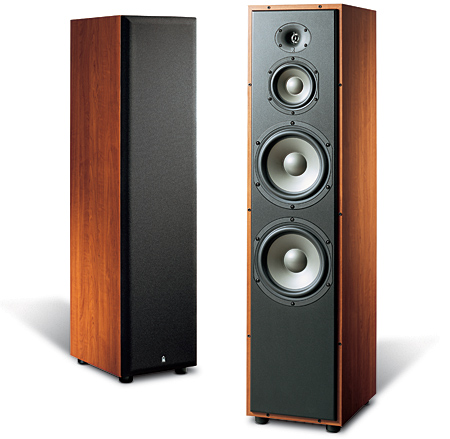
I am a Revel junkie. Their Ultima">http://www.stereophile.com/floorloudspeakers/302">Ultima Studios have been my reference loudspeakers for years, and I've spent many happy hours with their Performa">http://www.stereophile.com/floorloudspeakers/244">Performa F-30s and Ultima">http://www.stereophile.com/standloudspeakers/89">Ultima Gems. They're all great speakers. When the original Gem was launched, it was made clear that all the corporate and economic weight of Revel's parent company, Harman International, was behind the development of this new line. When I visited Revel some years back, I saw cutting-edge design and development, in-house manufacturing of the most critical parts under the tightest scrutiny, and quality control of nearly compulsive meticulousness. All of this was reflected in the speakers' prices, which were reasonable for their quality and performance.

DALI Ikon 6 loudspeaker

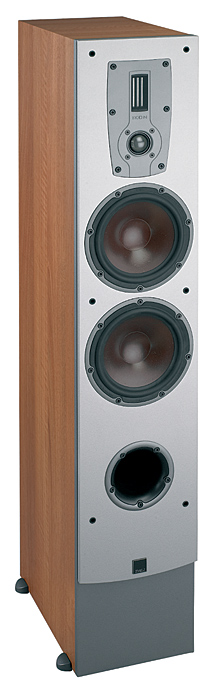
When I review an affordable loudspeaker, first impressions are important. Once I've unpacked the speaker, noted the quality of its construction and finish, and have complimented or grumbled about the ergonomics of its five-way binding posts, I fire 'er up and give 'er a first listen. Occasionally, the sound will put a smile on my face, either because I'm impressed with the amount of uncolored detail emanating from such an affordable product, or because the speaker sounds so sweet that I'm intoxicated.

Vandersteen Audio Quatro loudspeaker

Record playback could have been designed to go from the inside out instead of the other way around. With most pieces of music ending louder than they started, doesn't it make more sense to end the side at the widest circumference, longest wavelength, least congested part of the groove spiral? Compact discs read from the center hole out, and they don't even have to.

Ruark Templar loudspeaker

As I trundled the WATT/Puppyshttp://www.stereophile.com/standloudspeakers/477">WATT/Puppys; off to the Stereophile laboratory complex for our test procedures (see my review in the last issue), I idly wondered to myself, "Gee, what am I going to do for an encore?" Visions of exotic butterfly-like horns danced in my head (nope, J-10 Scull gets those babies). I was tantalized by the call of ambitiously designed behemoths (Major Tom gets those, he's got the room for 'em). Maybe some jewel-like, state-of-the-art minimonitors? (JA glommed 'em—editor's prerogative, y'know.) So what does that leave me?

The Fifth Element #36

Were I trying to make a living by giving piano recitals, David Stanhope's new CD, A Virtuoso Recital (Tall Poppies TP184), just might tempt me to wash down a fistful of pills with a bottle of Scotch. The saving grace being that Stanhope seems to have enough things to occupy himself with in his native Australia. The risk of his showing up in New York City and playing a recital, thereby giving a lot of people existential crises and sleepless nights, seems remote.

Audio Physic Scorpio loudspeaker

There is a sweet spot in any manufacturer's lineup where minimum price and maximum performance meet. More expensive products in the line may offer higher fidelity, but the cost may not be commensurate with the improvement. For instance, VPI's HRX and Super Scoutmaster turntables cost more than their standard Scoutmaster model, and they perform better—but for my money, the sweet spot of VPI's line is the standard Scoutmaster, with or without such options as the outer clamp and Signature tonearm.

Fulton Musical Industries Model 80 & "J-Modular" loudspeakers

In the last issue we published a rather enthusiastic "Quickie" report on a small, $190/pair speaker system from a new company—the FMI Model 80. It was virtually devoid of low end, even as a stereo pair (pairing effectively doubles bass output), and slightly rough as well as a shade soft at the high end, but it had a quality of "aliveness" to it that almost defied belief. Was it a breakthrough in design? A new transducing principle? No, it was neither. In fact, the Model 80 looks like any one of those hundreds of little bookshelf systems that clutter, the pages of Stereo Review's "Hi-Fi Directory" in tedious profusion.

Mirage M-3 loudspeaker

It may surprise some readers to learn that all of the contributors to Stereophile do not get the chance to hear, at our leisure and in familiar circumstances, everything that passes through the magazine's portals. Not that we wouldn't like to, but there just isn't time. Nor are the logistics always right. I was therefore probably as intrigued as the average reader by LA's glowing">http://www.stereophile.com/floorloudspeakers/689mirage">glowing report on the $5000/pair Mirage M-1 in the June 1989 issue. The M-1s had been on the market long enough for me to have heard them on several occasions, of course, but generally at shows and not under the best of conditions. I did get to hear them briefly at LA's later that same summer, but the hustle and bustle of a Stereophile Writers' Conference party isn't the optimum place for value judgments.

Advertisement
Advertisement
Advertisement